

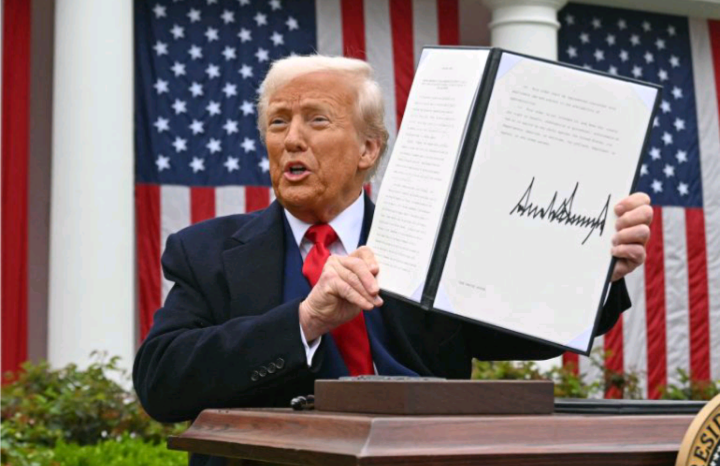
A US appeals court on Thursday reinstated many of President Donald Trump’s tariffs, the day after another court blocked them. The move puts a pause on a trade court’s ruling that Trump exceeded his authority in imposing his “Liberation Day” tariff regime, adding a jolt of legal chaos to the uncertainty surrounding Trump’s global trade war.
Trump’s advisers, who had condemned the tariff block as a “judicial coup” celebrated the reprieve, but the possibility of the initial ruling being reinstated weighs heavily on the White House.
Despite the setback, Trump will likely be undeterred in his aim to “rewrite the rules of global commerce in America’s favor,” The Wall Street Journal wrote.
Meanwhile, President Donald Trump’s trade war has cost companies more than $34 billion in lost sales and higher costs, according to a Reuters analysis of corporate disclosures, a toll that is expected to rise as ongoing uncertainty over tariffs paralyzes decision making at some of the world’s largest companies.
Across the United States, Asia and Europe, companies including Apple (AAPL.O), Ford (F.N), Porsche and Sony (6758.T), have pulled or slashed their profit forecasts, and an overwhelming majority say the erratic nature of Trump’s trade policies has made it impossible to accurately estimate costs.
Reuters reviewed company statements, regulatory filings, conference and media call transcripts to pull together for the first time a snapshot of the tariff cost so far for global businesses.
The $33 billion is a sum of estimates from 32 companies in the S&P 500, three companies from Europe’s STOXX 600 (.STOXX), and 21 companies in Japan’s Nikkei 225 (.N225). Economists say the cost to businesses will likely be multiple times what companies have so far disclosed.
“You can double or triple your tally and we’d still say … the magnitude is bound to be far greater than most people realize,” said Jeffrey Sonnenfeld, professor at the Yale School of Management.
The ripple effects could be worse, he added, citing the potential for lower spending from consumers and businesses, higher inflation expectations.
While a recent pause in Sino-US trade hostilities has offered some relief and Trump has backed down from tariff threats against Europe, it is still not clear what the final trade deals will look like.
A U.S. trade court on Wednesday blocked Trump’s tariffs from going into effect. In this environment, strategists say companies will look to strengthen supply chains, boost near-shoring efforts, and prioritize new markets – all of which will push up costs.









Leave a Reply