


In a historic yet contentious decision, the Orange Democratic Movement (ODM) has appointed Siaya Senator Dr. Oburu Oginga as its Acting Party Leader, following the death of his younger brother and party founder, Rt. Hon. Raila Amollo Odinga.
The announcement, made by the ODM National Executive Committee (NEC) on Thursday, was delivered with an air of unity and reverence. The committee described the appointment as “unanimous,” with members agreeing that Oburu’s decades of loyalty and seniority within the party made him the natural interim choice to guide ODM through this moment of national mourning and transition.
“The National Executive Committee (NEC) has this morning met and unanimously endorsed the designation of the Senator of Siaya County, Dr. Oburu Oginga, as the Acting Party Leader. This appointment takes effect immediately,” read the official statement.
But beyond the formality and symbolism of the gesture, deep questions now emerge: Is Oburu Oginga the right man to step into Raila’s colossal shoes—or merely a ceremonial placeholder at a time when ODM faces an existential crossroads?
A Legacy Too Large to Inherit
Raila Odinga was more than a political leader; he was the embodiment of Kenya’s democratic struggle, a political brand that transcended party lines and generations. In his absence, ODM must confront a haunting truth—it has lost its ideological anchor and its unifying voice.
Dr. Oburu Oginga, 82, is undeniably a veteran of Kenyan politics, having served as Assistant Minister for Finance, MP for Bondo, EALA legislator, and now Siaya Senator. Yet, he has often been perceived as operating in Raila’s shadow—a loyal lieutenant rather than a charismatic commander.
Critics now question whether the party’s decision was driven by strategy or sentimentality.
“This appointment feels like a nod to lineage, not leadership,” one senior ODM insider told this writer on condition of anonymity. “The country mourns Raila, but the party cannot afford to confuse family ties with political renewal.”
The Age and Energy Question
Dr. Oburu’s age looms large over the debate. At a time when ODM faces a generational revolt from younger leaders such as Secretary-General Edwin Sifuna and Embakasi East MP Babu Owino, the nomination of an octogenarian risks deepening perceptions that the party is clinging to its past rather than forging its future.
Observers note that Oburu’s appointment could signal a transitional or caretaker phase, meant to buy time for ODM to reorganize before electing a substantive leader. But others fear that time may not be on ODM’s side.
“Politics, like nature, abhors a vacuum,” remarked a political analyst from the University of Nairobi. “If ODM fails to project a clear post-Raila vision soon, its youthful wings will break off—and take the energy, votes, and street power with them.”
Already, subtle rifts are visible. While Sifuna publicly praised the NEC’s decision, insiders suggest that he and Babu Owino are quietly mobilizing support within the party’s youth structures, positioning themselves as heirs to the Odinga political empire.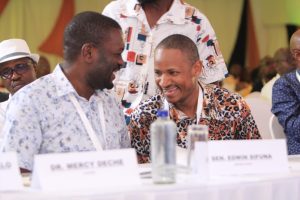
Ceremonial Leadership or Strategic Continuity?
The choice of Oburu raises another crucial question: Does ODM need a ceremonial elder to maintain calm—or a transformative leader to navigate the turbulence ahead?
The party is not only grappling with grief but also with ideological fatigue. The “handshake generation” that once rallied around Raila’s reformist message now appears disillusioned, divided between those seeking accommodation in President William Ruto’s “broad-based government” and those still clinging to opposition purity.
Oburu’s own statements in recent months hint at his alignment with the former camp. He has publicly defended ODM’s cooperation with the government and rebuked dissenting voices like Governor James Orengo for “vomiting on us from within.”
That posture may calm ODM’s establishment wing—but risks alienating its activist heart.
“ODM’s identity was built on resistance,” noted a veteran party member in Kisumu. “Replacing that with reconciliation under Oburu could turn ODM into a shell of its former self.”
A Party at the Crossroads
ODM’s internal transition coincides with Kenya’s broader political realignment following Raila’s death. Regional alliances are shifting, power centers in Nyanza are recalibrating, and the vacuum left by the Enigma threatens to redraw the country’s political map.
In that context, Oburu’s leadership—however temporary—could either stabilize ODM through continuity or accelerate its fragmentation.
If he can leverage his family’s symbolic capital to rally Raila’s loyal base while steering a smooth leadership transition, Oburu may yet play a critical stabilizing role. But if his tenure turns into a nostalgic holding pattern, the party risks losing relevance to emerging movements led by younger, more dynamic politicians.
The Verdict of Time
For now, ODM members have chosen familiarity over experimentation—a safe pair of hands in uncertain times. But history may judge the move differently.
As Raila Odinga’s body lies in state and the nation prepares to bid him farewell, his party too must decide whether it will preserve his legacy or evolve from it.
Dr. Oburu Oginga now carries not only the family name but also the weight of a movement’s destiny. Whether he proves to be a bridge to ODM’s next chapter—or a relic of its glorious past—will depend on how he answers the questions now echoing across Kenya’s political landscape:
Is he up to the task?
Is this the leader ODM needs—or the one it simply could not refuse?




Leave a Reply