

The Kenyan government has launched a series of high-profile influencer panels to dissect the controversial Computer Misuse and Cybercrimes Amendment Act 2025, just days after key sections of the legislation were dramatically suspended by the High Court. While the government insists the move is a genuine attempt to engage with the public, critics are accusing the administration of engaging in a slick PR campaign, cleverly disguised as public discourse.
The initiative, spearheaded by the Ministry of Information, Communications, and the Digital Economy, aims to foster dialogue about the future of cyber regulation in Kenya. However, the choice of panelists has raised eyebrows, with social media ablaze with accusations of superficiality and a lack of genuine understanding of the complex legal and technological issues at stake.
The Computer Misuse and Cybercrimes Amendment Act 2025, signed into law by President William Ruto on October 15th, was intended to tighten regulations surrounding online activity, addressing issues such as cyberbullying, hate speech, and the spread of misinformation. The Act, however, immediately faced legal challenges. The High Court, on October 22nd, dramatically suspended key provisions, citing concerns about inadequate public consultation and potential violations of fundamental rights, particularly freedom of expression. This ruling has thrown the implementation of the Act into turmoil, leaving a significant legal void in the crucial area of cyber regulation.
Enter the influencers. The government has brought together a diverse group, including popular comedian YY, media personality Oga Obinna, radio presenter Alex Mwakideu, and other media personalities with large social media followings. The stated goal: to gather input from these figures and approximately 500 invited guests on the implications of the suspended Act.
“We believe in engaging with all stakeholders to ensure that our cyber laws are fit for purpose and protect all Kenyans,” a spokesperson for the Ministry of Information, Communications, and the Digital Economy stated in a press briefing. “These discussions are vital for understanding the public’s concerns and finding common ground.”
However, this noble ambition has been met with a tidal wave of skepticism. Social media platforms have exploded with criticism, with many questioning the influencers’ expertise on the nuanced legal and technical aspects of cybercrime. Social media users are mocking the perceived lack of substance among the panelists and accusing the government of attempting to whitewash the controversial legislation.

“Putting comedians and morning talk show hosts in charge of discussing complex legal issues is a slap in the face to genuine public discourse,” said prominent lawyer, Nelson Havi. “It’s a carefully crafted PR stunt designed to distract from the real issues at hand.”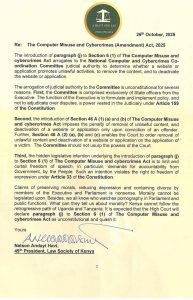
The timing of this influencer outreach is also significant. The discussions coincide with ongoing and increasingly acrimonious strikes by university lecturers, highlighting the broader context of strained relations between the government and various sectors of Kenyan society. Observers note that the focus on influencers, at a time when other critical issues demand attention, may be viewed as a deflection tactic.
Skeptical Voices Within the Media:
The media landscape, however, remains skeptical. Journalists and media practitioners are increasingly wary of the government’s motives. “While we recognize the need for public dialogue, the composition of the panel and the lack of expertise on display raise serious questions about the government’s true commitment to resolving the impasse,” says one seasoned political analyst, speaking on condition of anonymity. “The heavy reliance on influencers, while ignoring the insights of legal experts, cybersecurity professionals, and civil society organizations, suggests a desire to control the narrative rather than genuinely address the underlying concerns.”
Furthermore, the government had the option to conduct direct questionnaire-type of audit with a cross-section of influencers whether running big or small accounts but displaying an understanding of social media ethics rather than confining itself to a select panel.
This skepticism is further fueled by the upcoming panel discussion slated for Wednesday, October 29th, at the Panari Hotel on Mombasa Road. The event promises to be a focal point of the influencer-led discussions, and is expected to further clarify the government’s position on the suspended Act. However, the overwhelming presence of comedians and morning talk show presenters on the panel has only amplified the prevailing skepticism within the journalistic community. Many are asking whether the government is genuinely looking to resolve the legal complexities surrounding the cybercrimes legislation or is instead prioritizing a carefully choreographed public relations strategy.
The outcome of these influencer panels and their impact on the future of the Computer Misuse and Cybercrimes Amendment Act 2025 remain uncertain. As the legal challenges continue to unfold and the public debate intensifies, it is clear that the government’s chosen path is fraught with risk. If these discussions are perceived as insincere, the government risks further alienating the public and undermining its credibility. If, however, they can find a common ground and offer real solutions, then the cybercrime laws could be on the right path.


