


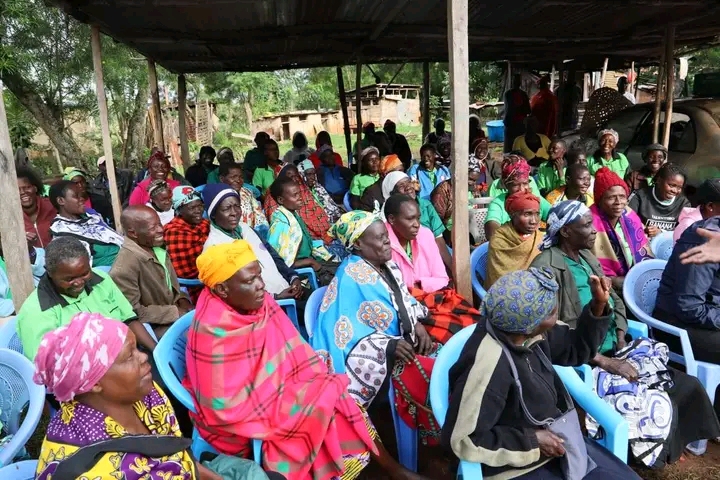
A fresh storm is brewing within Kenya’s opposition sphere as leaders from both UDA and ODM openly challenge Wiper Party leader Kalonzo Musyoka’s assertions that he stands as Raila Odinga’s closest ally and political heir. The public rebuke, issued during a women empowerment programme in Ugunja’s Nyasanda area, has exposed widening cracks within the opposition matrix and reignited a long-standing debate about who truly carries Raila’s torch.
Kalonzo Musyoka, a veteran politician and former vice president, has repeatedly portrayed himself as a constant pillar in Raila’s political journey. Yet the pushback from some of Raila’s staunchest allies suggests that his claim is far from universally accepted. Their argument is clear: Raila’s legacy is not up for casual appropriation, nor can proximity be claimed without a legacy of unwavering sacrifice.
Few political legacies tower above Kenyan politics as dramatically as Raila Odinga’s. To millions, Raila represents resilience, democratic struggle, and the unyielding fight for reform. Thus, declaring oneself his closest ally is not a mere political boast—it is an attempt to inherit a political movement that spans generations and ethnic boundaries. Kalonzo’s claim is therefore seen not simply as self-branding, but as an effort to position himself as the natural successor to a political icon.
However, critics maintain that true alliance with Raila cannot be self-declared; it must be earned. They point to pivotal chapters in Kenya’s political history, particularly the disputed 2007 elections, where Kalonzo’s independent presidential run was viewed by some as diluting Raila’s momentum. That decision, they argue, planted seeds of mistrust whose effects still linger within Raila’s support base.
Further complicating matters is Kalonzo’s sporadic engagement with ODM programmes. His absence from key party events and his public disagreement with certain ODM strategies—including Raila’s interactions with the Kenya Kwanza administration—have opened him up to scrutiny from leaders who question the consistency of his loyalty.
That the confrontation unfolded at a women empowerment forum underscores another dimension of Kenya’s political climate: the infiltration of political rivalry into spaces intended for development and cohesion. The tension-laden remarks from MPs went beyond mere political theatre—they revealed how deeply personal ambitions and legacy battles are interwoven into grassroots mobilization tactics ahead of future electoral contests.
The clash reflects a broader truth about Kenyan politics: alliances are fluid, built and broken by convenience, not always conviction. In this context, claiming to be Raila’s closest ally becomes a high-stakes political weapon, offering leverage in negotiations, influence over succession politics, and potential dominance in future opposition structures.
For Kalonzo, these claims feed into a larger strategy to remain relevant in a rapidly shifting political landscape. For those opposing him, challenging the assertion safeguards their own political capital, forged through decades of steadfast association with Raila’s movement.
Ultimately, the tussle over Raila’s political legacy is more than an ego battle—it is a contest over legitimacy, authority, and the future of opposition politics. Raila’s journey has always been collective, strengthened by leaders who shared both triumphs and tribulations. The real test for opposition leaders now lies in forging unity that transcends individual ambitions.
The Ugunja Nyasanda episode serves as a revealing snapshot of the fragility within Kenya’s opposition ranks. As leaders wrestle over symbolism, succession, and political inheritance, one truth remains clear: Kenya’s democracy requires a united, principled opposition. Whether the current rift widens or narrows will shape not just the future of Raila’s legacy, but the trajectory of the nation’s political discourse in the years to come.
By James Bwire Kilonzo – Media and Communication Practitioner





Leave a Reply