


I. THE LAST SCENE BEFORE THE VACUUM
On October 15, 2025, Kenya awoke to news that marked the end of an era: the death of Raila Amollo Odinga, a man whose political influence shaped not only opposition politics but the country’s entire democratic architecture for over four decades. With his passing came an immediate and unavoidable question—one that had been whispered for years, but now demanded an answer:
Who would inherit a legacy too large for any single individual to be ready for?
The public conversation gravitated quickly toward familiar names. Peter Anyang’ Nyong’o, Gladys Wanga, Ida Odinga and even Edwin Sifuna. Then the conversation shifted to Raila Junior, and attempts at family-head coronation appeared to set him apart as the natural heir in the public imagination. Senior party loyalists floated the idea of a “collective leadership” while others pointed to regional kingpins, a certain Cabinet Secretary, and several old-guard operators including James Orengo who had spent decades orbiting Raila’s inner circle.
But within key ODM corridors—those that rarely speak publicly but set the tone for the party’s internal calculations—a different name surfaced with unusual consistency: Winnie Odinga, Raila’s youngest daughter.
To the public, she was the daring, street-sharp daughter who clung to the sides of campaign vehicles; the one seen behind the scenes of major rallies; the digital strategist who helped modernize her father’s electoral machinery; the spirited EALA legislator whose political instincts seemed inherited rather than taught.
Inside ODM headquarters, however, her role was far more consequential than most knew. And after Raila’s death, that quiet influence would suddenly matter.
II. THE APPRENTICESHIP NOBODY TOOK SERIOUSLY
To understand why Winnie Odinga is central to ODM’s most dramatic ideological confrontation in two decades, one must examine her political formation—an apprenticeship that unfolded in plain sight but was not always recognized for what it truly was.
Born in 1990, Winnie grew up at a time when her father was transitioning from political dissident to national statesman. This placed her at the intersection of two worlds: one shaped by the older generation’s liberation struggles, and another defined by new globalized political tools—digital mobilization, data-driven campaigning, youth-centered messaging, and multipolar diplomacy.
Her earliest political imprint came through proximity. Winnie became a fixture in her father’s campaigns, often navigating crowds with a confidence that belied her age. She was not merely present; she was working. In the 2013, 2017, and 2022 campaigns, she played a central role in Raila’s communications and digital strategy teams. Her work helped ODM modernize its online presence at a time when social media was reshaping Kenya’s political battleground.
Her father trusted her deeply for a reason. Those who worked around them, including ODM Party spin doctor, Phillip Etale describe her as strategic, unflappable in tense moments, and willing to take on tasks that others avoided. She handled logistical crises, coordinated digital engagement, and—crucially—became one of Raila’s most dependable aides during high-pressure political moments.
This trust extended beyond campaigns. When Raila launched his 2023–2024 bid for the African Union Commission, Winnie was part of his regional engagement and communications setup, interacting with continental actors and diplomatic players. Her role allowed her to observe the subtleties of continental politics—alliances, regional power balances, and the quiet language of diplomacy that often shapes African institutions.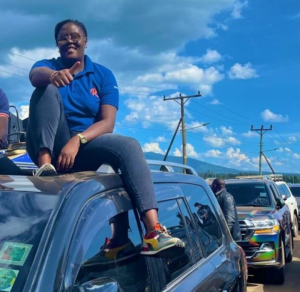
In 2022, she was elected to the East African Legislative Assembly (EALA), representing Kenya. The position, sometimes dismissed by domestic political observers, gave Winnie a rare vantage point: a seat within a regional parliament where trade, security, and integration are negotiated. Her contributions emphasized youth empowerment, digital policy, and cross-border cooperation—issues that aligned with her generational identity.
Through these experiences, she developed a political profile that fused the diplomatic polish of continental engagement with the urban street-savvy instincts of Nairobi’s political youth culture.
Yet even as she matured politically, her emergence as a future ODM power center was rarely acknowledged publicly. She remained, in the public imagination, “Baba’s daughter”—until the Mombasa anniversary changed everything.
III. THE MOMBASA MOMENT: A WALK THAT SHIFTED PERCEPTIONS
On November 15, 2025, ODM marked its 20th anniversary in Mombasa. What was meant to be a celebration quickly evolved into a symbolic moment in the Raila succession story.
A video circulated widely that afternoon: Winnie Odinga walking through the anniversary grounds in orange t-shirt, cargo pants, sneakers, and a sun hat. Her stride was confident and unhurried. Observers immediately drew comparisons to her father’s recognizable gait—one defined by measured confidence and calm presence.
The clip went viral within hours. Social media lit up with remarks noting her resemblance to Raila’s aura—not physically, but politically. Her composure, posture, and confidence triggered an unexpected sentiment: a sense of continuity.
For many Kenyans, the resemblance was comforting. For ODM insiders, it was revealing.
What happened next cemented the moment: when she took the microphone, she delivered a pointed message that transcended personal tribute or ceremonial remarks. Without theatrics, she declared:
“ODM’s legacy is not for sale.”
She cautioned against infiltration, warned of double-speaking actors who performed loyalty publicly but undermined the movement behind closed doors, and insisted that the future of the party be decided by its members through a National Delegates Convention—not by political elites negotiating outside party structures.
The speech was a shock to the pro-government wing of ODM, and an inspiration to the purist faction. It marked the first time Winnie positioned herself publicly as a custodian of ODM’s ideological backbone.
This was the beginning of her emergent centrality to the party’s future.
IV. THE ODM SCHISM: A PARTY AT WAR WITH ITSELF
The Mombasa anniversary did not create the crisis within ODM—rather, it exposed and accelerated it.
For months, the party had been drifting between two contradictory identities:
1. The Pro-Government Faction
Led by influential figures such as Mining Cabinet Secretary Hassan Joho, Treasury CS John Mbadi, and new party leader Dr. Oburu Oginga, this group argued that ODM belonged within President William Ruto’s “broad-based government.” Their stance was rooted in the March 7, 2025 pact between Ruto and the late Raila Odinga, which had positioned ODM politicians inside Cabinet and senior state offices.
Their rallying cry, “Hatuwezi Kurudi Opposition”, argued that ODM counties benefited more from cooperation with government than confrontation from the outside.
2. The Opposition Purists
This faction, anchored by leaders such as Secretary-General Edwin Sifuna, Siaya Governor James Orengo, and Vihiga Senator Godfrey Osotsi, insisted that ODM’s identity had always been defined by its role as a constitutional watchdog. They maintained that co-optation endangered the party’s reformist legacy.
Orengo dismissed permanent alignment with the government as “idiotic.”
Sifuna clarified that ODM’s agreement to remain in the broad-based arrangement until 2027 did not mean endorsing Ruto’s re-election.
Into this rift stepped Winnie Odinga—not as a neutral arbiter, but as a vocal defender of ODM’s historical ideological clarity.
Her call for a delegates convention struck at the heart of the dispute: who should determine the party’s 2027 strategy—state-aligned elites or grassroots members?
The battle lines sharpened.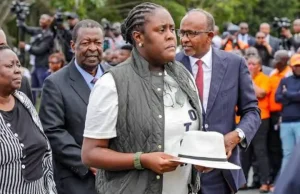
V. THE EMERGING WINNIE FACTION
As ODM’s internal struggles unfolded, something else became evident: Winnie was no longer acting alone. A constellation of party actors—some veterans, some youthful, most ideologically driven—began to gravitate toward her.
This emergent faction included:
James Orengo
Edwin Sifuna
Babu Owino
Otiende Amollo
George Aladwa
Youth mobilizers
Digital activists
Ideological loyalists entrenched in ODM’s early reform spirit
The group’s cohesion stemmed from a shared belief that the party’s future required safeguarding. They argued that ODM risked diluting itself beyond recognition if it embraced long-term cooperation with Kenya Kwanza.
Winnie’s role in this faction was notable not merely because of her lineage, but because she had become a voice capable of articulating ODM’s generational anxieties.
Her presence gave younger ODM supporters a focal point around which to coalesce.
VI. THE ONLINE DIMENSION: NEW POLITICS, NEW APPEAL
Winnie’s political rise is inseparable from her online influence. She occupies a rare space in Kenyan politics: a millennial political figure who engages digital audiences not through overly scripted messaging but through humor, authenticity, and directness.
During the anniversary period, her interactions with online admirers—especially women praising her assertive energy—went viral. When she responded humorously, promising to “engage some privately,” it generated a wave of relatability uncommon among Kenyan political elites.
Sharply in memory is an interview where she asks the moderator — kwani mimba ni yao? — in reference to rumours that she had conceived.
This digital resonance matters. In a country where over 70 percent of the population is under 35, political legitimacy is increasingly shaped by online presence as much as by party structures. Winnie’s capacity to connect with young voters could determine ODM’s relevance in 2027 and beyond.
VII. WHAT MAKES HER DIFFERENT: FACTUAL ELEMENTS OF HER POLITICAL VALUE
To evaluate Winnie Odinga’s role factually, one must look past sentiment and observe her measurable political assets:
1. She Has Regional Legislative Experience
As an elected EALA MP, she has participated in regional policymaking—experience rare among youthful Kenyan politicians.
2. She Has Diplomatic Exposure
Her work during Raila’s AU campaigns placed her in rooms that shape continental decision-making.
3. She Understands ODM’s Operations From Inside
Having served in campaign strategy teams and worked closely with Raila, she understands both organizational mechanics and party messaging.
4. She Has Youth Appeal
This is not anecdotal; her online traction and reception at public events reflect a demographic shift.
5. She Has Internal Legitimacy
Key ODM stalwarts see her not as an outsider but as someone who understands the party’s ideological foundations.
These facts contribute to why she is being considered—fairly or not—as a focal point in the post-Raila vacuum.
VIII. THE POST-RAILA REALITY: WHY HER INFLUENCE MATTERS NOW
Raila Odinga’s death left ODM without its unifying force. For decades, disagreements were softened by his presence; ambitions were tempered by his strategic patience.
In his absence, long-suppressed tensions have resurfaced:
Should ODM remain part of the government beyond 2027?
Should the party field its own presidential candidate?
Who has moral authority to interpret Raila’s political legacy?
How should the party maintain relevance among young voters?
Winnie’s influence matters because she has credibility among both old-guard loyalists and younger supporters. Moreover, she has a personal understanding of Raila’s political thinking—an asset that carries weight in internal debates.
ODM is not merely deciding strategy; it is redefining its identity.
Winnie Odinga has emerged as one of the few figures capable of articulating what ODM once stood for and what it might become.
IX. THE BROADER IMPLICATIONS FOR 2027 AND BEYOND
The ideological contest within ODM will shape Kenya’s political landscape for years. The pro-government faction sees 2027 as an opportunity to align with Ruto strategically, possibly securing regional development benefits and influencing national policy.
The purist faction insists that loyalty to foundational principles is non-negotiable.
If Winnie’s influence grows—and current indicators suggest it is—ODM may chart a path that:
reasserts its independence,
elevates youth leadership,
demands ideological clarity, and
repositions the party as a competitive force in 2027.
This trajectory does not automatically translate into presidential ambition for Winnie. What it does signal is her role as a gatekeeper in determining which leaders rise within ODM and how the Raila legacy is interpreted.
X. THE CONTINUITY OF A LEGACY, WITHOUT THE BURDEN OF IMITATION
Winnie Odinga’s political emergence is often framed through comparisons to her father. While the resemblance in style and presence is undeniable, her political identity is distinct.
She belongs to a generation more fluent in digital ecosystems than in liberation rhetoric.
She sees regional integration through the lens of EAC realities rather than Cold War legacies.
She views political mobilization through youth-centered empowerment rather than ethnic blocs.
Yet she also understands what ODM meant to the millions who followed Raila for decades—its emphasis on constitutionalism, accountability, and reform.
This blend of continuity and generational differentiation is what makes her an influential figure in the party’s future.
XI. THE TRUMP CARD IN THE SUCCESSION MATRIX
Winnie Odinga is not the leader ODM expected to emerge after Raila. She is not the most senior, nor the most politically experienced. But she is:
the most widely recognized Odinga child in active politics,
the one with legislative experience,
the one with diplomatic exposure,
the one embraced by the youth electorate,
the one with deep internal networks,
and the one who witnessed Raila’s final political months most closely.
In a party defined by its founder’s unique presence, authenticity matters. So does loyalty. So does narrative.
Winnie embodies all three.
For this reason, she is not simply another ODM politician. She is a symbol—of continuity, of generational transition, and of ideological safeguarding.
And in ODM’s most consequential ideological battle in 20 years, she has become the trump card in the complex succession calculus.
XII. CONCLUSION: THE FUTURE OF ODM MAY NOT BE ABOUT WHO LEADS—BUT WHO DEFINES IT
ODM’s challenge is not merely to choose leaders or determine alliances. It must answer a deeper question that many political parties never confront:
What does it mean to honor a legacy while reinventing the movement for a new generation?
Winnie Odinga stands at the heart of that question—not because she claims the mantle, but because her experiences place her uniquely at the intersection of history, ideology, and generational change.
Whether she becomes ODM’s next national leader is secondary to the fact that she is already shaping its internal battles and external perception.
In the years to come, analysts may interpret this moment differently. Some may see it as a generational shift. Others as the maturation of a political apprentice. Others still as the consolidation of an ideological faction.
But one fact is already clear:
In the post-Raila era, no serious analysis of ODM’s future can ignore the influence of Winnie Odinga.
She is, in many ways, the party’s quiet stabilizer.
Its most credible link between past and future.
And the unexpected force shaping how a political giant navigates its most uncertain moment.



Leave a Reply