


In Gem Constituency, 2027 is already shaping up to be a bruising political showdown — and all signs point to one man at the centre of the storm: Elisha Odhiambo Akuba.
Despite a past fallout with the ODM Party, analysts say it was always unlikely that the second-term MP would be toppled merely by badmouthing his perceived closeness to President William Ruto. Gem politics has never been that simple.
In this region, political survival rests on three pillars:
1. Deep grassroots networking,
2. Ability to marshal mobilisers — often fiercely loyal and sometimes rowdy, even violent —,
3. A defendable development track record.
In the eyes of many voters, Akuba checks all three boxes, and that reality is now re-emerging with force.
An incident in Gombe sub-location of Yala on Saturday provided what political watchers are calling the clearest signal yet of where the wind is blowing.
A representative linked to Team Christine Ombaka was openly booed by mourners while attempting to speak — a moment that left the crowd buzzing and rival camps reading meaning into every second.
Was it stage-managed political theatre, or a genuine expression of shifting voter sentiment?
Either way, the optics were terrible for Ombaka’s team and electrifying for Akuba’s camp.
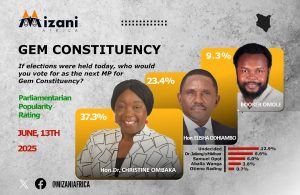
It is worth noting that Gombe lies within Gem South Ward, the turf of MCA Brian Anyango Otuom Polo, a staunch Akuba ally.
Here, Akuba enjoys a near-ironclad support base, and the incident only reinforced perceptions that the incumbent has regained serious ground.

With ODM’s traditional endorsement machinery weakened, the 2027 Gem contest will not be decided by party loyalty alone.
For the first time in years, merit, personality, and tangible performance are expected to dictate the outcome.
At the start, Woman Representative Christine Ombaka appeared the most credible challenger. But the tide now seems to be turning against her.
Local political observers say residents of Gem have two major complaints:
Her 15-year tenure in office is said to have seen most projects under her docket implemented in Alego-Usonga and Ugenya, allegedly to please successive governors.
Her once-impeccable public relations machinery has “lost touch with the ground,” with critics pointing to longevity without corresponding impact.
Additionally, locals claim she scaled down village-level women empowerment programs while widening her national focus — a shift that some feel left her grassroots base unattended.
These concerns are forming the core attack lines being weaponised by her detractors ahead of the 2027 showdown.
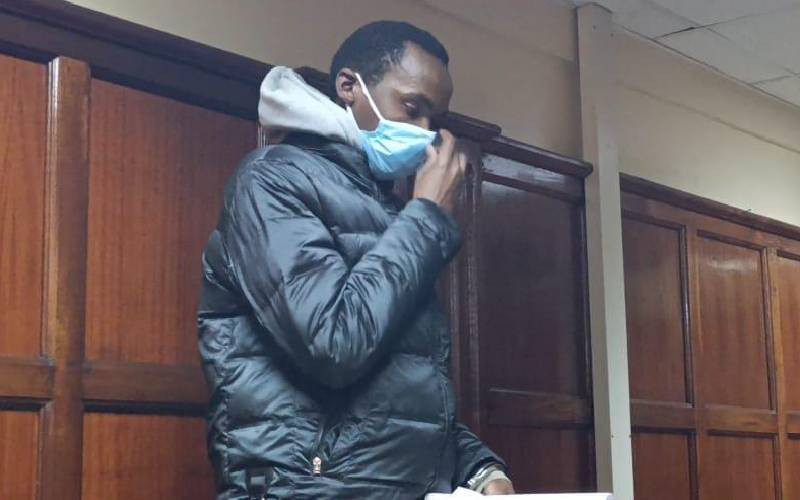
Another previously formidable challenger, Kisumu City Manager Michael Abala Wanga, is now battling allegations relating to forged academic documents — a saga that political observers say has severely dented his momentum.
Though investigations are ongoing, the mere shadow of the scandal is enough to unsettle supporters and shrink his viability.
With Ombaka weakened and Abala politically hobbled, analysts argue that Akuba now faces a far more manageable field of contenders.

Political insiders also note that President William Ruto rarely forgets those who stood with him when it was risky.
When the Siaya ground was openly hostile to the Head of State, Elisha Odhiambo Akuba — alongside Lang’ata’s Felix Odiwuor (Jalang’o) — boldly crossed the aisle to work with the President.
With 2027 approaching, such gestures may translate into quiet but significant political capital, especially if national networks and development incentives begin aligning in Akuba’s favour.
Akuba’s popularity, once on a downward slide due to the ODM fallout, is rising again across the constituency.
Voters appear to be gravitating toward the familiar, the tested, and the politically battle-hardened.
With grassroots mobilisation structures intact, ward-level political alliances thriving, and opponents stumbling at critical moments, Elisha Odhiambo Akuba enters the 2027 race not as a wounded incumbent — but as a revived frontrunner causing jitters across Gem.




Leave a Reply