

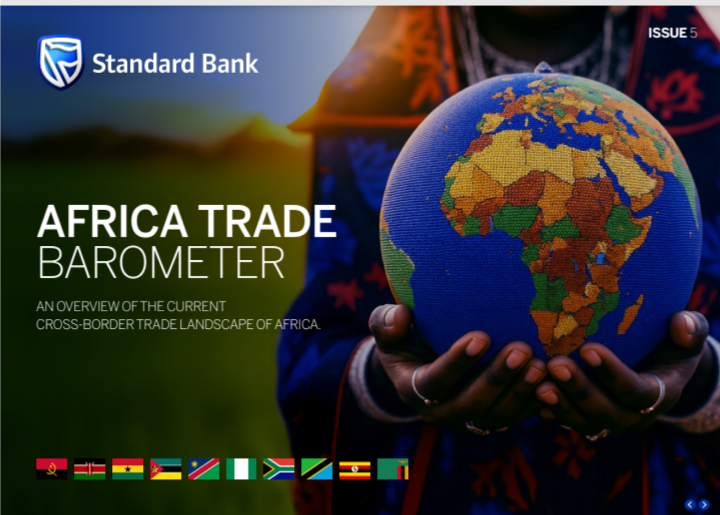
Africa’s trade landscape is showing encouraging signs of transformation, with improved infrastructure, rising business confidence and stronger regional integration shaping a more optimistic outlook for cross-border commerce. This is according to the latest findings of the Standard Bank Africa Trade Barometer (ATB), which highlights broad progress across several key economic indicators.
The fifth edition of the annual survey by Standard Bank Group indicates that trade-enabling infrastructure across major African economies is steadily improving, marking a turning point in the continent’s efforts to strengthen logistics capacity and support regional trade growth.
Covering ten markets—Angola, Ghana, Kenya, Mozambique, Namibia, Nigeria, South Africa, Tanzania, Uganda and Zambia—the report notes improvements in every major infrastructure category, including power supply, telecommunications, transport corridors, ports and digital border systems.
According to Philip Myburgh, Head of Trade for Business and Commercial Banking at Standard Bank Group, the latest findings represent a significant milestone. For the first time since the ATB was launched in 2022, all infrastructure indicators have improved simultaneously across the surveyed markets, reflecting growing investment in logistics networks and digital trade facilitation.
“These ten markets together account for about 68 per cent of Sub-Saharan Africa’s GDP,” Myburgh noted, adding that the positive shifts suggest a more favourable outlook for trade and investment across the continent.
Stronger Growth and Business Optimism
Economic conditions across the surveyed countries are also improving. Growth across ATB markets is projected to trend toward 4.3 per cent in 2026, supported by easing inflation in seven of the ten economies and improving external debt positions.
Business sentiment has strengthened significantly, with the survey’s confidence index rising to 65. Many firms anticipate stronger turnover and more stable trading conditions in the coming year. The continued strength of commodities such as gold, platinum and copper has further boosted export revenues and foreign exchange inflows for several economies.
The report draws insights from a blend of macroeconomic data and survey responses from 2,218 companies, around 71 per cent of which are small and medium-sized enterprises (SMEs).
East Africa Leads Trade Expansion
The report identifies East Africa as the strongest-performing sub-region, recording a 10-percentage-point rise in export activity. Analysts attribute this surge largely to policy coordination and trade facilitation reforms within the East African Community.
Kenya has emerged as a key driver of this progress. A recent trade reclassification agreement between Kenya and Uganda now treats goods originating in Kenya as intra-regional transfers rather than imports, reducing administrative barriers to trade. At the same time, renewed commitments by Kenya and Tanzania to eliminate non-tariff barriers are helping ease cross-border flows.
Combined with upgrades to major transport corridors across the Northern and Central routes, these measures are reducing border delays, improving logistics reliability and lowering transaction costs for regional businesses.
AfCFTA Gains Momentum
Regional integration efforts are also gaining traction under the African Continental Free Trade Area (AfCFTA). Awareness of the continental trade pact has now reached 50 per cent among surveyed firms, many of which cite easier movement of goods, expanded market access and industrialisation opportunities as key benefits.
Early AfCFTA-enabled shipments are already demonstrating tangible progress, signalling that the agreement is gradually shifting from policy ambition to practical implementation.
Changing Global Trade Dynamics
The report also highlights shifts in global trade patterns. Tariff adjustments affecting access to the United States market have reduced engagement with American partners for some African firms. At the same time, businesses are increasingly turning to Asian markets—particularly China—due to competitive pricing, wider product variety and stronger supply-chain reliability.
Meanwhile, Europe remains a strong destination for African exports.
Digital Trade Systems Expand
Another key trend is the rapid adoption of digital payment systems in cross-border trade. The report shows that digital platforms now facilitate 78 per cent of cross-border sales and 79 per cent of purchases.
This shift has been driven by bank-led payment rails, mobile money integration and the growing use of the Pan‑African Payment and Settlement System (PAPSS), which allows faster settlement in local currencies and reduces reliance on hard-currency intermediaries.
Climate Risks Persist
Despite the positive momentum, climate change continues to pose challenges for businesses. About 38 per cent of firms reported shifts in demand linked to climate impacts, while 32 per cent cited productivity losses.
The report notes that strengthening climate-resilient infrastructure and production systems will be essential to sustaining long-term trade growth.
Outlook
Overall, the ATB concludes that Africa’s trade outlook is increasingly shaped by deeper regional integration, improved infrastructure and stronger macroeconomic fundamentals.
However, geopolitical developments—including the ongoing tensions in the Middle East—could still influence energy prices and supply chains, potentially affecting trade costs in the short term.
Myburgh says that as AfCFTA implementation deepens and countries continue to harmonize customs processes and logistics platforms, Africa will be better positioned to expand industrial capacity, strengthen regional value chains and boost global competitiveness.