
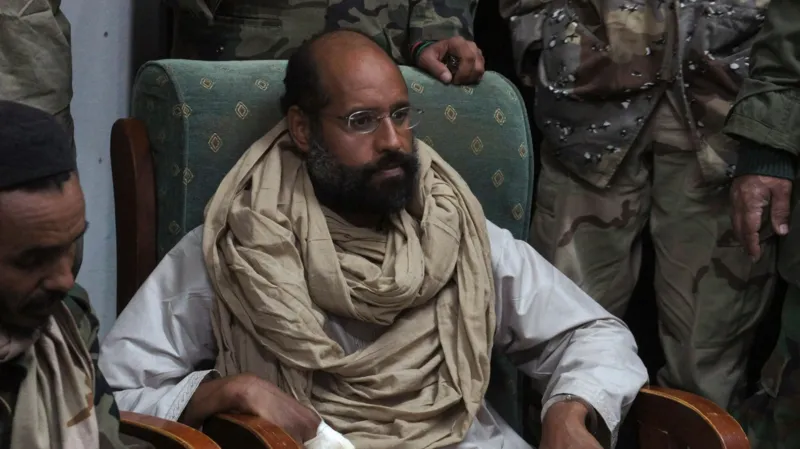
Libya has been thrown back into turmoil following reports that Saif al-Islam Gaddafi, the influential son of slain strongman Muammar Gaddafi, has been shot dead in what appears to be a targeted killing — a development that could further destabilize an already fractured nation.
According to the Libyan News Agency, the death of the 53-year-old was confirmed on Tuesday by the head of Saif al-Islam’s political team. His lawyer told AFP that a “four-man commando unit” carried out an assassination at his residence in the western Libyan city of Zintan, though no group has yet claimed responsibility.
Conflicting accounts have since emerged. In a rival version of events, Saif al-Islam’s sister told Libyan television that he died near the Libya–Algeria border, adding to the fog of uncertainty surrounding his final moments — a familiar hallmark of Libya’s post-revolutionary chaos.
Once widely viewed as Muammar Gaddafi’s political heir, Saif al-Islam was for years considered the most powerful man in Libya after his father, who ruled the oil-rich nation from 1969 until his violent overthrow in 2011.
Born in 1972, Saif al-Islam was educated in the West and played a central role in Libya’s rapprochement with Europe and the United States in the early 2000s. Despite holding no formal government post, he shaped policy and led high-stakes negotiations — most notably those that convinced Libya to abandon its nuclear weapons programme, triggering the lifting of international sanctions.
To Western diplomats, he was once portrayed as a reformist face of a changing Libya. To critics, he was the polished enforcer of a brutal regime.

That image shattered during the 2011 Arab Spring uprising, when Saif al-Islam was accused of helping orchestrate the violent crackdown on protesters. After his father’s death, he was captured by a militia in Zintan and held for nearly six years.
The International Criminal Court sought his extradition to face charges of crimes against humanity, while a court in Tripoli sentenced him to death in absentia in 2015. Yet Libya’s fractured justice system ensured his survival: he was released in 2017 by eastern-based authorities under a controversial amnesty law.
Against all odds, Saif al-Islam resurfaced politically. In 2021, he announced a bid for the presidency, reigniting fears — and hopes among loyalists — of a Gaddafi-era revival. The elections, however, were postponed indefinitely amid deep political divisions.
Libya today remains split between rival governments and competing militias, with lawlessness and assassinations still common. If confirmed, Saif al-Islam’s killing would mark the violent end of one of the most polarizing figures in modern Libyan history — a man who once promised reform, survived revolution, and flirted with a political comeback.
Whether his reported death becomes a footnote or a flashpoint now depends on what Libya does next — and whether the truth behind his final hours ever fully emerges.


