
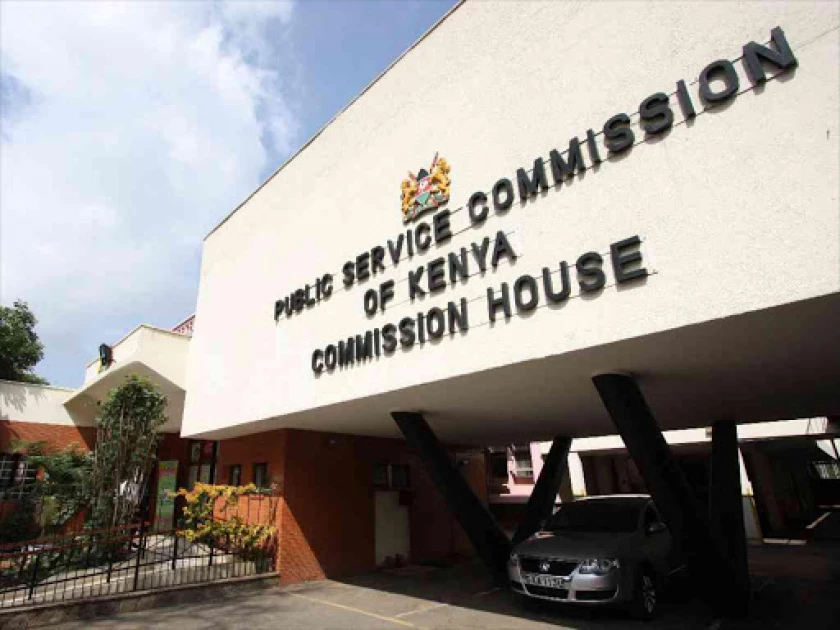
Kenya’s public service stands accused of operating a de facto ethnic cartel at the highest levels, with the latest Public Service Commission (PSC) compliance report revealing that nearly half the country’s ethnic communities have been completely shut out of top government positions.
The 2025 PSC annual compliance report delivers a damning verdict: 47.8 per cent of Kenya’s 46 recognized ethnic communities — that’s roughly 22 entire groups — have zero representation in senior public service roles. The audit, which measures adherence to constitutional values of equity and diversity under Articles 10 and 232, paints a picture of systemic exclusion that critics are already calling a “rigged system” favouring a tiny clique of dominant communities.
Fresh data from the complementary 2025 National Cohesion and Integration Commission (NCIC) ethnic and diversity audit reinforces the PSC findings with brutal clarity:
– Five ethnic communities — Kikuyu, Kalenjin, Luo, Luhya and Kamba — control over 70% of all jobs in state corporations and parastatals.
– When you add Kisii, Meru and Mijikenda, eight communities gobble up 88% of parastatal positions, leaving just 12% to be shared among the remaining 37 ethnic groups.
– At the very top, 86% of CEO positions across state corporations are held by these same eight communities, with Kikuyu, Kalenjin, Luo and Luhya alone commanding nearly two-thirds of top leadership roles.
– Public universities show the same pattern: the five dominant groups hold 85.7% of positions.

Even in fresh recruitment, the tilt is unmistakable. The PSC report covering appointments up to June 30, 2025 shows Kalenjin and Kikuyu communities scooped 34% of all new public service jobs — 2,458 out of 7,224 hires. By December 2024, Kikuyus numbered 47,543 (20%) and Kalenjins 40,820 (17.6%) in the entire public service.
The Constitution demands that public institutions reflect Kenya’s diversity. The County Governments Act caps any single community at roughly 30% in county staffing. Yet the PSC audit found widespread breaches, with some institutions still operating as ethnic strongholds.

State agencies were ordered to roll out affirmative action programmes by June 30, 2025 to fix the gaps. The latest report suggests many missed the deadline — or simply ignored it.
Smaller communities — including Kenyan-Somalis, Turkana, and dozens of other minority groups — continue to hover at negligible or zero representation in senior cadres, despite making up significant portions of the national population.
The NCIC has repeatedly sounded the alarm: this level of ethnic concentration “threatens national unity and social cohesion.” Yet the dominance persists across ministries, parastatals, constitutional commissions and diplomatic postings.
Opposition voices and governance experts say the figures confirm what many Kenyans have long suspected — that access to plum government jobs still depends more on who you know and where you come from than on merit or qualifications.
The PSC itself has urged institutions to stop non-competitive hiring, especially for advisory roles, and to enforce diversity quotas. Whether today’s report will finally force action remains to be seen.
As Kenya pushes its Bottom-Up Economic Transformation Agenda, the question looms large: can the country achieve inclusive growth when the very institutions driving policy and implementation remain captured by a narrow ethnic elite?
The 2025 PSC compliance report is not just another government document. It is a red flag — one that demands urgent, transparent reform before resentment hardens into something far more dangerous.
Kenya has 46 ethnic communities. The data now shows fewer than half of them are even in the room when top decisions are made.
The rigged system isn’t hidden anymore. It’s in the numbers.
This article draws from the official 2025 PSC compliance report and the NCIC 2025 Ethnic and Diversity Audit, as reported across major Kenyan media outlets.


