
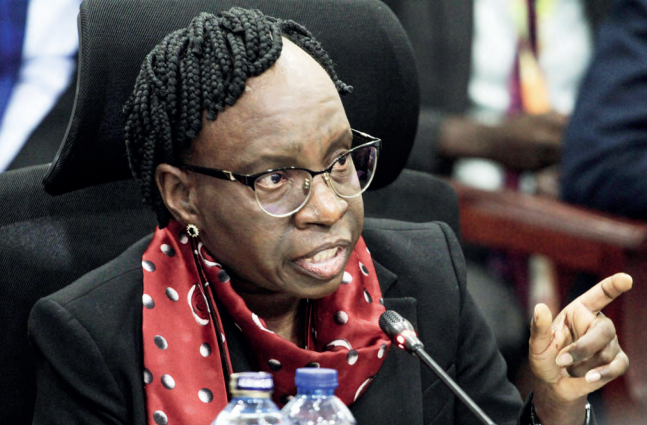
Kenya’s Auditor-General Nancy Gathungu has sounded a blistering alarm over Sh19.6 billion (nearly Sh20bn) in World Bank funds earmarked for affordable housing loans, declaring she cannot trace how the money was spent or confirm its proper use.
In a damning audit revelation that has reignited fears of financial opacity in President William Ruto’s flagship Affordable Housing Programme, Gathungu told MPs the funds—disbursed to the Kenya Mortgage Refinance Company (KMRC)—remain shrouded in mystery due to restricted access to records.
“This is because the financial statements of KMRC are not audited by the Auditor-General or a delegated auditor appointed in line with Section 23 of the Public Audit Act, 2015,” Gathungu stated. “In the circumstances, the accuracy and appropriate utilisation of Sh19,620,451,418 disbursed to KMRC for project implementation could not be confirmed.”
The funds stem from a €219 million (approximately Sh33.1 billion at current rates) loan agreement signed with the World Bank’s International Bank for Reconstruction and Development (IBRD) in December 2019, aimed at expanding access to affordable mortgages for ordinary Kenyans (wananchi). The loan was intended to refinance home loans through banks and SACCOs, making homeownership more reachable amid soaring property prices.
Yet Gathungu’s audit exposes a glaring accountability gap: her office has been unable to verify onward lending to beneficiaries or even track loan repayments. This echoes earlier concerns in 2024, when Sh11.66 billion from the same facility raised similar red flags.
KMRC CEO Johnstone Oltetia pushed back strongly against the claims, insisting the funds are fully accounted for. “The funds have been used to refinance mortgages strictly in line with the governing agreements. KMRC has refinanced over 5,100 mortgages so far through various banks and SACCOs, facilitating single-digit, fixed-rate, and longer-term loans, thereby enhancing affordability,” he told the Nation.
Oltetia added that Gathungu’s team visited KMRC in August 2025 and verified the deployment of the Treasury-disbursed loan.
The controversy comes as the government presses ahead with the controversial 1.5% Housing Levy—deducted from workers’ salaries despite fierce public and legal backlash—which has amassed tens of billions for the programme. Critics argue such audit queries undermine trust in a scheme promised to deliver hundreds of thousands of affordable homes.
With housing a cornerstone of Ruto’s Bottom-Up Economic Transformation Agenda, these untraceable billions raise tough questions: Are taxpayer and donor funds truly reaching aspiring homeowners, or vanishing into bureaucratic black holes?
As parliamentary scrutiny intensifies, Kenyans await answers on whether this Sh20bn mystery will finally unlock real homes—or just more headlines.