

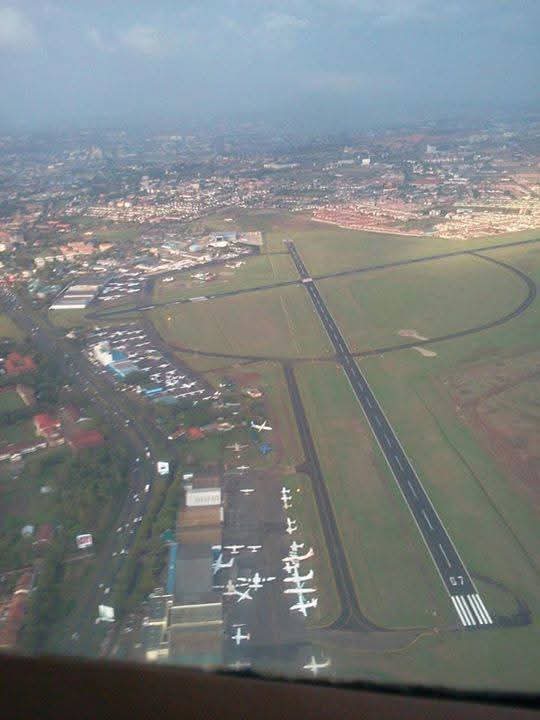
Every single day, hundreds of training flights, safari charters, medevac missions and commercial operations thunder in and out of Wilson Airport, East Africa’s busiest general-aviation hub. Yet beneath the roar of engines lies a facility quietly rotting: cracked runways, leaking roofs, unreliable power, derelict aircraft choking the apron and high-rise buildings stabbing straight into protected flight paths. Pilots and safety experts are no longer whispering the warning – they are shouting it. Wilson Airport has become a “waiting death” zone.
A damning multi-agency technical report delivered in late 2023 painted the picture in brutal detail: Kenya’s major airports, Wilson included, suffer from defective and inadequate infrastructure and electro-mechanical systems. Two full years later, almost nothing has changed. Water pipes still leak, ceilings still drip, backup generators still fail, and the once-spacious apron is now cluttered with abandoned planes that shrink usable space for live operations.
But the most terrifying threat is not on the ground – it is literally rising around it.
Rapid, unregulated urban development has pushed concrete towers and informal settlements deep into the 15-kilometre protected airspace that should be kept clear for safety. From Nairobi West, South B, South C, Lang’ata, Karen, Kibera, Ongata Rongai and the fringes near Bomas, buildings now breach the final approach and departure “funnel” that pilots depend on. Control-tower sightlines are blocked. Safety buffers have vanished. When one runway is closed for overdue repairs, all traffic squeezes onto tighter paths directly over Kibera and Nyayo Stadium – a recipe for disaster.
In February 2026 the Kenya Civil Aviation Authority finally drew a line in the sky, issuing a 30-day ultimatum: every offending building must install Class B medium-intensity obstacle lights or face immediate enforcement. New construction without KCAA approval is now illegal. Yet cranes continue to climb and land-grabbing persists, turning what should be clear blue skies into an obstacle course.
The warnings are not theoretical. Recent tragedies trace directly back to operations out of Wilson.
In August 2025 an AMREF Flying Doctors Cessna Citation 560XLS medical evacuation flight lifted off Runway 14, vanished from radar within minutes and slammed into a residential area in Mwihoko. All four people on board plus two on the ground died. Eyewitnesses reported smoke trailing from an engine before the fiery impact.
Add to that a string of runway excursions, engine failures on departure, training-aircraft incidents and a 2024 mid-air collision over Nairobi National Park between a Safarilink Dash 8 and a student Cessna. Even the perimeter fence struggles to hold back wildlife from the adjacent national park – wildebeest strikes remain a recurring hazard.
Congested airspace, chronic understaffing on the ground and an ageing control tower turn every small problem into a potential catastrophe. Young trainee pilots – the very future of Kenyan aviation – are being asked to fly in conditions that veteran captains describe as unacceptable.
The Kenya Airports Authority and KCAA have now called emergency multi-agency meetings with operators and Nairobi County. Plans are on the table: runway rehabilitation, modernized facilities and aggressive demolition or lighting of illegal structures. Aerial surveys have mapped every breach. Officials insist they are racing to restore ICAO compliance and protect Kenya’s status as the region’s pilot-training and tourism gateway.
Yet those who fly every day say the response has been too little, too late. “We cannot afford to wait for the next body count,” one senior operator said.
Wilson Airport is not just another airfield. It handles more daily movements than many international airports in the region. It launches tourists to the Maasai Mara, rushes doctors to emergencies across East Africa and trains hundreds of pilots annually. If this hub collapses under the weight of neglect and greed, the shockwaves will hit Kenya’s tourism economy, medical services and regional aviation hard.
The message from the cockpit, from the tarmac and from the latest investigations is now impossible to ignore: the physical decay and urban invasion at Wilson Airport have moved beyond inconvenience. They are a clear and present danger to lives in the air and on the ground.
Kenya’s aviation authorities face a stark choice. Defuse this ticking time bomb with swift, visible action – or let bureaucratic inertia and unchecked development write the next tragic headline.