
 ADVERTISEMENT
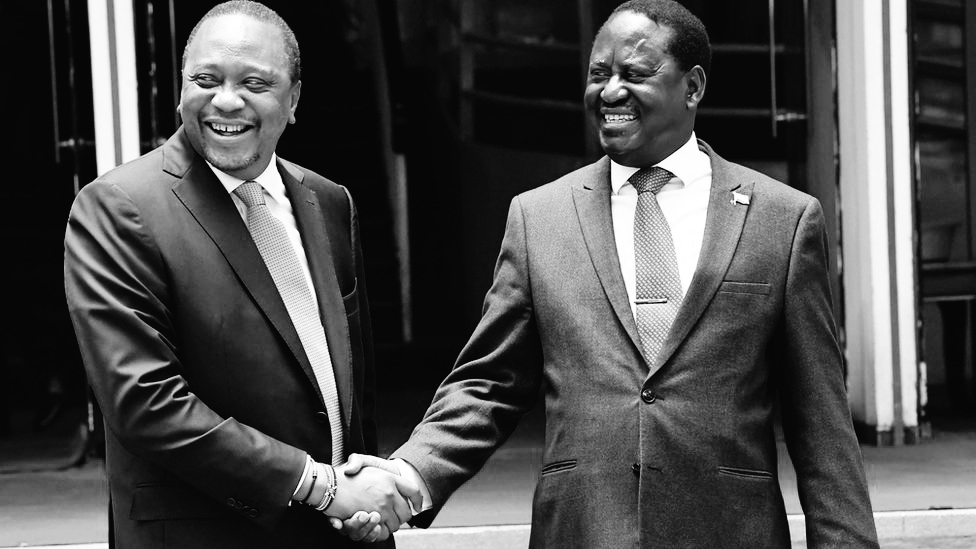
 In the ever-evolving landscape of Kenyan politics, moments brimming with potential for national unity and progress often falter under the weight of mistrust, political grandstanding, and competing ambitions. The recent developments surrounding the NADCO report and the resurgent collaboration between Kenya Kwanza’s deputy president William Ruto’s UDA and Raila Odinga’s ODM illuminate this very predicament. This collaboration, which many had hoped would signal a new era of cooperation, has instead precipitated a wave of skepticism and criticism — none more vehement than that of Moses Kuria, whose stark dismissal threatens to cast a shadow on what could have been a promising political alliance.
Moses Kuria’s condemnation of the NADCO report, likening it to the doomed Building Bridges Initiative (BBI), reveals the entrenched cynicism that continues to permeate Kenyan politics. The BBI, once hailed as a transformative blueprint for national unity and governance reforms, ended in legal challenges and political upheaval. It became a stark reminder of how ambitious national projects, despite their potential, can collapse due to political contestation and erosion of public trust. Kuria’s prediction that the NADCO report will suffer the same fate is far from mere pessimism; it echoes a historical pattern of grand initiatives unraveling before taking root.
Indeed, the NADCO report — a blueprint commissioned to address systemic challenges of economic development, digitalization, infrastructure expansion, and social welfare — offers a comprehensive vision for Kenya’s future. But it faces a political environment riddled with skepticism and factionalism. The real question is not just about the report’s merits but also about the willingness of political leaders to implement its recommendations with honesty and unity.
Kuria’s characterization of the recent UDA-ODM meeting as akin to a “dowry payment” pointedly captures the transactional nature of many political alliances in Kenya, where negotiations and compromises often favor political survival over genuine reform. This analogy also reflects deeper cultural resonance: dowry, while a traditional ceremonial exchange, is sometimes criticized for its potential to commodify relationships and obscure power dynamics. In Kenya’s politics, such symbolism evokes concerns that deals struck come at a cost to the national interest, with politicians prioritizing alliances that secure power rather than deliver on promises to the people.
Such criticism exposes not only intra-party tensions but also a broader problem in Kenyan governance — the persistent struggle to balance ethnic and party loyalties with visionary leadership. The repetition of political cycles where hopes revolve around charismatic coalitions or grand national projects underlines a continuity of unrealized potential. The BBI, launched amid a national desire to overcome ethnically charged politics and inclusive governance, was ultimately stalled by a Supreme Court ruling and divergent political interests. The fate of NADCO could follow a similar trajectory if the underlying divisions remain unresolved.
Yet, it is essential to recognize that political skepticism, while justified to an extent, can also entrench paralysis. Kenya stands at a critical juncture where addressing deep-seated issues — youth unemployment, infrastructural deficits, corruption, and digital transformation — demands political maturity. The renewed collaboration between UDA and ODM, despite its flaws and current critiques, might represent a fragile opening to transcend adversarial politics. After all, the nature of democracy often involves pragmatic compromises. The challenge is ensuring these do not dilute national priorities or reduce policy processes to mere bargaining chips.

Kuria’s harsh dismissal is a double-edged sword: it calls for vigilance against political opportunism but risks deepening polarization. The danger lies in framing every political rapprochement as betrayal or opportunism, which may discourage constructive political engagement and foster cynicism among citizens. The ongoing discourse about the NADCO report and the political alliances forged in its context must therefore be anchored in both critical oversight and an openness to cooperation for the public good.
Kenya’s political class must heed the lessons from past efforts like the BBI. Legal frameworks and judiciary independence played a decisive role in protecting the constitution, but equally important was the lack of broad, inclusive consensus that made these reforms vulnerable. This time around, leaders must prioritize transparent stakeholder engagement—including ordinary citizens, civil society, and marginalized groups—to ensure that reforms on paper translate into lived realities. Without this, any plan—no matter how meticulously crafted—risks becoming another political exercise in futility.
Moreover, the role of media and opposition figures in shaping public opinion cannot be underestimated. When voices like Kuria’s dominate headlines, they influence how ordinary citizens perceive national projects — often swinging the pendulum between hope and despair. Responsible discourse is imperative, one which scrutinizes policies vigorously yet also promotes unity rather than division. At a time when Kenya faces significant economic and geopolitical challenges, internal cohesion is more than a luxury; it is a necessity for sustainable development.
In concluding this reflection, Kenya’s enduring challenge remains transforming political will into concrete action capable of lifting the country beyond ethnic and partisan fracturing. The promise of the NADCO report and the UDA-ODM cooperation lies not merely in their existence but in their execution and the political culture that nurtures or sabotages them. Moses Kuria’s prophecy, while a stark warning, should spark renewed commitment rather than resignation.
For Kenya to break free from the cycle of failed political projects, it needs leaders who see beyond immediate power struggles — leaders who can cultivate trust, champion accountability, and embrace inclusive nation-building. The stakes are enormous: Kenya’s next chapter depends on whether hope will meet reality with courage, conviction, and unity, or whether the country will remain trapped by its own political demons, watching promising moments turn to dust.
In this battle between hope and cynicism, the future of Kenya’s democracy, development, and national cohesion hangs in the balance. It remains to be seen if the political elite can rise to this occasion or if yet another chance will slip away into the annals of what might have been.
James’ Kilonzo Bwire is a Media and communication practitioner.


