

 ADVERTISEMENT
 Kenyans were treated to a breathtaking celestial show on Sunday night, September 7, as a rare blood moon coincided with Saturn’s alignment, painting the skies in shades of red from the peaks of Mt. Kenya to the Coast’s sandy beaches.
The Kenya Space Agency (KSA) explained that the phenomenon, officially known as a total lunar eclipse, occurs when the Earth slips directly between the Sun and the Moon, casting its shadow on the lunar surface. The atmosphere filters sunlight, leaving the Moon glowing a deep red.
“A lunar eclipse can only occur during a full Moon, and the glowing red phase is among the most mesmerizing sights in the night sky,” KSA noted, calling it a reminder of the solar system’s graceful mechanics.
Partial Solar Eclipse Skips Kenya
But even as Kenyans marvel at the blood moon, sky-watchers are being reminded that the next major astronomical event — a partial solar eclipse on September 21, 2025 — will not be visible in Kenya.
The eclipse’s path will cut across the Southern Hemisphere, with the best views expected in New Zealand, eastern Australia, several Pacific islands, and even parts of Antarctica.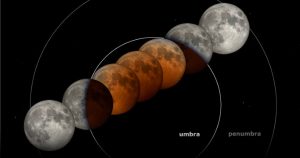

The eclipse will begin at 17:29 UTC (8:29 pm EAT), peak at 19:41 UTC (10:41 pm EAT), and end at 21:53 UTC (12:53 am EAT, September 22). At maximum, up to 85% of the Sun will be obscured.
What Kenyans Can Expect Next
While the September event will miss Kenya, there’s good news on the horizon. A partial solar eclipse is expected to be visible from parts of the country on August 2, 2027.
Until then, the memory of the blood moon — glowing over Samburu, Taita Hills, and the Rift Valley — will linger as one of 2025’s most spectacular astronomical highlights.


