

Nairobi, October 30, 2025 — What began as a routine courtesy call between Siaya Senator and acting ODM Party Leader Oburu Oginga and Embakasi East MP Babu Owino has quickly evolved into a political moment loaded with meaning — one that lifts the veil on the silent but fierce power reconfiguration within the Orange Democratic Movement (ODM).
Held on Thursday morning at Oburu’s Senate office, the meeting was officially described as an effort to “strengthen unity and inclusivity within the ODM Party.” But interviews with multiple insiders reveal it was anything but ordinary. Beneath the handshakes and polished press statements lay strategic calculations — a subtle realignment that could determine ODM’s future in a post-Raila era.
Dr. Oburu Oginga, Raila Odinga’s elder brother and now acting party leader, struck a conciliatory tone after the meeting.
“Hon. Babu Owino symbolizes the vibrant energy and determination of our youth. He has a promising future, and we are together,” Oburu declared.
Yet, those close to ODM’s core leadership interpret this statement as both a reassurance and a warning. The reassurance: that ODM remains open to its youthful wing. The warning: that loyalty remains the ultimate currency.
According to ODM sources who spoke on condition of anonymity, Babu’s frustration with the party’s “old guard” had reached boiling point. He reportedly feared that influential figures in the Orange Executive Council, quietly led by Director of Elections Ong’wen, Junet Mohammed, Treasurer Timothy Bosire, and Deputy Party Leader Wycliffe Oparanya, were planning to edge him out of contention for the 2027 Nairobi gubernatorial race.
It is against this backdrop that Oburu’s outreach becomes crucial — not just as a peace gesture but as a calculated move to neutralize dissent before it fractures the party.
In the weeks following Raila Odinga’s passing, ODM’s internal architecture has shifted dramatically. At the top sits Oburu Oginga, the party’s elder statesman, trying to project continuity and calm.
Beneath him, however, lie distinct and competing camps:
The Legacy Bloc, led by veterans like Oparanya, Bosire, and John Mbadi, who are intent on safeguarding the Odinga family’s political brand and maintaining ODM’s traditional command structure.
The Reform Bloc, a restless generation of younger leaders — Babu Owino, Nairobi Senator Edwin Sifuna, and Suba South MP Caroli Omondi — who want a more democratic, less personality-driven ODM.
The Bridge Builders, including figures like Mombasa Governor Abdulswamad Nassir and Suna East MP Junet Mohammed, who are attempting to mediate between the two forces to prevent a full-scale rupture.
It is this invisible tug-of-war that makes the Oburu–Babu meeting so politically charged. By personally reassuring Babu that he would not be denied the ODM ticket if he wins the nomination, Oburu was effectively sending a message to both camps: the future of ODM cannot be decided in backrooms.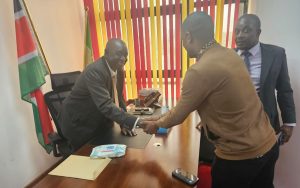
Sources within the party’s National Executive Council (NEC) told this publication that the decision to engage Babu directly came after weeks of quiet lobbying from youthful MPs and county assembly leaders.
“There was growing concern that if Babu felt cornered, he might bolt out and join a rival coalition,” said a senior ODM operative. “That would be catastrophic for ODM’s urban vote — especially in Nairobi, where he has a cult-like following among the youth.”
Indeed, Babu’s recent social media posts had hinted at alienation, with cryptic statements about “sacrifice, betrayal, and revolution.” By inviting him in, Oburu may have prevented a public fallout that could have further weakened the party’s image of unity.
But make no mistake — this is a truce, not a surrender. Insiders describe ongoing tensions over the party’s succession strategy and the distribution of power between the old guard and new aspirants.
At 81, Dr. Oburu Oginga is fully aware that he stands at a political crossroads. While his name commands respect across ODM’s base, he knows the party must evolve or risk irrelevance.
In his dual role as both caretaker and mediator, Oburu has sought to position himself as a bridge between legacy and renewal — maintaining the Odinga name’s moral authority while opening space for new political actors.
“He’s doing what Raila did best — keeping the house together through dialogue,” said political commentator Dr. Lydia Odhiambo. “But unlike Raila, Oburu doesn’t have the same charismatic leverage. He’s relying on institutional diplomacy rather than mass mobilization.
Nairobi’s 2027 gubernatorial race is emerging as ODM’s biggest internal test. Babu Owino’s name tops early speculation lists, with insiders suggesting that Oburu’s latest assurance was meant to calm fears of bias in the nomination process.
Still, whispers persist that a faction within ODM — allegedly allied to Sifuna and a section of the party’s secretariat — is quietly scouting alternative candidates, possibly from the corporate or technocratic world, to counter Babu’s populist brand.
Such moves, if confirmed, could reopen old wounds about fairness in party nominations — the very issue that has historically cost ODM loyal members in competitive regions.
Interestingly, as Oburu met Babu, Kiambu Senator Karungo Thang’wa and Nyandarua Senator John Methu — both from the Kenya Kwanza camp — visited Oburu at his Siaya home.
Publicly, it was framed as a condolence visit and mentorship moment. Privately, it reinforced Oburu’s emerging stature as a national elder — one whose influence transcends ODM.
“The visits are a subtle acknowledgment that Oburu is now a political node — both a custodian of Raila’s legacy and a pivot for intergenerational dialogue,” said governance analyst Charles Ochieng.
The Oburu–Babu meeting, therefore, was not merely about unity. It was about survival.
It was a glimpse into ODM’s struggle to reinvent itself — caught between loyalty to a founding legacy and the urgency of generational renewal. The quiet handshake between the 81-year-old senator and the 36-year-old firebrand MP might well go down as a symbolic turning point: the moment the Orange Party began confronting its future instead of mourning its past.
As one senior official put it bluntly, “ODM is no longer Raila’s party. It’s Kenya’s to redefine. Oburu knows that — and Babu is part of that equation.”
Behind the polished smiles and official statements, ODM’s inner matrix is shifting. The veterans guard the legacy. The youth demand a stake. And in the middle stands Oburu Oginga, navigating a fragile truce that could either restore ODM’s vibrancy — or expose its deepest fractures.
For now, the orange flame still burns — but it flickers between nostalgia and a restless hunger for change.


