

 ADVERTISEMENT
 When James Orengo delivered his 2025 State of the County Address for Siaya County on December 9, many residents and observers expected a candid accounting of past failures alongside celebrated successes. Instead, they got a polished narrative of “bold development strides” — a speech heavy on ambition, optimism, and gloss.
But beneath the rhetoric lies a complex reality: stalled projects, accusations of mis-management, endemic hiring irregularities, and a community staring at rising climate risks. Here is an investigative breakdown of what the address covered — and more importantly, what it omitted, and how that matters for Siaya.
Orengo framed his administration in 2025 as one on an “accelerated development trajectory.”
Own-source revenue growth: The county’s own-source revenue has reportedly grown to KSh 948 million in the 2024/2025 financial year — up from KSh 508 million in 2022/2023 and KSh 610 million in 2023/2024, a steady upward trend he attributed to automation and a cashless revenue collection system.
Increased development spending: According to Orengo, the county invested a total of KSh 6.4 billion in infrastructure over the past three years, with development expenditure rising from KSh 1.35 billion (2022/23) to KSh 2.8 billion (2023/24) and then to KSh 3.6 billion (2024/25).
Governance, audit, and financial discipline: The Governor emphasised that the county had earned unqualified (or at least robust) audit opinions, a milestone indicating better financial management and accountability compared to previous years.

Ambitious sectoral investments:
In healthcare: He announced the planned 500-bed Siaya County Referral Hospital (a KSh 500M project), upgrades to several sub-county hospitals and health centres, promotions for over 800 staff, expansion of HIV and child health programmes, and improved ECD services for children under five.
In agriculture and blue economy: The address flagged fertiliser, seed, livestock and fish-farming interventions; recruitment of agricultural extension officers; revival of cotton processing through a local plant; rice-mill rehabilitation; and support for jua-kali artisans and cooperatives.
In digital transformation and governance reforms: Orengo said the administration rolled out automated systems, performance contracts, and staff audits, and pursued a skills audit to ensure the right placement of staff.
In infrastructure: Promised ring-roads (Usenge, Akala, Sega) to be upgraded to bitumen standards once funds are available.
In his address and subsequent interviews, Orengo blamed delayed disbursements from the national treasury (exchequer) for stalling many flagship county projects — suggesting the delays, not mismanagement, are responsible for slowed implementation.
Despite the glowing presentation, several major and arguably more urgent issues were barely addressed — or not mentioned at all.
What Was Left Out or Underspecified
Pending bills / county debt: While Orengo acknowledged “pending bills,” he did not provide a clear breakdown (suppliers, contractors, small businesses) nor a transparent payment plan or realistic timeline. This leaves many small businesses and contractors — crucial to local economies — uncertain, destabilised, and possibly at risk of collapse. Lack of clarity undermines trust and further erodes investor confidence.
Why so many projects are stalled or delayed The blame was placed squarely on delayed exchequer release. There was no discussion of internal inefficiencies, procurement issues, or governance weaknesses. Without acknowledging internal faults, future projects remain vulnerable to the same bottlenecks even if funding improves.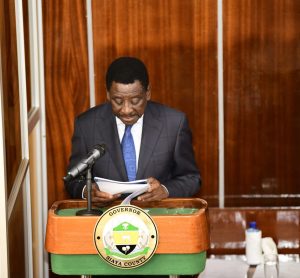
Irregular hiring and alleged corruption scandals: There was no mention of the ongoing investigations by Ethics and Anti-Corruption Commission (EACC) into irregular hiring of over 382 health workers, alleged bribes, ghost workers, and unlawful contract extensions — issues that arguably strike at the heart of governance and public service delivery. Ignoring these scandals undermines the administration’s claims of accountability. The unresolved allegations heighten public distrust and question the legitimacy of recent “staff promotions.”
Realities in health service delivery— staff, drugs, corruption: While infrastructural upgrades were highlighted, there was no mention of chronic understaffing, drug stock-outs, theft/pilferage of medicines, or reports of misappropriated funds meant for ICU installations (e.g. KSh 72 million scandal). Past disclosures by Orengo himself indicate drugs meant for public hospitals were being diverted to private facilities. A building is only as good as the staff, equipment and services within. Without addressing systemic dysfunction, improved infrastructure may amount to hollow promises. Patients may still face drug shortages, unqualified staff, or no services despite “new hospitals.”
Climate risk — drought and food security There was no concrete plan to address manifest vulnerabilities posed by climate change, drought, unpredictable rainfall and food insecurity — even though the county’s own climate risk assessments show recurrent droughts, drying water sources, declining crop yields due to drought, and increased need for adaptation investments. With a majority of Siaya’s population reliant on rain-fed agriculture and fishing, neglecting drought preparedness threatens livelihoods, food security, and could push more people into poverty.
Beyond these, the speech avoided any discussion of leadership fissures inside the county executive — no mention of tensions, acting appointments, or ambiguity over who runs the county day-to-day among his closest aides, including kith and kin: issues currently fueling public suspicion and uncertainty.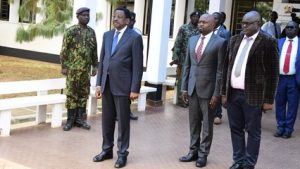
Why did Orengo present a selective narrative? The reasons likely combine political strategy and optics:
1. Protecting the “success narrative” ahead of future elections
Presenting robust own-source revenue numbers (KSh 948 million) positions Siaya as fiscally disciplined and prosperous. That helps build investor confidence, especially ahead of events like investment conferences (e.g., SITICO 2025) or the 2027 election cycle.
Acknowledging unresolved debts, stalled contracts, or systemic failures (corruption, irregular hiring) would undercut that narrative, perhaps discouraging investors and reducing public confidence.
2. Avoiding accountability and difficult questions
By attributing stalled projects to delayed national disbursements, the administration deflects internal scrutiny.
Silence on corruption and hiring scandals prevents fueling public outrage or demands for resignations.
3. Maintaining political unity — at least in appearance
Avoiding any reference to internal leadership tensions, staff unions, or operational dysfunction helps project an image of a stable, united government. For a county leader gunning for a second term, political stability is a strong asset.
4. Prioritising optics over substance — “show before fix” philosophy
Prioritising flashy promises (hospitals, ring roads, big revenue figures) rather than grappling with messy systemic issues reflects a top-down governance style focused on legacy and appearances.
The omissions are not trivial — they carry real consequences for ordinary people in Siaya:
Small businesses and contractors might continue to suffer if “pending bills” are not cleared, undermining livelihoods and the local economy.
Healthcare users risk access to sub-par services — a lack of drugs, understaffed facilities, or poorly-equipped hospitals reduces the benefit of any new buildings.
Young job-seekers and professionals may lose trust in public service recruitment processes, especially a sector (health) that is critical for both employment and service delivery.
Farmers, fishermen and rural communities remain vulnerable to drought and climate shocks if the county does not invest in adaptation, irrigation, water harvesting, and alternative livelihoods — putting food security and income at risk.
Public trust in governance may erode further, especially if the perception grows that the county is more interested in optics than genuine reform.
To move beyond rhetoric, Siaya needs:
A transparent audit and public disclosure of all pending bills, contracts, and debt — with clear payment plans and timelines.
A full forensic audit into the hiring irregularities, ghost workers, and alleged bribery in recruitment — then accountability for those responsible.
A comprehensive health-sector review: staffing, drug supply chains, equipment procurement, and service delivery — not just infrastructure upgrades.
A climate-resilience plan backed by resources: water harvesting, drought-resistant crops, climate-smart agriculture, irrigation — because studies show droughts in Siaya are correlated with major crop-yield losses.
Sustained citizen engagement and oversight: the county assembly and civil society must demand and monitor delivery, not just wait for “success stories.”
The 2025 State of the County Address by James Orengo was polished — but incomplete. It highlighted ambitions, revenue growth, and transformation while glossing over the realities many Siaya residents live: stalled bills, stories of corruption, fragile health services, and growing climate vulnerability.
A bold address should not just sell hope — it should confront hard truths. Siaya deserves honesty, not political packaging; transparency, not showmanship; real delivery — not promises.


