

 ADVERTISEMENT
 Cabinet Secretary for Energy and Petroleum James Wandayi Opiyo has thrown fresh weight behind Taita Taveta County’s development ambitions following high-level consultations with Governor Andrew Mwadime and his delegation—an engagement that signals how Kenya’s devolved energy agenda is shifting from rhetoric to results.
At the heart of the talks was a detailed appraisal of ongoing and planned energy projects earmarked for Taita Taveta in the current financial year. But beyond budgets and timelines, the session crystallized a broader vision: one where national energy policy converges with county-led priorities to unlock inclusive growth under President William Ruto’s Bottom-Up Economic Transformation Agenda (BETA).
Energy is the backbone of modern economies, and CS Wandayi made it clear that Taita Taveta is no longer a peripheral player. With Kenya’s electricity access now hovering around 95 percent and the country holding global acclaim in geothermal energy, the ministry’s focus has shifted to ensuring that historically underserved counties share in these gains.
Taita Taveta—rich in minerals, agriculture, and solar potential—has long struggled with unreliable power and infrastructure gaps. That narrative is now changing.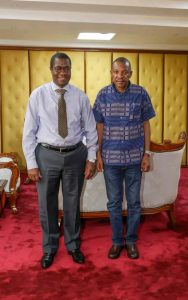
Flagship projects such as the Paranga Electrification Project and an expansive last-mile connectivity programme targeting Wundanyi and neighboring wards took center stage. Valued at over KSh 1.1 billion, these initiatives are complemented by rural electrification rollouts in Voi and Mwatate sub-counties, bringing grid power closer to households, schools, and health facilities.
These are not abstract promises. They mean transformers coming alive, businesses running past sunset, and families graduating from kerosene lamps to clean, reliable electricity.

Wandayi emphasized the productive use of energy—a policy shift that views electricity not merely as a social service but as an economic catalyst. From irrigation pumps and cold storage for horticulture to value-addition in mining and agro-processing, power access is being positioned as a direct weapon against unemployment and poverty.
The impact could be transformative: stronger avocado and tea value chains, energized mining operations extracting iron ore and gemstones, and new opportunities for small and medium enterprises across the county.
Taita Taveta’s credibility was bolstered by its early adoption of a County Energy Plan, only the seventh county in Kenya to do so. Developed with input from Voi, Mwatate, Wundanyi, and Taveta, the blueprint aligns seamlessly with the national Integrated National Energy Plan, ensuring coherence between local needs and national infrastructure.
The plan prioritizes grid reinforcement, off-grid solar solutions for remote pastoralist communities, and resilience against climate shocks—an increasingly urgent concern in arid and semi-arid regions.
Looking ahead, CS Wandayi outlined bold strategies to harness the county’s renewable energy bounty. Among them is a landmark 600 MW supply capacity deal, potentially a game-changer for a county bathed in year-round sunshine—ideal for large-scale solar farms.
Geothermal exploration near the Tsavo volcanic belt could deliver stable baseload power for energy-hungry mining.


