

 ADVERTISEMENT
 A rare unity of voices from western Kenya has ignited a political and environmental firestorm after Luhya and Luo elders jointly issued a hardline statement rejecting plans to establish a 1,000-megawatt nuclear power plant in Siaya County, warning that the project could pose catastrophic health and ecological risks to Lake Victoria and the wider East African region.
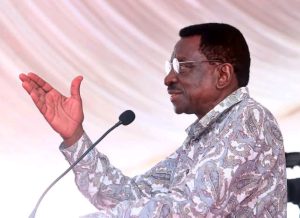
What has stunned observers even more is the conspicuous silence of Siaya Governor James Orengo—a politician renowned nationally for his fierce opposition to controversial national government projects. On this one, Orengo has gone unusually quiet.
Meeting in a high-level consultative forum over the weekend, elders drawn from the Luo Council of Elders and their Luhya counterparts broke ranks with Nairobi’s energy planners, terming the proposed nuclear reactor “an existential threat” to communities living around Lake Victoria.
In a unanimous resolution, the elders rejected outright the government’s plan to construct the $3.8 billion (Sh489.9 billion) nuclear facility at Luanda K’Otieno in Bondo, a site that emerged after the State quietly shelved an earlier proposal to locate the plant in Uyombo, Kilifi County.
“In view of the likely implications of the nuclear plant for health and environmental concerns around the entire East African region, the council resolves to reject in total the plans of going ahead with the project,” the elders said in a joint statement.
The symbolism of Luhya–Luo unity on a mega national project has not been lost on political analysts. Historically divided on many issues, the two communities are now presenting a consolidated front—suggesting that opposition to the nuclear plant could morph into a powerful regional movement.

At the heart of the elders’ objections is Lake Victoria, Africa’s largest freshwater lake and the lifeblood of millions across Kenya, Uganda and Tanzania. Elders fear that any accident, waste leakage or long-term radiation exposure could permanently damage the lake’s fragile ecosystem, devastate fishing livelihoods and trigger cross-border diplomatic fallout.
To move beyond rhetoric, the council announced the formation of a technical committee led by a senior engineer, with support from the Luo Council of Elders, mandated to independently assess the plant’s environmental, health and safety implications.
The committee is expected to present its findings to the council before any further engagement with the national government.
Perhaps the most intriguing twist in the unfolding saga is the uncharacteristic quietness of Governor James Orengo.
Orengo has built a reputation as one of the most vocal critics of what he views as poorly thought-out national government projects imposed on counties without adequate consultation. From infrastructure to governance reforms, the Siaya governor is rarely shy of a microphone.
Yet on the nuclear question—arguably the most consequential project ever proposed in Siaya—Orengo has neither issued a firm public statement nor addressed the elders’ concerns head-on.
Political insiders say the silence is fueling speculation: Is the governor walking a tightrope between local resistance and national power brokers? Or is there a deeper political calculus at play as Kenya pushes to diversify its energy mix?
Nuclear Ambitions vs Public Trust
The national government has defended nuclear energy as a safe, reliable and globally tested power source, capable of transforming Kenya into an industrial powerhouse. Energy planners argue that nuclear plants have a stronger safety record than hydropower and fossil fuels when properly regulated.
But critics counter that public trust, transparency and informed consent have been glaringly absent—especially in regions earmarked for high-risk installations.
The elders also used the forum to sound the alarm over gold mining activities in western Kenya, accusing investors of acquiring ancestral and community land without meaningful consultation.
Their concerns follow the discovery in November of gold deposits in Kakamega County valued at over $5.28 billion (Sh683 billion) along the Lirhanda Corridor—a 1,200-kilometre mineral belt stretching through Kakamega and Vihiga.
“We are concerned with the rapacious approach in which ancestral and community lands are being taken up by investors, many of whom are not known to the people,” the elders warned.
With elders mobilized, a technical committee in place, and regional unity crystallizing, the Siaya nuclear project is fast becoming a national flashpoint.
And as pressure mounts, all eyes are now on Governor Orengo.
In a county where silence is rarely neutral, his next words—or continued quiet—could define the political fate of Kenya’s nuclear ambitions in Nyanza.


