

 ADVERTISEMENT
 Cabinet Secretary for Energy and Petroleum James Wandayi joined President William Ruto in Kabarnet town, Baringo County, to commission the Sh1.5 billion 132kV Lessos–Kabarnet Transmission Line and substation—an infrastructure milestone that finally plugs this historically marginalized region into Kenya’s national grid. This project is more than steel pylons and high-voltage cables; it is a long-overdue lifeline delivering reliable, affordable, and stable electricity to thousands of households and businesses across Baringo and Elgeyo-Marakwet counties.
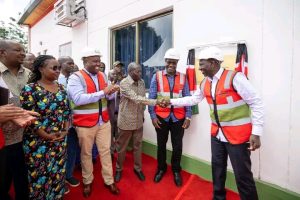
In a country where darkness has too often dictated destiny, the Lessos–Kabarnet line stands as a practical expression of President Ruto’s bottom-up economic model. It brings essential services closer to the people, unlocks youth employment, and fuels inclusive growth in areas that have waited decades for meaningful state investment. For communities accustomed to promises without delivery, this commissioning marks a decisive shift from rhetoric to results.
For far too long, regions like Baringo have existed on the fringes of Kenya’s development story. Pastoralists herding livestock under starlit skies, traders dependent on unreliable solar lamps, and entrepreneurs crippled by frequent outages have embodied the daily reality of energy poverty. This transmission line directly confronts that reality. By integrating Baringo seamlessly into the national grid, the project reduces transmission losses and stabilizes supply in areas previously reliant on diesel generators or inconsistent rural electrification.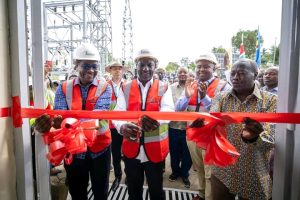
The implications are immediate and transformative. Households in Kabarnet can now switch on lights without fear of blackouts. Students can study well into the night. Agro-processors can refrigerate milk and meat without constant spoilage. This Sh1.5 billion investment—delivered through coordinated public financing and Kenya Power’s expanded mandate—demonstrates that devolved governance, when aligned with a coherent national vision, can turn peripheral counties into engines of growth.
President Ruto’s presence at the commissioning was not symbolic. It reinforced his administration’s determination to anchor development in tangible outcomes rather than ceremonial politics. Unlike the headline-driven launches of the past, this project delivers measurable value. During construction alone, it created hundreds of jobs, while ongoing operations will sustain skilled employment in maintenance, monitoring, and auxiliary services.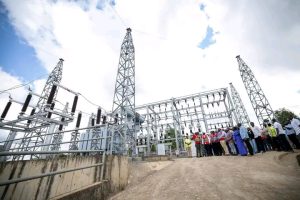
For Baringo’s youth—many of whom face chronic unemployment—the project opens doors to technical careers. Through training programs aligned with the Energy and Petroleum Regulatory Authority (EPRA), young technicians are gaining skills that extend beyond this line into solar installations, mini-grids, and emerging green energy sectors. Businesses, from milk cooling plants to irrigation schemes, will now operate at full capacity, driving productivity that spills into neighboring Elgeyo-Marakwet and the wider Kerio Valley.

This progress, however, should not blind us to history. Kenya’s energy sector is littered with stalled ambitions and costly delays—from the prolonged integration of the Lake Turkana Wind Power project to the uneven rollout of Last Mile Connectivity. What distinguishes the Lessos–Kabarnet line is execution. Despite global supply chain disruptions and inflationary pressures, the project was completed on schedule. That efficiency reflects a sharper focus within the current administration on delivery and accountability.
CS Wandayi’s stewardship of the Energy ministry has been central to this shift. His approach—technocratic, disciplined, and outcomes-driven—signals a break from an era when energy projects were synonymous with cost overruns and controversy. Under his watch, grid expansion is no longer an abstract policy goal but a visible, measurable process tied to the Kenya Kwanza manifesto and the target of universal electrification by 2030.
The broader economic ripple effects of this project are profound. In a county dominated by pastoralism, electricity enables cold storage for meat and dairy, dramatically reducing post-harvest losses. It creates space for value addition, allowing farmers to earn more without expanding herds in an already climate-stressed environment. For women entrepreneurs, reliable power means extended business hours, cleaner operations, and access to digital platforms that expand markets beyond local trading centers.
Youth migration to urban slums—driven largely by rural job scarcity—may finally slow as green energy opportunities emerge locally. Skills such as cable splicing, substation management, and electrical installation are not only employable today but future-proofed as Kenya accelerates toward a low-carbon economy. With stable electricity, Baringo also becomes viable for eco-tourism and hospitality ventures around Lake Baringo, diversifying incomes and attracting private investment.
Critics may question the Sh1.5 billion price tag at a time of fiscal pressure, but the return on investment is compelling. Each unit of power delivered here reduces dependence on expensive thermal generation, conserving foreign exchange and strengthening Kenya’s renewable-heavy energy mix. The project also advances constitutional guarantees of economic inclusion and environmental sustainability, correcting long-standing regional imbalances in power distribution.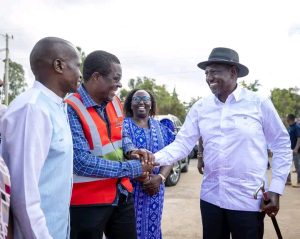
Looking ahead, the Lessos–Kabarnet line is a building block in a much larger grid renaissance. It strengthens Kenya’s position within the Eastern Africa Power Pool and supports future interconnections with Ethiopia and Uganda. For Baringo County, under Governor Benjamin Cheboi, the challenge now is complementary investment—feeder roads, industrial parks, and SME financing—to fully capitalize on this new energy backbone.


