

 ADVERTISEMENT
 The latest press statement by the Nyanza Council of Church Leaders should worry anyone who still believes the Church exists as society’s moral conscience rather than as an annex of the State.
Draped in scripture, soaked in gratitude to power, and heavy with political praise, the statement reads less like a prophetic call to justice and more like a well-rehearsed after-dinner speech delivered at the high table of authority.
Once again, the Church has spoken—but only because it had been invited to dine and wine.
A Church That Speaks Only When Summoned
The troubling pattern is now familiar in Siaya, Nyanza, and increasingly across Kenya: church leaders emerge from silence only when a Cabinet Secretary provides a “forum,” a State House nod is acknowledged, or political benefactors foot the bill. When citizens groan under the weight of over-taxation, unemployment, corruption, police brutality, and economic despair, the pulpits fall eerily quiet. But when power beckons, the collars appear, cameras roll, and scripture is carefully selected to sanctify the political moment.
The Nyanza Council of Church Leaders’ press statement is a textbook example. It offers lavish thanksgiving to President William Ruto, praises “statesmanship,” blesses political partnerships, and urges citizens to rally behind the government—all without a single hard word about the lived suffering of ordinary Kenyans. There is unity talk, yes. Peace talk, certainly. But justice? Accountability? Truth to power? Conspicuously absent.
From Prophets to Praise Singers
Historically, the Church earned its place in public life by standing apart from power—challenging kings, rebuking excess, and defending the poor. Today’s Nyanza prelates appear to have traded that prophetic distance for proximity to the State. Their moral authority has been mortgaged to access, allowances, and political relevance.

This did not start today. Kenyans will recall the extensive delegations of church leaders trooping to then–Deputy President William Ruto’s Karen residence before he ascended to the presidency. The visits were framed as “prayers,” but the optics were unmistakable: the Church positioning itself early on the side of power. That history makes today’s glowing endorsements ring hollow and transactional.
Selective Blindness to Evil
What makes the situation more damning is the Church’s selective eyesight. It sees evil when it is safe to see it, and remains blind when seeing would cost invitations, influence, or funding. It prays loudly for unity but avoids naming the injustices tearing the country apart. It blesses leadership but refuses to interrogate policy failures, broken promises, or state violence.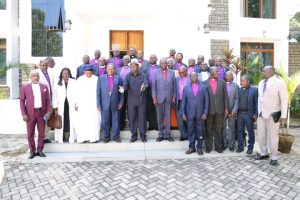
In this, the Nyanza Council of Church Leaders mirrors another hollow institution: the Luo Council of Elders. Both are increasingly perceived as shells—structures that bark not at wrongdoing, but at the bidding of whoever pays the piper. Their statements may sound authoritative, but they carry little moral weight among a population that can clearly see the distance between rhetoric and reality.
Enormous Influence, Squandered Credibility
Ironically, the Church still wields enormous influence in Kenya. A united, courageous clergy could shape national debate, restrain excesses of power, and offer ethical leadership in a morally confused time. Instead, that influence is squandered on ceremonial prayers, political endorsements, and carefully worded communiqués designed to offend no one in authority.
By choosing to be in bed with the State, the Church has abandoned its most powerful weapon: credibility. And without credibility, no amount of scripture quoting can restore its standing as the nation’s moral compass.
Siaya, Nyanza, and Kenya at large do not need a Church that echoes government talking points. They need one that asks uncomfortable questions, stands with the oppressed even when uninvited, and speaks truth whether or not there is a banquet afterward.
Until that happens, statements like this will continue to be read not as divine guidance, but as political choreography—polished, pious, and profoundly disconnected from the pain of the people.
And that, perhaps, is the greatest tragedy of all.


