
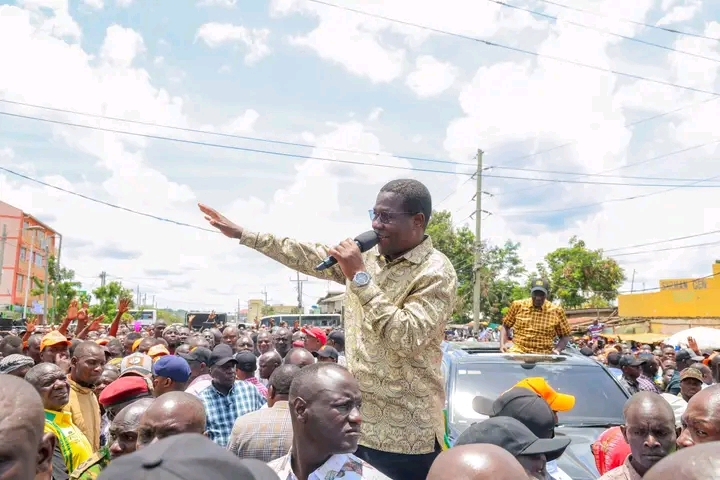
Cabinet Secretary for Energy and Petroleum Opiyo Wandayi has aligned himself with President William Ruto’s call to “Ti Gi Wiyi,” urging leaders to embrace thoughtful, results-driven decision making in advancing development across the Nyanza region.
Wandayi interprets this directive as a mandate to protect development opportunities through disciplined resource management and strategic planning. He explains that leaders must avoid past mistakes, corruption, poor project execution, and disconnected priorities, that have undermined progress in Nyanza. Every shilling allocated must produce measurable outcomes, every project must undergo rigorous vetting, and every decision must prioritize community needs over political expediency. Wandayi positions energy development as the test case for whether regional leaders can deliver on national commitments without falling into familiar pitfalls.
Speaking during recent regional engagements, Wandayi underscored the central role of electricity in transforming livelihoods. Expanding access to affordable and dependable power represents not just a policy goal, but a necessity for economic inclusion. Achieving this requires careful prioritization, efficient use of public resources, and clear understanding of local needs. Wandayi links energy access directly to Nyanza’s development priorities, explaining how electricity powers small businesses like jua kali workshops, enables cold storage for Lake Victoria fish, supports irrigation for rice farming, and keeps rural schools operational through extended study hours.
Throughout his development tour, President Ruto challenged local leaders directly. In Yala, he called on Samuel Atandi to align budgetary processes with real development outcomes, emphasizing funding decisions as the backbone of government delivery. In Homa Bay, he delivered a similar message to John Mbadi about intentional resource allocation for national programmes. Wandayi builds on these directives, applying them specifically to energy delivery. He has convened meetings with Nyanza MPs, governors, and MCAs to synchronize county development plans with national energy projects, stressing that fragmented efforts waste resources while coordinated action delivers results.
Wandayi demonstrates his leadership through project transparency and accountability measures. He requires ministry teams to publish detailed work plans for all Nyanza energy initiatives, including timelines, budgets, and expected deliverables. Every project proposal must include community impact assessments and maintenance plans to prevent infrastructure decay. Wandayi established monitoring committees with local representation to oversee implementation, ensuring funds reach intended purposes. This systematic approach counters the historical pattern of incomplete rural electrification projects and non-functional infrastructure.
Matching public funds to verified community needs defines Wandayi’s approach. He prioritizes grid extensions to unserved areas, off-grid solar solutions for remote settlements, and mini-hydro projects along Nyanza’s rivers. During public forums, he explains how these address specific economic activities, reliable power for fish processing plants, energy for sugarcane crushing machines, electricity for rural trading centers. Wandayi rejects oversized power stations in low-demand areas, insisting every investment generates immediate livelihood improvements.

Addressing high electricity costs, a major barrier for Nyanza households, Wandayi outlines concrete actions. He details negotiations with Kenya Power for tiered tariffs lowering rates for low-income consumers while maintaining commercial viability. Wandayi commits to expanding rebate programs for prepaid meter users and exploring group metering for village polytechnics and churches. These measures ensure energy benefits reach ordinary citizens rather than remaining theoretical policy goals.
Capacity building forms another pillar of Wandayi’s strategy. He mandates training programs for local youth as solar technicians, power line repair crews, and meter readers, creating sustainable employment while building regional expertise. Wandayi partners with TVET institutions in Kisumu and Homa Bay to certify these workers, establishing a skilled labor pipeline reducing dependence on expensive external contractors. He notes MPs and governors must allocate bursaries and workshop spaces to support these programs, ensuring energy infrastructure endures beyond initial installation.
Public participation defines Wandayi’s planning process. He facilitates regular barazas where communities identify priority areas, irrigation pumps for rice schemes, power for mama mboga refrigeration units, lighting for night study groups. Ministry engineers document these needs through structured templates, ensuring feedback shapes annual work plans. Wandayi established a toll-free hotline for reporting project delays or quality issues, requiring ministry resolution within 14 days. This builds public ownership and verifies projects meet community expectations.
Wandayi’s petroleum sector oversight complements electricity delivery. Despite global supply pressures, he coordinates with oil marketers to maintain steady fuel availability in rural depots. He explains logistics improvements, bulk storage in Kisumu, improved trucking schedules from Mombasa, emergency reserve tanks, to prevent shortages disrupting fishing operations and farm transport. Reliable petroleum supply proves equally critical to Nyanza’s economic engine.
Wandayi addresses critics dismissing his approach as rhetoric by pointing to tangible deliverables. Completed transmission lines serve Siaya trading centers, solar-powered health centers reduce maternal mortality through nighttime deliveries, vocational institutes gain reliable power for extended training. These outcomes validate prioritizing projects with immediate impact over ambitious but impractical schemes. Wandayi challenges skeptics to measure progress through completed connections and reduced outages.
Sustainable progress demands consistent, well-informed decisions backed by rigorous accountability. Wandayi leads by example as Cabinet Secretary, demonstrating how methodical leadership transforms challenges into opportunities. His blueprint, transparent planning, community validation, technical capacity, relentless oversight, sets the standard for Nyanza’s public servants. Through deliberate actions, Wandayi proves protecting development opportunities requires excellence in execution.
James’ Kilonzo Bwire is a Media and Communication Practitioner.


