 ADVERT

 ADVERT
On Friday, the Nation Media Group splashed a headline that placed Siaya County at the bottom of the table in collection of own-source revenue, a revelation that has sparked debate on the county’s financial management. The coverage came barely a month after Nation signed a multi-million shilling public relations contract with the Siaya County Government to promote the Siaya International Trade Conference scheduled for October. That timing has raised eyebrows, but scrutiny of the numbers shows that the media house was not peddling malice—if anything, it amplified findings from the Controller of Budget’s latest report, which paints a worrying picture of how counties are spending their money.
The gist of the CoB report is not just about low revenue generation. It is about the structural imbalance in county finances. Controller of Budget Margaret Nyakang’o revealed that counties collectively spent Sh346.98 billion—or 74 per cent of their budgets—on recurrent costs like salaries and operations. Only Sh123.76 billion went to development activities, translating to a paltry 26 per cent. Out of 47 counties, only 12—including Nandi, Trans Nzoia, Narok, Meru and Kericho—managed to utilise more than 70 per cent of their development funds. Siaya, by contrast, failed both in raising sufficient local revenue and in meeting the development spending threshold, leaving the county heavily dependent on Treasury disbursements while failing to invest meaningfully in projects that directly impact citizens’ lives.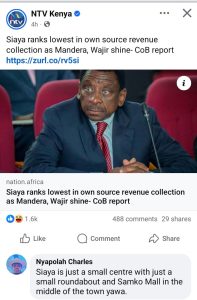
The figures are stark. While counties like Kisii, Tana River, Mandera and Kirinyaga overshot their revenue collection targets—some by more than 120 per cent—Siaya posted the lowest performance nationwide. The CoB data suggests weak enforcement mechanisms, lack of innovation in local revenue streams, and overreliance on external funding. More worryingly, Siaya’s fiscal underperformance mirrors a national pattern: Nairobi and Kisumu absorbed only 29 per cent of their development budgets, while Kisii and Nyamira managed less than 40 per cent.
For Siaya residents, the issue goes beyond statistics. With roads in disrepair, stalled health projects, and perennial water shortages, the revelation of poor fiscal discipline raises hard questions about accountability. Was the multimillion PR blitz designed to project an image of progress that the numbers do not support? Or does it reveal a government more committed to appearances than to the hard task of building local revenue bases and delivering services?
The Nation’s reporting—despite its commercial ties with Siaya—appears to have been grounded in fact and backed by official data. But the CoB’s report forces a deeper reflection: unless counties like Siaya rethink their fiscal strategies and prioritise development over recurrent expenditure, residents will continue to shoulder the cost of a government that spends more on sustaining itself than on transforming lives.
 ADVERT


