 ADVERT

 ADVERT
Bungoma Governor Kenneth Makelo Lusaka is not a man known for missteps. From the day he left the Provincial Administration to plunge into elective politics, Lusaka has nurtured a reputation as a shrewd political weatherman — always sniffing the direction of power before it shifts. His mantra, “I have never gone wrong”, now reverberates across the political terrain as Kenya tilts toward the 2027 elections.
Lusaka, whose two-term gubernatorial career will expire in 2027, is quietly positioning himself for a return to the national stage. Unlike other Western Kenya politicians haunted by divisive rivalries and failed gambles, Lusaka’s political trajectory has been a steady climb — from District Officer (DO) to Principal Secretary, from the Office of the President to the Ministry of Livestock, and finally as the first Governor of Bungoma under the 2010 constitutional order. He later transitioned to the Senate, before reclaiming his county’s top seat in 2022 under President William Ruto’s Kenya Kwanza coalition.
In a region where political careers are often undone by shifting loyalties, Lusaka has mastered the art of staying on the winning side. He has never antagonized key players, never burned bridges, and, crucially, never backed a losing ticket. This consistency, analysts say, has endeared him to State House operatives who value reliability over flamboyance.
“Lusaka is the kind of politician who knows when to step back and when to step forward. He is not loud, but he’s effective,” notes Dr. Charles Nyongesa, a political analyst at Masinde Muliro University. “That makes him one of the few Western leaders President Ruto could trust in the post-2027 succession game.”
Indeed, Lusaka has been a loyal cog in Ruto’s machinery, avoiding the pitfalls that have tripped other Mulembe leaders who oscillated between opposition camps. When he recently told a cheering crowd in Naitire that he had “never taken them to the opposition and never gone wrong”, it was more than a joke — it was a statement of intent.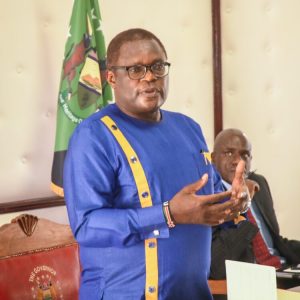
 ADVERT
President William Ruto is widely tipped to secure a second term. His ongoing political détente with opposition chief Raila Odinga under the “broad-based government” arrangement is seen as neutralizing major threats. The power of incumbency, state machinery, and coalition arithmetic all tilt in his favor.
If Ruto wins, the 2027–2032 political cycle will revolve around succession planning. Western Kenya, historically marginalized in presidential politics, could suddenly find itself in contention. Farouk Kibet, Ruto’s powerful aide, has already hinted that the Luhya region should “inherit the presidency” after Ruto exits. That statement has triggered speculation — and Lusaka’s name has surfaced prominently in those conversations.
As his gubernatorial tenure winds down, Lusaka has several national options: a Cabinet slot, a speakership, even the deputy presidency. But analysts whisper of a bigger possibility — a carefully crafted succession plan in which Lusaka, untainted by scandal and boasting a pan-Kenyan profile, becomes Ruto’s chosen heir.
At home in Bungoma, Lusaka has leaned heavily on development to reinforce his credibility. His administration boasts of upgrading over 50,000 kilometers of roads, revamping early childhood education with feeding programs, equipping health facilities with essential drugs, and initiating anti-corruption reforms in county staffing.
“My administration has no time for corrupt officers. Anyone involved will be shown the door,” Lusaka declared recently while reshuffling senior officials. Such pronouncements have bolstered his image as a disciplined technocrat rather than a patronage politician.
His developmental record, coupled with his reputation for humility, has earned him the title of “political father figure” among many in the Mulembe nation. Unlike some contemporaries dogged by graft cases or divisive rhetoric, Lusaka enters the succession debate relatively baggage-free.
Yet, Kenyan politics is never linear. For Lusaka to emerge as a national contender, several hurdles remain. First is the entrenched rivalry among Western leaders — Moses Wetang’ula, Musalia Mudavadi, and a younger crop of ambitious MPs. Second is the reality that Ruto may prefer a deputy from Mt. Kenya or Rift Valley to secure his base.
Still, Lusaka’s advantage lies in being non-combative, reliable, and acceptable across divides. He may not be the loudest Mulembe politician, but he could easily be the compromise candidate — the man everyone rallies behind when the dust settles.
As 2027 approaches, Kenneth Lusaka will be watched closely. Whether as Cabinet Secretary, Speaker, Deputy President, or even Ruto’s heir-apparent, his political journey is far from over. His confidence in predicting Ruto’s second term is not idle bravado but a continuation of a career built on calculated moves and uncanny political timing.
The question now is not whether Lusaka has “never gone wrong” — but whether his shrewd instincts can carry him from Bungoma to the highest echelons of power in Nairobi after Ruto’s reign.
And if history is any guide, dismissing Lusaka’s quiet ambition may itself be the biggest political mistake of all.


