 ADVERT

Cabinet Secretary James Wandayi Opiyo, at the helm of Kenya’s Energy and Petroleum docket, hosted His Excellency Joshua Tabah, Canada’s Ambassador to Kenya, in a meticulously orchestrated high-level engagement at his Nairobi office—an encounter that set the tone for a potentially transformative phase in bilateral cooperation. The meeting unfolded in an atmosphere of mutual respect and forward-looking pragmatism, marked by extended deliberations, technical briefings, and candid exchanges. At its core was a shared recognition that renewable energy cooperation is no longer optional but central to economic resilience, climate adaptation, and inclusive development. While Kenya and Canada have long enjoyed cordial relations anchored in development cooperation, this dialogue elevated diplomatic goodwill into a structured pathway toward tangible, mutually beneficial outcomes.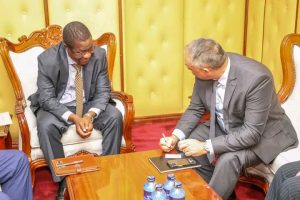
From the outset, CS Wandayi framed the discussion with a comprehensive overview of Kenya’s evolving energy landscape. He outlined the country’s impressive renewable portfolio—anchored in geothermal, wind, and solar—while candidly acknowledging systemic gaps that threaten sustainability gains. Issues of energy storage, grid stability, rural access, and financing constraints featured prominently. Ambassador Tabah responded by situating Canada as a partner with deep technical experience rather than a distant donor, drawing on Canada’s hydroelectric dominance, advanced battery research, and emerging green hydrogen capabilities. The exchange set a collaborative tone, emphasizing peer learning, co-investment, and long-term capacity building over short-term interventions.
The dialogue revealed a nuanced appreciation of Kenya’s strengths and limitations. CS Wandayi highlighted the country’s geothermal supremacy, citing Olkaria’s more than 800 megawatts of installed capacity and its role as a regional benchmark. He also referenced the 310-megawatt Lake Turkana Wind Power Project, Africa’s largest, as evidence of Kenya’s ambition and technical competence. Yet he was equally forthright about challenges: the intermittency of solar energy after dusk, seasonal wind variability, and the geological and financial barriers that slow geothermal expansion. These realities, he noted, complicate the quest for universal, affordable, and reliable energy.
Ambassador Tabah countered with Canada’s practical lessons in managing similar constraints. He detailed how Hydro-Québec supplies over 60 percent of the province’s electricity through hydropower, ensuring grid stability at scale. He shared insights from Canadian battery laboratories pioneering lithium-iron-phosphate technologies designed to stabilize renewable-heavy grids, and described pilot green hydrogen plants in British Columbia that convert surplus renewable power into dispatchable energy. These examples, he suggested, could be adapted to Kenya’s context to smooth variability and unlock new industrial uses for clean energy.
As discussions deepened, the meeting took on a distinctly technical character. Maps of Siaya County’s solar-rich lakeside zones were reviewed as both delegations explored the feasibility of hybrid micro-grids to address chronic blackouts affecting fish processing and cold-chain storage. Financing models blending Export Development Canada loans with Kenya’s growing green bond market were examined as mechanisms to de-risk private investment. Rural electrification, still lagging in parts of western Kenya where farmers remain dependent on costly diesel generators, emerged as a shared priority. The environmental and fiscal toll of petroleum imports—running into billions of shillings annually—prompted parallel conversations on biofuels, electric mobility, and just transition pathways.

The meeting concluded with agreement on immediate, actionable next steps. Both parties committed to developing a memorandum of understanding to formalize cooperation, including structured exchanges of engineers and policy experts. A joint technical task force was proposed to translate policy intent into time-bound deliverables, ensuring that commitments would not dissipate into diplomatic abstraction. The symbolism of the final handshake was matched by the substance of agreed timelines and institutional responsibility.
Canada’s suitability as a strategic partner was reinforced by the granularity of its contributions. Data from Natural Resources Canada on indigenous-led wind cooperatives illustrated models that could be adapted to Kenya’s Maasai rangelands or Luo fishing communities, aligning energy development with local ownership. The delegations explored the idea of joint research hubs focusing on solar-hydrogen hybrids tailored to humid, lakeside environments, where climate stress threatens livelihoods without reliable energy for preservation and value addition. Capacity-building proposals included annual training of hundreds of Kenyan technicians at Canadian universities and embedded placements for Kenya Power engineers to gain hands-on experience with smart grids and AI-driven demand forecasting.
Both sides were careful to build on precedent rather than theory. Ambassador Tabah referenced Canada’s support for the Kipeto Wind Power Project, which generated thousands of local jobs through robust local-content requirements, and earlier agricultural technology partnerships that boosted productivity in Kenya’s Rift Valley. Importantly, discussions moved beyond aid toward investment. Canadian pension funds, attracted by Kenya’s green bond yields, were cited as potential anchors for long-term financing. CS Wandayi’s probing questions on technology transfer and intellectual property protections elicited assurances of co-ownership arrangements, reinforcing the principle of equitable partnership.
The implications of this cooperation extend beyond national energy metrics into the realm of public service reform and devolution. CS Wandayi underscored that centralized energy planning has historically marginalized county-level priorities, a gap this partnership could help bridge. Canadian models of indigenous participation offered templates for county-driven solar cooperatives in areas such as Uyoma and Bondo, with the potential to electrify markets, stabilize fish exports, and create installation and maintenance jobs for youth. In a region grappling with high unemployment, such localized energy solutions could catalyze broader economic revival.
Equally significant was the emphasis on a just transition. As Kenya explores electric mobility and low-carbon alternatives, safeguards for workers in fossil-fuel-dependent sectors were discussed, including retraining programs inspired by Canada’s own transition frameworks. Carbon markets and forest conservation also entered the conversation, with Canada’s cap-and-trade experience informing Kenya’s ambitions to monetize forest carbon while strengthening environmental stewardship. Transparency and accountability mechanisms—ranging from open procurement to performance metrics tracking megawatts delivered per shilling spent—were framed as non-negotiable pillars of the partnership.
Skeptics may argue that such high-level engagements often fail to touch ordinary lives, yet the Kenya–Canada record suggests otherwise. From pandemic-era medical equipment to investments in health facilities and agricultural processing, bilateral cooperation has previously delivered tangible benefits. Renewable energy, the delegations agreed, directly addresses everyday challenges: failed cold storage that undermines fish exports, unreliable power that constrains small enterprises, and rising fuel costs that burden households. If executed with discipline, the partnership could accelerate Kenya’s march toward 100 percent renewable energy, cut millions of tonnes of carbon emissions, and attract billions of dollars in green investment.
Looking ahead, both sides acknowledged that momentum must be institutionalized. Proposals included quarterly task-force reviews jointly overseen by the Ministry of Energy and Global Affairs Canada, a six-month pilot of a 50-megawatt solar project in Siaya supported by blended financing, and ring-fenced funding subject to parliamentary oversight. Regional export opportunities to Uganda and Tanzania were also flagged, positioning Kenya not only as a consumer but as a clean-energy hub for East Africa.
In sum, the dialogue between Cabinet Secretary James Wandayi Opiyo and Ambassador Joshua Tabah marks a pivotal moment in Kenya–Canada relations. Against a backdrop of climate volatility, rising inequality, and urgent development needs, the meeting illuminated a path where technical expertise, political will, and shared values converge. If sustained, this renewable energy alliance has the potential to power homes, transform livelihoods, and position Kenya as a continental leader in the green transition—turning diplomatic conversation into lasting, sustainable prosperity.


