 ADVERT

 ADVERT
In a political twist few saw coming, President William Ruto has been symbolically crowned the Luo political kingpin—a move that is already sending shockwaves through Orange Democratic Movement (ODM) politics and threatening the survival instincts of its loudest belligerents.
The decision by the Luo Council of Elders to anoint Ruto as an elder of the community, while designating Oburu Odinga as the official Luo spokesperson and a key ODM figure, has fundamentally reordered the political chessboard of Luo Nyanza. In one decisive stroke, the Council clipped the wings of ambitious power brokers and placed Ruto squarely at the centre of Luo politics heading into the 2027 General Election.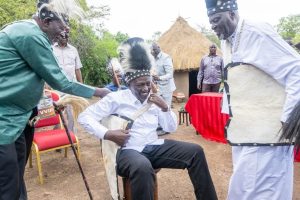
For seasoned politicians such as Governor James Orengo and Nairobi Senator Edwin Sifuna, the coronation presents an existential dilemma. Long accustomed to positioning themselves as ideological purists and internal power centres, they may now be forced to recalibrate—or risk political extinction.
Ruto’s elevation carries deeper historical irony: he is a founding member of the ODM Party. That pedigree, now reinforced by cultural legitimacy from the Luo Council of Elders, gives him a unique claim over a political space previously considered impregnable to outsiders.
The message was reinforced when President Ruto openly declared—without equivocation—that both before and after 2027, he intends to construct a broad-based political alliance between ODM and his United Democratic Alliance (UDA). In political terms, that statement effectively settled the debate.
 ADVERT
ODM heavyweights such as Energy CS Opiyo Wandayi, National Treasury CS John Mbadi, Alego Usonga MP Samuel Atandi, and Homa Bay Governor Gladys Wanga—each angling for kingpin status—were left politically flat-footed. The Council’s move abruptly ended that succession contest before it could even mature.
Ruto had already fired an earlier warning shot during Jamuhuri Day celebrations by announcing the renaming of Talanta Stadium after Raila Odinga. The gesture not only honoured Raila’s legacy but also neutralised alternative power centres seeking to inherit his political mantle.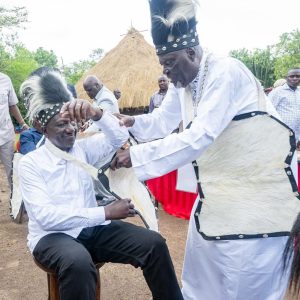
All signs now point to one conclusion: President Ruto effectively commands the Luo political space. Insiders indicate that Luo politics heading into 2027 will largely revolve around him, with expectations that he will personally choreograph the political lineup and introduce a new generation of loyalists.
Notably, Ruto has publicly observed that many Luo politicians who trail him noisily lack genuine grassroots backing, instead relying on self-promotion and elite bargaining. His assessment appears informed by hard electoral data.
Recent by-elections in Kasipul and Ugunja delivered a sobering lesson. Low voter turnout exposed deep voter apathy and revealed that political mobilisation in Luo Nyanza remains fragile. To Ruto, the message was clear: significant groundwork is still required to convert symbolic support into actual votes.
In that context, figures such as Wandayi, Wanga, Atandi, Mbadi, and others appear politically insufficient to deliver the grassroots machinery needed for a decisive 2027 outcome.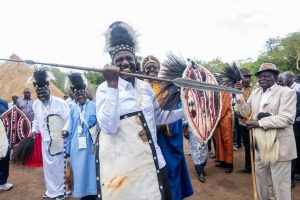
With the blessing of the Luo Council of Elders, the strategic endorsement of Raila Odinga’s legacy, and a declared ODM–UDA alliance, President Ruto has pulled off what many thought impossible: positioning himself as the uncontested arbiter of Luo politics.
As the dust settles, one reality is unavoidable—ODM’s internal power brokers must either align with the new kingpin or risk being rendered politically irrelevant. The Luo political succession battle is over. And William Ruto, improbably but decisively, has won it.


