 ADVERT

 ADVERT
Cabinet Secretary for Energy and Petroleum James Wandayi Opiyo joined H.E. Governor Gladys Wanga at the Homa Bay County Headquarters for a high-level consultative meeting with the Luo Council of Elders, led by National Chairperson Ker Odungi Randa. What unfolded was a compelling demonstration of collaborative governance—where national policy, county ambition, and traditional authority aligned around a shared development agenda. More than 50 stakeholders, including county executives, energy experts, elders, and community representatives, filled the modern lakeside complex overlooking Lake Victoria, a fitting backdrop for a conversation rooted in heritage yet focused firmly on the future.
The venue itself symbolized the fusion at play. Murals celebrating Luo culture lined the walls beside digital dashboards displaying county development metrics, reflecting a devolution model that respects identity while embracing innovation. CS Wandayi arrived to a warm welcome of traditional Luo drumbeats and elders in ceremonial regalia. His entrance was marked by a respectful bow to Ker Randa—an early signal that cultural authority would be central to the day’s deliberations. He opened candidly, acknowledging Nyanza’s persistent energy deficits and presenting national data on overloaded power lines, while pledging cabinet-level intervention to stabilize Homa Bay’s grid.
Over the next three hours, the meeting evolved into a robust exchange. Ker Odungi Randa articulated community priorities with measured urgency, highlighting unreliable power at more than 200 fish landing sites where outages force traders to discard fish worth an estimated KSh 50 million weekly. He also pressed for targeted youth programs to equip nearly 20,000 unemployed graduates with solar installation skills in a region grappling with youth unemployment rates approaching 70 percent. Members of the elders’ National Executive Committee—representing sub-clans from Mbita to Ndhiwa—added granular insights, identifying 15 off-grid hamlets in need of mini-grids and invoking Luo proverbs on communal stewardship to frame sustainability.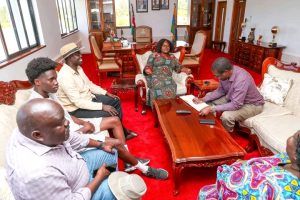
Governor Wanga anchored the discussion with her hallmark inclusivity and data-driven leadership. Using the county’s e-governance platform, she circulated a live digital agenda that ensured every voice—elder, technocrat, or community representative—was heard. She referenced the “Homa Bay Model,” noting that 5,000 women organized in cooperatives already process 30 percent of local fish production, a figure that could triple with reliable 24-hour cold storage powered by stable electricity.
CS Wandayi responded with concrete proposals rather than platitudes. He outlined plans for 10MW solar mini-grids under the Last Mile Connectivity Project, a proposed 100-kilometer transmission line linking Homa Bay to Olkaria’s geothermal power, and accelerated incentives under the Bottom-Up Economic Transformation Agenda to attract private solar firms by mid-2026. Ker Randa emphasized that development must honor cultural safeguards, calling for elder-led environmental audits and protection of sacred landing beaches. Governor Wanga bridged these positions, proposing hybrid public–private partnerships where county land would host solar farms in exchange for prioritized power supply to women’s groups and youth TVET centers.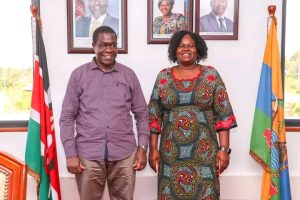
 ADVERT
Beyond the formal agenda, side discussions buzzed with energy. Engineers sketched feasibility ideas on notepads, elders negotiated apprenticeship quotas to guarantee at least 40 percent local employment, and policy aides drafted preliminary memoranda of understanding. The meeting culminated in a symbolic moment: Wandayi, Wanga, and Randa clasped hands over a solar panel during a joint photo-op, a visual testament to unity in a political climate often defined by division.
By early afternoon, the outcomes were tangible. CS Wandayi committed to fast-tracking KSh 2 billion in rural electrification funding and to convening a national–county energy taskforce by January 2026. The Luo Council of Elders pledged to anchor youth skilling programs that blend traditional fishing knowledge with modern technology, while overseeing sustainable fisheries through community-enforced conservation zones. Governor Wanga, in turn, committed 15 percent of her KSh 12 billion 2025/26 county budget to energy co-financing, linking reliable power to expanded digital services and the growth of women-led enterprises from KSh 1.2 billion to a projected KSh 4 billion in annual turnover.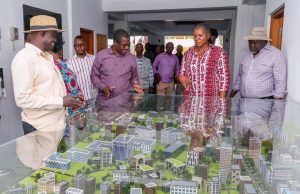
As participants shared a working lunch of lake-fresh tilapia, informal agreements crystalized into action plans: bi-weekly technical meetings, elder participation in project monitoring via a dedicated council dashboard, and joint advocacy for timely national treasury disbursements. County engineers departed with direct cabinet-level contacts, elders carried draft MOUs defining their oversight roles, and the governor’s team moved swiftly to integrate solar targets into the county’s 100-day devolution scorecard.
What transpired at Homa Bay County Headquarters stands as a vivid illustration of devolution’s promise under Article 174 of the Constitution. A cabinet secretary listening to folktales of resilient fishing communities, a governor translating tradition into enforceable policy, and a council of elders stepping forward as development partners—this was governance as a living partnership. In a nation still navigating ethnic and political fault lines, Homa Bay offered a different script: listen deeply, commit boldly, and deliver together.


