 ADVERT

 ADVERT
James Wandayi, Cabinet Secretary for Energy and Petroleum, was recently invited by Rongo Constituency MP Hon. Paul Abuor to officially open the newly constructed Kanyimach Secondary School in South Kamagambo Ward, Rongo Constituency. The state-of-the-art institution, developed under the NG-CDF patronage of Hon. Abuor, now stands fully connected to the national electricity grid through the Ministry of Energy and Petroleum. This achievement marks a pivotal moment in rural infrastructure synergy, where constituency-level investment aligns seamlessly with national energy policy.
Far from a routine ribbon-cutting ceremony, the opening of Kanyimach Secondary School symbolizes the practical fusion of devolved funding and central government execution. It directly advances President William Ruto’s Bottom-Up Economic Transformation Agenda under the banner of #PoweringTheNewKenya. In Migori County, where public schools have historically struggled with limited infrastructure and unreliable energy access, this project elevates education from mere survival to a pathway toward excellence. Fully powered classrooms, science laboratories, and dormitories now provide students with the tools needed to compete in Kenya’s increasingly digital economy.
The backstory of Kanyimach Secondary School reflects the careful planning and determination behind its success. South Kamagambo Ward, located in Migori’s agrarian heartland, has long grappled with challenges common across post-devolution rural Kenya: overcrowded primary schools, a lack of nearby secondary institutions, and near-total absence of electricity. Students previously relied on dim paraffin lamps, exposing them to fire hazards and health risks from toxic fumes. These conditions severely constrained learning outcomes and perpetuated intergenerational poverty.
Hon. Paul Abuor, elected in 2022 on a platform centered on educational equity and grassroots development, made education a top priority. From an annual NG-CDF allocation exceeding KSh 100 million, he committed approximately KSh 45 million from education bursary and infrastructure envelopes to establish Kanyimach Secondary School. Construction took 18 months and resulted in a modern institution equipped with ICT-enabled classrooms, a fully furnished science block, administrative offices, and sanitation facilities compliant with the Basic Education Act.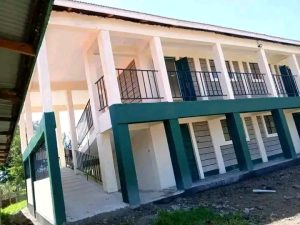
The NG-CDF framework, governed by the 2015 Act, requires at least 40 percent of funds to be directed toward education and security. This safeguard ensures community-driven priorities rather than political expediency. Abuor’s locally constituted NG-CDF committee oversaw transparent procurement and implementation, avoiding the corruption and inefficiencies that plagued earlier iterations of the Constituency Development Fund.
 ADVERT
Grid connectivity from the Ministry of Energy and Petroleum completed the transformation. Under Wandayi’s leadership, Kenya Power extended a 33kV medium-voltage line over five kilometers from the nearest substation. The project included transformers, metering infrastructure, and prepaid institutional systems. Subsidized at 75 percent through the ministry’s KSh 10 billion rural electrification program, the connection cost approximately KSh 8 million and delivers stable 240-volt power. To mitigate outages common during Nyanza’s rainy seasons, backup solar installations were incorporated into the design.
Migori County has since achieved an estimated 76 percent electricity penetration across more than 250 public schools and health facilities, a sharp increase from 42 percent in 2022. According to Kenya Power audits, this includes 180 fully electrified secondary schools, over 400 primary schools, and 50 health dispensaries. The remaining 24 percent are scheduled for connection by mid-2026, largely through off-grid solar and mini-grid solutions. This progress is already yielding tangible academic benefits, as Ministry of Education studies indicate that electrified schools record 15 to 20 percent higher KCSE mean scores due to extended study hours, access to digital resources, and improved teaching methods.
The Kanyimach milestone also underscores the evolution of NG-CDF as a credible instrument of devolution. While pre-2010 CDFs were marred by inefficiencies—losing up to 30 percent of funds to stalled or ghost projects—reforms such as electronic disbursement systems and mandatory public participation have reduced leakages to below 5 percent. Abuor’s broader development record in Rongo, which includes three secondary schools, two vocational polytechnics, and multiple water projects, demonstrates how accountable leadership can translate funds into visible impact.
Wandayi’s ministry has amplified these gains through the Last Mile Connectivity Project, which has received a KSh 27 billion allocation since 2023. Schools are deliberately prioritized as “anchor loads,” making grid expansion economically viable while catalyzing wider community connections. In Migori County—home to approximately 1.2 million people and marked by nearly 80 percent rural poverty—electrified institutions now support powered boreholes producing up to 20,000 liters of water daily, cold storage for dairy cooperatives, and vocational hubs offering training in welding, electrical installation, and basic coding. These interventions directly confront the county’s 35 percent youth unemployment rate.
Beyond infrastructure, the ripple effects are social and economic. Electrified schools like Kanyimach facilitate blended learning through platforms such as Eneza Education, narrowing the educational divide between urban centers and rural communities. In Migori’s agriculture-driven economy, classrooms now double as innovation hubs, hosting demonstrations on solar-powered fruit dryers, irrigation technologies, and data-driven farming techniques. Health outcomes improve as powered laboratories enable malaria diagnostics, while adult evening classes held at school facilities contribute to an estimated 12 percent increase in household incomes, according to World Bank assessments.
At the national level, Kenya’s school electrification rate has climbed from approximately 52 percent to 78 percent under the current administration, reversing a decade of stagnation. This expansion aligns with rising school enrollment and retention rates. Challenges remain, including infrastructure vandalism and gaps in teachers’ digital skills, but local solutions—such as proposed security allocations and targeted teacher training through the Teachers Service Commission—suggest a proactive approach to sustainability.
Wandayi’s presence in Migori also carries symbolic weight. His engagement in a predominantly Luo region reflects a maturing political culture that prioritizes service delivery over ethnic divisions. Such cross-regional cooperation strengthens national cohesion and reinforces public confidence in development-oriented leadership.
For the energy ministry, Migori’s progress validates a strategic shift toward hybrid electrification models, where grid connections are complemented by solar solutions to reduce transmission losses and enhance reliability.
Ultimately, Kanyimach Secondary School stands as a powerful illustration of what is possible when constituency leadership and national policy work in concert. It embodies the promise of #PoweringTheNewKenya: that targeted investment, transparent governance, and reliable energy can transform rural education and unlock human potential. From the fields of South Kamagambo to Kenya’s broader economic ambitions, lighting classrooms today is powering the nation’s future.


