
 ADVERTISEMENT
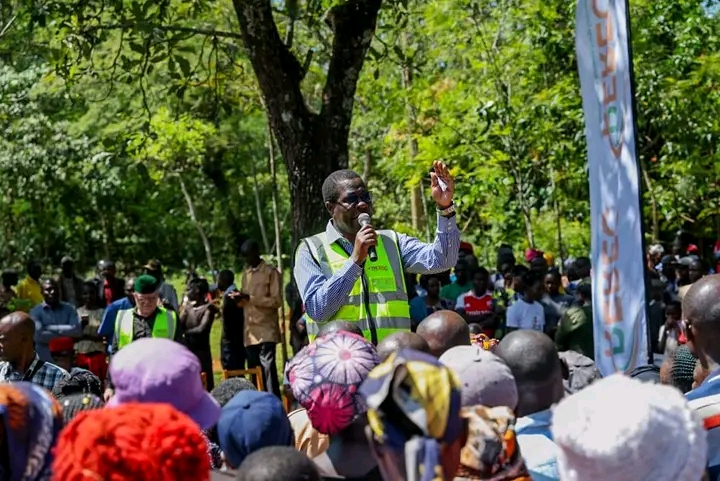
 Cabinet Secretary James Wandayi was in Bungoma County’s Webuye East Constituency to commission vital projects under the Government of Kenya’s Last Mile Connectivity Program (LMCP), while sensitizing wananchi on transformative energy development plans. This hands-on engagement was not mere ceremony; it embodied a profound commitment to electrifying Kenya’s rural underbelly, where darkness has long symbolized exclusion from national progress.
In Webuye East’s rolling hills, Wandayi flipped switches that lit up homes, schools, and markets, signaling the Kenya Kwanza government’s resolve to extend reliable power to the last mile. This act carried symbolism far beyond illumination. It affirmed energy as the lifeblood of bottom-up development and positioned Bungoma as a model for how targeted interventions can unlock human potential, spur agro-industrial growth, and narrow the persistent urban-rural divide.
At its core, Wandayi’s visit spotlighted the LMCP’s role in dismantling long-standing barriers to opportunity. Families once dependent on kerosene lamps and firewood now harness electricity for refrigeration, grain milling, and value addition. Small enterprises processing Bungoma’s famed maize and sugarcane are emerging, transforming subsistence livelihoods into income-generating ventures.
Anchored within President William Ruto’s Bottom-Up Economic Transformation Agenda (BETA), the LMCP prioritizes remote households historically sidelined from infrastructure planning. In Webuye East, new connections now allow farmers to irrigate at night, youth to launch digital enterprises, and women to escape the time-consuming burden of fuel gathering. Energy and Petroleum Regulatory Authority (EPRA) data indicating that over 40 percent of rural Kenyans remain off-grid underscores the program’s significance.
Beyond infrastructure, Wandayi’s sensitization forums converted wananchi from passive recipients into informed stakeholders. By demystifying expansion plans—ranging from solar mini-grids to geothermal scaling—he framed energy as a shared national project. For Bungoma, these plans promise an agro-processing boom, job creation, and long-term economic self-sufficiency.
Wandayi’s leadership also carried political nuance. As a senior ODM figure working within the Kenya Kwanza administration and a former Ugunja MP, his choice of Bungoma was symbolically potent. The county remains both economically vital and historically marginalized, serving as a cornerstone of national food security while grappling with youth unemployment and underinvestment.

Here, electricity becomes a catalyst for transformation. Reliable power enables agro-industries, digital hubs, and clean-tech startups, converting demographic pressure into productive capacity. By linking energy development to Vision 2030 enablers such as Olkaria geothermal expansion and emerging gas prospects, Wandayi framed power as the backbone of industrialization rather than a standalone utility.
The numbers reinforce this narrative. Since 2022, over 500,000 households have been connected nationally, with Bungoma contributing hundreds through phased implementation. This devolved, inclusive approach not only accelerates development but also mends political and regional divides, demonstrating how equitable governance can strengthen national cohesion.
Still, challenges remain and demand vigilance. Kenya’s dependence on hydroelectric power exposes the grid to climate volatility, while Independent Power Producer (IPP) debts and infrastructure constraints strain the system. As Bungoma’s newly sensitized residents celebrate connection, they are also positioned to hold leaders accountable to the government’s 2026 pledge of universal electricity access.
Affordability is another pressing concern. While subsidies reduce connection costs, sustaining usage requires innovative billing models such as pay-as-you-go systems to shield low-income households from bill shocks. This will test Kenya Power’s adaptability and commitment to inclusive service delivery.
With the 2027 elections on the horizon, Wandayi faces the task of elevating energy equity above partisan competition. The hopeful cheers in Webuye East represent more than political goodwill; they form a social contract that demands continuity, transparency, and results.
The broader implications are compelling. Rural electrification is catalyzing a renaissance in human capital. Youth groups mobilized through initiatives like TUTAM are experimenting with biomass energy, electric mobility, and green entrepreneurship, while women scale micro-enterprises once constrained by darkness and distance.
Devolution further amplifies impact as counties like Bungoma integrate local content into national energy plans. In doing so, Kenya positions itself as a continental leader in geothermal exports, reducing fuel imports and advancing climate resilience. Wandayi’s candid engagement with communities exemplifies the transparent governance required to sustain this trajectory.
In the end, Wandayi’s walk to the last mile distills the essence of sustainable progress. The glow spreading across Webuye East is both literal and symbolic—a reminder that development, when rooted in equity and participation, can illuminate the path toward a more prosperous and united Kenya.
James Kilonzo Bwire is a Media and Communication Practitioner.


