
By James Bwire
Cabinet secretary of Energy and Petroleum James Wandayi has once again demonstrated the government’s commitment to transforming the lives of ordinary Kenyans through practical and people-centered leadership. Earlier today, as part of the nationwide effort focused on extending access to grid electricity to underserved rural homes and businesses, Wandayi undertook an extensive tour of Bomet County to launch several Last Mile Connectivity Projects. His presence in the county was more than symbolic; it represented a clear statement that rural communities remain central to Kenya’s development agenda and that access to energy is a foundational pillar of inclusive growth.
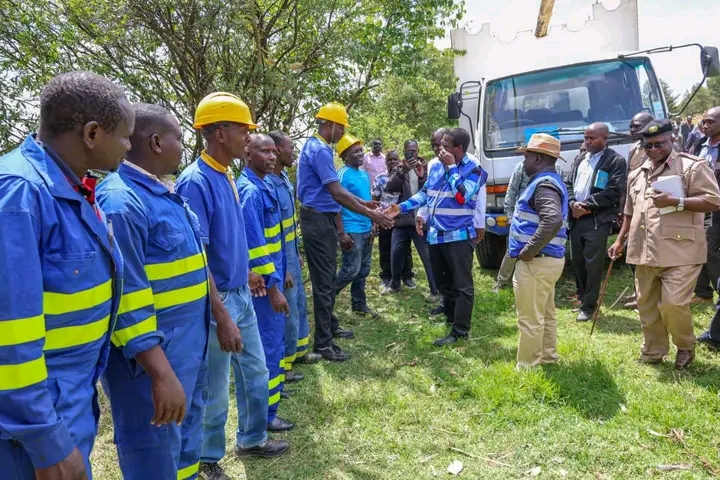
Accompanied by Area MP Hon. Richard in Bomet East Constituency, Wandayi began his engagements in Koita Village, Kikeres Ward, where he unveiled and flagged off construction materials for the Koita Last Mile Connectivity Project. This moment carried deep significance for residents who have waited years for reliable electricity. The launch signaled a shift from promises to action, offering renewed hope to households and small businesses that have long operated on the margins of the national grid. From Koita, Wandayi proceeded to Kembu Village in Kembu Ward and later to Bukunye Primary School in Chemaner Ward, where he officially groundbroke the Kembu and Bukunye LMCP projects being implemented by Kenya Power and Lighting Company. These initiatives underscored the government’s focus on connecting not only homes, but also key social institutions such as schools, which are vital to community development.
The visit continued in Bomet Central Constituency, where Wandayi was joined by Area MP Hon. Richard Kilel to launch the Chemamul Teri Dairy Center LMCP Project in Chesoen Ward. This project stood out for its direct link to the local economy, particularly dairy farming, which is a mainstay of livelihoods in the area. Reliable electricity at the dairy center is expected to improve milk handling, reduce post-harvest losses, and increase farmers’ incomes, demonstrating how energy access can directly strengthen rural economies. From Chesoen, the Cabinet Secretary proceeded to Cheboigong Village within Silibwet Township Ward, where he launched another LMCP project and engaged the wananchi in an open public forum. This interaction allowed residents to voice their expectations and reaffirmed the importance of citizen participation in development initiatives.
The Energy Ministry are making steady progress towards universal accessibility targets, and the activities witnessed in Bomet County provide tangible evidence of this momentum. The Last Mile Connectivity Projects are not isolated undertakings but part of a broader national vision to ensure that no Kenyan is left behind in the energy transition. For communities like those in Koita, Kembu, and Cheboigong, electricity means more than lighting homes; it opens doors to entrepreneurship, improves access to information, enhances security, and raises overall living standards. Schools such as Bukunye Primary stand to benefit from improved learning environments, while health facilities and water projects can operate more efficiently with stable power supply.
Beyond the immediate benefits, Wandayi’s hands-on approach sends a powerful message about accountability and delivery. By personally flagging off materials, breaking ground, and engaging residents, the Cabinet Secretary reinforced confidence in public institutions and placed responsibility squarely on implementing agencies to deliver results. The involvement of local leaders ensured that national policies were grounded in local realities, increasing the likelihood that projects would be protected, utilized, and sustained by the communities they are meant to serve.
The tour of Bomet County highlighted the broader truth that rural electrification is a catalyst for dignity, equity, and opportunity. It reflects a development model that recognizes energy as a basic enabler of social and economic transformation rather than a privilege for a few. As Kenya continues to pursue its universal electricity access goals, the experiences from Bomet offer a clear lesson: progress is most meaningful when it reaches the last mile and touches everyday lives.
In the end, the launches in Koita, Kembu, Bukunye, Chemamul Teri, and Cheboigong symbolize more than infrastructure development; they mark a renewed social contract between the state and its citizens. James Wandayi’s visit reaffirmed that effective leadership is visible, engaged, and responsive. As construction begins and connections are made, the people of Bomet County stand at the threshold of new possibilities, illuminated by the promise that development, when thoughtfully implemented, can indeed reach every corner of the nation.
James Kilonzo Bwire is a Media and Communication Practitioner.