
 ADVERTISEMENT
 In a developing political controversy swirling across Kenya’s social media landscape, a decades-old dismissal letter allegedly detailing Rigathi Gachagua’s firing as a District Officer for mismanaging relief food has resurfaced — reigniting long-standing disputes over his early career and political legacy.
The document, purportedly dated 30th July 1997 and signed off by the President’s Office, states that District Officer 1 Rigathi Gachagua was summarily dismissed for “desertion of duty and reported mismanagement of relief food for Laikipia district.” It directs him to report to the Rift Valley Provincial Commissioner for handover and clearance, effectively terminating his employment immediately.
That letter — widely circulated across WhatsApp, TikTok, X and Facebook this week — has become the latest flashpoint in Kenya’s fractious political battles, with critics seizing on it to question Gachagua’s suitability as a national leader and potential 2027 presidential contender.
The resurfacing of the dismissal document comes amid heightened political tension, especially after former Gachagua aide Martha Miano publicly accused him on social media of stealing relief food during his civil service days — a claim that quickly went viral and intensified debate online.
Political opponents, bloggers and sections of the public have amplified the narrative, citing past statements from government officials like former Interior PS Karanja Kibicho, who has in the past asserted that Gachagua was sacked — not resigned at his own will — for mismanaging relief supplies in the 1990s.
These historical claims have resurfaced at a time when Gachagua, now leader of the Democracy for Citizens Party (DCP) after being impeached as Deputy President in 2024, remains an active and polarising force in Kenyan politics. His frequent public grievances — including letters to police leadership alleging threats of violence and claims of political victimisation — have kept him in the national spotlight.

Supporters of President William Ruto’s United Democratic Alliance (UDA) have been eager to highlight the dismissal letter to undermine Gachagua’s credibility, framing it as part of a pattern of historical misdeeds linked to his public service tenure and political conduct. Meanwhile, Gachagua’s backers dismiss the renewed focus on the letter as an orchestrated smear campaign aimed at derailing his political resurgence.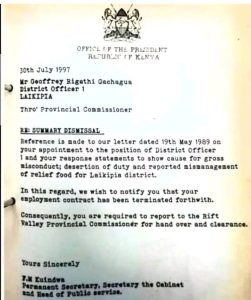
Critics argue that if the allegations were credible, they would have been subject to formal investigation or legal scrutiny long ago. Supporters counter that decades-old administrative discipline matters should not define a contemporary politician.
This controversy underscores how historical records and old administrative disputes can be weaponized in modern political discourse — especially in closely contested regions and in the run-up to major elections. The digital age has magnified the impact of archival documents and past accusations, allowing them to influence present-day reputations and political calculations.
Whether the dismissal letter will have any lasting impact on Gachagua’s political fortunes is uncertain. But in an era of heightened political sensitivity, even allegations from more than 25 years ago are proving potent fodder for contention, dialogue and division across Kenya’s vibrant online and broadcast media ecosystems.
Note: The accuracy and authenticity of the letter in circulation have not been independently verified by mainstream news outlets at the time of writing. Readers are encouraged to approach historical documents with caution and consider corroboration from credible sources where available.


