
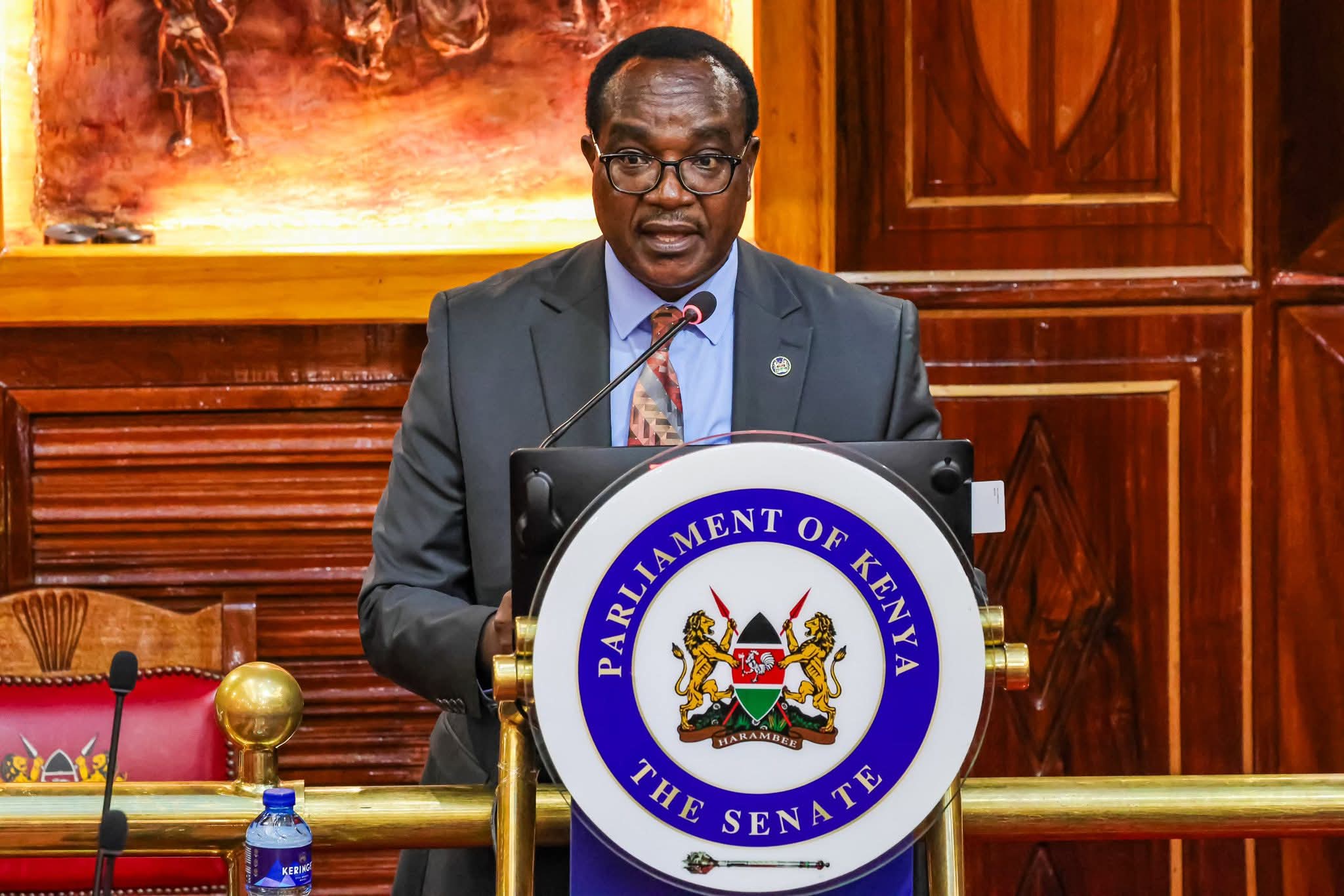
The Cabinet Secretary for Education, Julius Migos Ogamba, on Wednesday faced tough questions in the Senate over the management of Junior Schools, the credibility of the 2025 Kenya Junior School Education Assessment (KJSEA) results, and the progress of government-backed talent development programmes across the country.
Appearing before the Senate plenary at Parliament Buildings, the Education CS responded to queries raised by Edwin Sifuna (Nairobi) and Tom Ojienda (Kisumu), who sought clarity on the administration of Junior Schools within primary institutions, allegations of possible manipulation of KJSEA results, and the status of co-curricular development programmes in Kisumu County.
Addressing concerns about where Junior Schools should be domiciled, Ogamba said the government’s decision to host them within existing primary schools was informed by extensive public consultations conducted by the Presidential Working Party on Education Reform.
According to the CS, about 93 percent of stakeholders who submitted views supported the idea of locating Junior Schools within primary school compounds, with only a minority proposing their transfer to secondary schools or the creation of standalone institutions.
Ogamba explained that placing Grade Seven to Nine learners in primary school environments is both practical and beneficial to learners’ wellbeing.
“Psychosocial considerations, logistical efficiency and cost implications all pointed to the need to integrate Junior Schools within existing primary school infrastructure,” he told senators.
He noted that classrooms previously occupied by upper primary classes provide an immediate solution, avoiding the heavy cost of constructing entirely new facilities nationwide.
Under the current framework, both primary and Junior Schools operate under a single Head of Institution and a unified Board of Management to ensure streamlined governance and a smooth academic transition for learners.
The CS also clarified concerns about the existence of separate financial accounts for Junior School operations.
He said the arrangement does not mean that Junior Schools operate independently but is necessary to manage different government capitation allocations.
While primary school learners receive about Sh1,420 per year, Junior School learners are funded at Sh15,042 annually, requiring distinct accounting systems to enhance financial planning, transparency and accountability.
On teacher management, Ogamba told the Senate that all teachers deployed to Junior Schools are trained graduate educators qualified to handle the Competency-Based Education curriculum.
He added that the educators fall under the Secondary School Career Progression Framework administered by the Teachers Service Commission.
The framework stems from the Career Progression Guidelines introduced in 2018 following a comprehensive job evaluation conducted in collaboration with the Salaries and Remuneration Commission and aligned with the 2017–2021 Collective Bargaining Agreement signed with teacher unions.
Responding to questions from Ojienda regarding alleged manipulation of the 2025 KJSEA results, Ogamba firmly dismissed the claims.
He said the Ministry of Education had not received any credible reports indicating misreporting or tampering with results released by the Kenya National Examinations Council.
“The results released were accurate and have already guided the placement of learners into Grade 10,” the CS said.
He explained that KJSEA is designed as a competency-based assessment taken at the end of Grade Nine to evaluate learners’ skills, interests and aptitude rather than rank them through traditional aggregate scores.
Performance is categorized into levels such as Exceeding Expectations, Meeting Expectations, Approaching Expectations and Below Expectations, each broken down further into bands to give a more nuanced picture of learner achievement.
Under the Competency-Based Education framework, final learner performance is determined through a combination of assessments: 20 percent from the Kenya Primary School Education Assessment (Grade Six), 20 percent from School-Based Assessments in Grades Seven and Eight, and 60 percent from the KJSEA examination.
Ogamba assured senators that robust safeguards exist to protect the integrity of national assessments.
These include pilot testing of examination papers, automated scoring systems, the deployment of supervisors and invigilators, and rigorous verification of scores before results are released.
Schools also use the Competency-Based Assessment Portal to manage School-Based Assessments, providing a digital platform that supports standardized scoring rubrics and verification procedures.
On talent development, Ogamba said the Ministry continues to promote co-curricular activities as a central pillar of holistic learning under the Competency-Based Education system.
In Kisumu County alone, 617 public primary schools and 232 secondary schools participate annually in structured programmes coordinated through organizations such as the Kenya Secondary Schools Sports Association, the Kenya Primary and Junior Schools Sports Association and the Kenya Music Festival.
The CS noted that between 2022 and 2025, more than 500 student-athletes from Kisumu participated in regional training camps organized by the Kenya Academy of Sports, with several going on to represent the country in regional and East African competitions.
He highlighted notable success stories, including students securing sports scholarships at Masinde Muliro University of Science and Technology and female athletes joining development programmes linked to the national women’s football team, the Harambee Starlets.
Despite the progress, Ogamba acknowledged that talent development still faces several hurdles, including inadequate sports infrastructure, unequal access to opportunities for learners in remote areas, and coordination gaps among schools, county governments and sports federations.
To address integrity concerns in school competitions, the Ministry has introduced digital athlete registration systems linked to the Kenya Education Management Information System (KEMIS), replacing manual processes that previously raised credibility issues.
Ogamba concluded by reiterating the government’s commitment to strengthening inclusive talent development programmes and ensuring that learners across the country — particularly those in marginalized areas — can access platforms that nurture their skills and open pathways to national and international opportunities.
The Senate engagement underscored the growing scrutiny surrounding Kenya’s ongoing education reforms, particularly the implementation of the Competency-Based Education system and its impact on learners, teachers and school governance nationwide.


