

It was supposed to be a day of solemn unity — a moment when political rivalries would yield to collective grief. But even amid the mourning drums and military salutes in Bondo, Kenya’s politics refused to stay silent.
Barely twenty-four hours after the nation laid Raila Amolo Odinga to rest, Kakamega Senator Boniface Khalwale has reignited political debate with a pointed message that many saw as a cold jab at Siaya Governor James Orengo.
“Understandably, not all of us could’ve spoken at Tinga’s burial in Bondo yesterday. So we just sat there listening to all speakers, save for Gov Orengo, appearing to limit celebration of this great man to his sunset days in the broad-based government. His greater and more impactful days were elsewhere,” Khalwale wrote.
The remark, terse and surgical, cut through layers of grief like a scalpel. To some, it was an unnecessary provocation; to others, it was a sober reminder that politics never buries easily — not even at a state funeral.
When the Mourner Becomes the Message
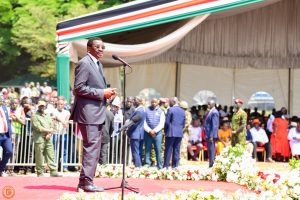
James Orengo’s tribute to Raila Odinga was fiery, emotional, and unmistakably political. The seasoned lawyer and longtime ally of Baba declared before thousands that he would “carry the democratic torch lit by Raila Odinga,” describing the fallen leader as “a titan, a patriot, and an icon.”

“Rest in Power, Jakom!” he thundered, his voice cracking under the weight of loss and loyalty.
But beneath the grief lay a message — one of continuity, of defiance, of unfinished struggle. Orengo was not simply eulogizing a man; he was reaffirming a cause. And for a political class now recalibrating under President William Ruto’s charm offensive, that message landed with mixed feelings.
Ruto’s Calculated Embrace of His Rival’s Legacy
President Ruto’s treatment of Raila’s passing was a masterclass in political symbolism. From according the ODM leader full military honours to conferring upon him Kenya’s highest state award, Ruto appeared every bit the magnanimous statesman.
It was a move as strategic as it was sentimental — an olive branch extended to a constituency long alienated from his administration. Analysts read it as a quiet wooing of the ODM Party ahead of 2027, when alliances will matter more than ideology.
“Ruto is rewriting the political playbook,” observes political analyst Prof. David Mukhisa. “He’s courting the Odinga legacy, not by fighting it, but by embracing it — and that puts ODM in an awkward position. Do they resist the hand of friendship or join the table of power?”
The Rift in the Afterglow
Khalwale’s intervention, then, was no accident. Those who know the Kakamega Senator understand his knack for reading the pulse of Western politics. His critique of Orengo wasn’t just about tone; it was about timing — and direction.
By suggesting that Orengo confined Raila’s greatness to his twilight years within the government fold, Khalwale subtly reclaimed the earlier, revolutionary Raila — the fiery reformer, the agitator, the man of the streets — from the hands of a political establishment he views as co-opted.
“Dr. Khalwale has always positioned himself as a truth-teller,” says commentator Dr. Mercy Achieng. “He’s signaling to the Luhya bloc that Orengo’s grief has turned political, while hinting that Ruto’s camp is now the new custodian of national reform — however ironic that sounds.”
Orengo: The Reluctant Heir
Inside ODM, Orengo remains the spiritual heir to Raila’s ideological mantle. His legal brilliance, loyalty, and historical closeness to Odinga make him the most natural successor in principle — but perhaps the least flexible in practice.
Unlike an emerging crop of ODM leaders — Oburu Oginga, Opiyo Wandayi, Gladys Wanga and John Mbadi — Orengo represents the unyielding tradition of opposition politics. He speaks the language of justice and constitutionalism, not accommodation and coalition.
The language also resonates with an emergent faction in ODM Party led by Secretary General Edwin Sifuna, Babu Owino and a number of the younger crop of leaders.
And that is precisely where the new political fault line lies.
A Legacy Still in Motion
Raila Odinga’s burial was meant to be the end of an era. Yet, if the voices from Bondo and beyond are anything to go by, it marked the beginning of a new contest — not for votes, but for meaning.
Was Raila’s legacy about eternal opposition or strategic inclusion? Was his struggle for democracy meant to be preserved in defiance or advanced through partnership?
These are the questions Khalwale’s comment has reignited — uncomfortable, but necessary.
The Echo of the Enigma
In life, Raila Odinga was the great disruptor — a man who shaped history by refusing to accept it as it was. In death, he remains exactly that: a figure whose memory still unsettles the political order.
Governor Orengo wept for a mentor and a movement. Khalwale, ever the provocateur, reminded the nation that the story of Raila is too vast to be owned by any single faction or philosophy.
And somewhere between the eulogy and the tweet, Kenya was reminded of a deeper truth — that grief, in this country, is never just about loss. It’s about power, identity, and who gets to write the next chapter of the nation’s story.
Editor’s Reflection:
As Raila Odinga’s casket was lowered into the Siaya soil, it wasn’t just the end of a life — it was the scattering of seeds. Seeds of ambition, loyalty, betrayal, and hope. In their bloom lies the answer to who Kenya becomes next.


