 ADVERT

 ADVERT
The sudden withdrawal of security assigned to James Orengo has ignited a fresh political storm, with the veteran lawyer and governor framing the move as a calculated attempt to silence dissent within Kenya’s increasingly fractured opposition politics.
In a strongly worded protest to Inspector General of Police Douglas Kanja, the Siaya governor condemned the abrupt removal of his entire security detail on the night of May 19, describing it as “highly irregular, unprovoked and deeply concerning.”
The dramatic development comes at a politically sensitive moment when Orengo has emerged as one of the fiercest critics of President William Ruto’s administration despite the growing cooperation between sections of the opposition and the government.
According to Orengo, security officers attached to both his official movements and Nairobi residence were withdrawn without prior communication, explanation or replacement — a move he argues violates constitutional protections accorded to state officers.
While his formal complaint avoided directly accusing State House, Orengo has in recent public rallies and political engagements linked the withdrawal to his outspoken criticism of the government during the ongoing “Linda Mwananchi” forums.
 ADVERT
“Security is not a favour extended at the pleasure of political actors. It is a constitutional and statutory guarantee intended to facilitate public service and protect state officers,” Orengo said.
The county boss maintained that he would not be intimidated into silence, insisting he would continue speaking on governance, economic hardship and what he terms the shrinking democratic space in the country.
The incident is widely being interpreted in political circles as an early stress test for Orengo’s growing influence within opposition politics and his perceived attempt to position himself as a possible ideological successor to veteran opposition leader Raila Odinga.
For months, Orengo has increasingly distanced himself from sections of the Orange Democratic Movement (ODM) Party leadership viewed as warming up to President Ruto’s Kenya Kwanza administration.
His hardline posture has earned him admiration among radical opposition supporters who believe ODM risks losing its identity through political accommodation with the government.
Analysts say the withdrawal of security could further elevate Orengo’s profile among anti-government forces by reinforcing his image as an uncompromising defender of opposition politics.
The controversy also unfolds against the backdrop of an escalating political showdown between Orengo and Gladys Wanga, one of ODM’s most influential national figures and Chairperson of the Party.
The two leaders have recently differed sharply over ODM’s engagement with the broad-based political arrangement involving President Ruto.
While Wanga has defended cooperation with the national government as pragmatic and development-oriented, Orengo has repeatedly warned that the opposition risks abandoning its watchdog role.
Their public exchanges have exposed widening ideological cracks inside ODM, with emerging camps now informally split between accommodationists and hardliners.
The withdrawal of Orengo’s security has now triggered demands for transparency from the Ministry of Interior and the National Police Service, amid growing concern over the politicisation of state security apparatus.
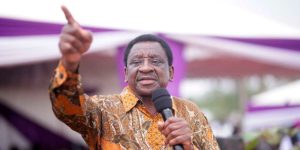
Critics argue that if elected leaders can have security withdrawn without due process, it could set a dangerous precedent in Kenya’s already tense political environment.
Supporters of the government, however, have dismissed claims of political persecution, arguing that security deployments remain an administrative function subject to periodic review.
Even so, the timing of the move has intensified speculation that the state may be tightening pressure on dissenting voices ahead of a potentially volatile political season.
For Orengo, a veteran of Kenya’s second liberation struggle, the latest confrontation appears to signal that his renewed push for opposition relevance is now entering a far more consequential phase.



