 ADVERT
 ADVERT
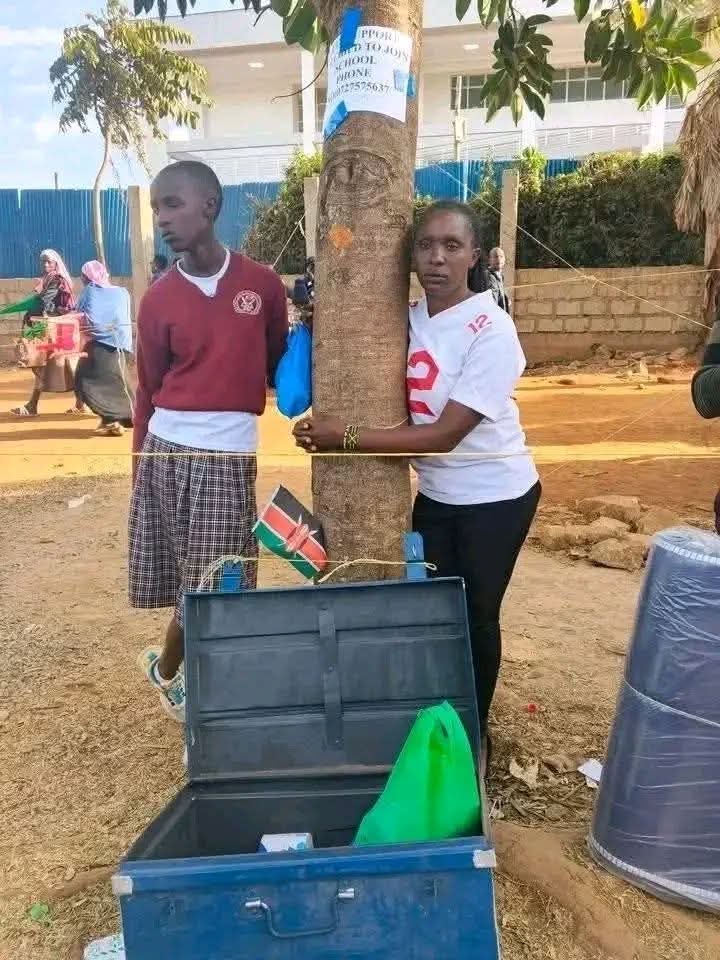
In the bustling streets of Kapsabet town, Nandi County, a heartbreaking scene unfolds: Everline Jepkogei, a devoted mother from Kipserkech in Chepkunyuk ward, clings to a tree trunk alongside another woman. Her placard tells a story of quiet desperation – she is hugging the tree to raise school fees and learning materials for her bright daughter, Olivia Jepchirchir, who is set to join Grade 10 at Sambirir Girls Secondary School in Elgeyo-Marakwet County after completing Grade 9 at Siwo School.
Jepkogei, who proudly voted for President William Ruto and Transport CS Kipchumba Murkomen in 2022, now finds herself in a public plea for help. Social media posts circulating the story carry a direct appeal: “Please Ruto saidia yeye” – a cry for the President to intervene.
This is not an isolated act. What began as a powerful environmental protest has morphed into a nationwide “tree-hugging craze” in early 2026, with Kenyans embracing trees for hours – sometimes days – to highlight personal hardships, from medical bills to education costs.
The trend traces its roots to late 2025, when 22-year-old climate activist Truphena Muthoni made global headlines by hugging a tree for a record-breaking 72 hours at the foot of Mount Kenya. Her goal? To protest deforestation, raise mental health awareness, and protect indigenous trees.
Muthoni’s feat drew inspiration from historical movements like India’s Chipko (“to embrace”) protests of the 1970s, where villagers hugged trees to prevent logging. In Kenya, it resonated deeply amid ongoing debates over forest conservation.
 ADVERT
Her success went viral, inspiring genuine causes: a pastor’s 80-hour hug for cancer awareness, a teenager’s 50-hour challenge for his brother’s surgery.
But by January 2026, the narrative has shifted dramatically. Tree-hugging has become a go-to tactic for fundraising personal needs – predominantly school fees in a country where secondary education remains a financial burden for many despite government subsidies.
– In Trans Nzoia, father David Wanyonyi hugged a tree after his daughter was denied admission over unpaid fees, only to face mob justice when locals accused him of turning it into a “con game” after receiving aid.
– In Kitale, another father abandoned a 120-hour challenge amid confrontations.
– Reports emerged of multiple people targeting the same trees, with causes ranging from genuine hardship to questionable motives.
Experts warn of health risks – dehydration, exhaustion, and physical strain – while critics argue the trend has “lost its purpose,” mutating into a viral fad detached from environmental roots.
The needy deserve support – no question. Poverty, rising education costs, and limited social safety nets push families to extremes. Jepkogei’s story, like many others, exposes systemic failures: Why must a mother who voted for change resort to public spectacle for her child’s basic right to education?
Yet, the moral quandary looms large. Is repurposing a symbol of environmental resistance for mundane personal appeals eroding its original power? When tree-hugging shifts from saving forests to crowdfunding school fees, does it trivialize the urgent climate crisis Kenya faces – including deforestation and drought?
Some attempts have sparked backlash, with accusations of greed or exploitation when participants refuse aid or prolong challenges unnecessarily. This raises uncomfortable questions: Are all cases genuine cries for help, or have opportunists hijacked a once-sacred act?
Kenya’s tree-hugging craze lays bare a nation’s contradictions: vibrant activism alongside grinding poverty. While individual stories tug at heartstrings – and often succeed in raising funds – the trend risks desensitizing the public and overshadowing real environmental advocacy.
Perhaps it’s time to ask harder questions of leaders: Why are bright students like Olivia Jepchirchir at risk of missing school? Where are the promised bursaries, the equitable education funding?
Until systemic change arrives, trees will continue to bear witness to Kenya’s struggles – hugged not just for survival of forests, but for the survival of dreams.


