 ADVERT

 ADVERT
Siaya Governor James Aggrey Bob Orengo has given a greenlight to whoever will be commemorating the historicity of the seventh of July tomorrow to go ahead unhindered.
The Governor alluded to the struggle of Kenya’s second liberation in the early ninties and said that even before the realization of the penultimate prize which was the 2010 Constitution others were already out to undermine civil liberties.
“The dream of Saba Saba was enshrined in Katiba2010. Before the ink dried it was turned on its head and every pillar of it weakened,” said Orengo, adding “Everything has not been spared including now the separation of Church and State. So the struggle must continue; Mwakenya, Saba Saba, Gen Z on and on.”
Governor Orengo has remained unwavering and unflinching in his fight for democratic tenets and a just society.
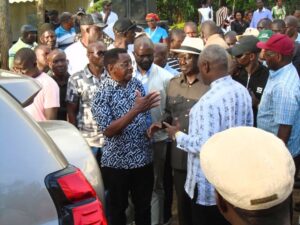
Saba Saba Day is unofficially commemorated in Kenya on July 7 in memory of the struggle for multi-party democracy.
 ADVERT
Over the decades, the Saba Saba protests have evolved into a powerful tradition of advocating for human rights, good governance, and economic justice. But this year they might be more poignant coming as it is in the heels of Gen Z commemorating another day; 25 June dedicated to the fallen heroes from unrest sparked by the 2024 anti-Finance Bill protests.
The inaugural Saba Saba protests took place on July 7, 1990, during the late President Daniel Arap Moi’s administration, when the country was a dejurè single-party state.
Eight years earlier, the government under President Moi had amended the Constitution to turn Kenya’s de facto one-party system into a dejurè one-party state, officially placing all political power in the hands of the Kenya African National Union (KANU).
Political dissent and press freedom were tightly suppressed, while widespread discontent grew over economic mismanagement and the systematic exclusion of various communities from governance.
On June 6, 1990, opposition leaders made a drive for a public rally to be held at Kamukunji Grounds in Nairobi on July 7, demanding the return of multiparty democracy.
Key opposition figures spearheading the protests were Kenneth Stanley Njindo Matiba, Charles Rubia, Martin Oyondi Shikuku, Jaramogi Oginga Odinga and James Aggrey Bob Orengo.
Raila Odinga, Gitobu Imanyara, Koigi wa Wamwere, the late Wangari Maatgai and Gibson Kamau Kuria played instrumental roles in the protests.
Despite the protests being banned by the Moi government, the opposition defied the ban, and thousands of Kenyans took to the streets to demand the return of multiparty democracy.
Opposition leaders were arrested and detained, while police violently dispersed protesters in a brutal crackdown.
On December 2, 1991, President Moi, during the delegates’ conference of KANU, announced the repeal of Section 2(A) of the Constitution, returning Kenya to a multiparty state after more than 20 years. As a result, some 19 new political parties were registered.
In 1992, Kenya held its first multiparty elections where 8 political parties participated. During the election Daniel Moi was re-elected as president under KANU beating Kenneth Matiba of Ford Asili.

Photo by Collins Oduor.
Over the years Saba Saba Day has evolved and taken a new meaning. Human rights defenders and civil society organizations in recent years have taken the stage in commemorating the day by calling for an end to police brutality and killings, respect for the constitution, and addressing issues affecting the country.
The 2023 Saba Saba Day was led by ODM leader Raila Odinga at the Kamukunji grounds who pushed for economic reforms to address the high cost of living and the quashing of the Finance Act 2023.
In 2024, Kenyans gathered at Uhuru Park to remember the youth who lost their lives during the deadly anti-finance bill protests.
Activists led by Boniface Mwangi organized a memorial concert with top Kenyan artists performing while paying tribute to victims of the protests.
In 2025, Kenyans are once again preparing to take to the streets on Monday, July 7, calling for better governance, an end to police brutality, and justice for victims of police killings.
Note: Additional reporting sourced



