 ADVERT

 ADVERT
A bold government initiative to compensate victims of violent demonstrations and police crackdowns has run into legal headwinds after the High Court in Kirinyaga temporarily halted the work of the Panel of Experts on Compensation of Victims of Demonstrations and Public Protests. The decision has thrown into question both the legality and the politics surrounding the committee, which is chaired by renowned lawyer Prof. Makau Mutua and deputized by Law Society of Kenya (LSK) President Faith Odhiambo.
The Court Order
On Monday, September 8, 2025, Justice Magare Dennis Kizito issued conservatory orders suspending the panel’s operations. The orders, prompted by a petition filed by Levi Munteri, effectively freeze the implementation of Gazette Notice 12002 of August 23, 2025, which created the framework for compensation.
“The court has issued a conservatory order staying the commencement of the mandate of the Panel of Experts on Compensation of Victims of Demonstrations and Public Protests, pending the hearing of the main application,” the ruling states.
Justice Kizito further ordered that no action be taken to enforce President William Ruto’s August 6, 2025 proclamation establishing the reparations framework. Any violation of this directive, the judge warned, would attract “penal consequences.”
 ADVERT
Why the Case Was Filed
At the heart of the challenge is a dispute over legality, constitutionality, and executive overreach. Munteri argues that the State Law Office, the Ministry of Interior, and other agencies overstepped by unilaterally creating the panel without parliamentary approval or a clear legal framework.
Critics say the committee risks being a political band-aid meant to calm public anger after months of deadly anti-government protests, rather than a genuine attempt at justice.
“This is not about helping victims—it’s about optics,” a Nairobi-based constitutional lawyer told us off record. “Without a legal anchor, such a committee could be manipulated for political gain.”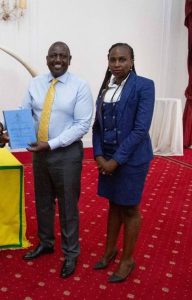
Who Sits on the Panel?
The 15-member team features a blend of legal scholars, civil society leaders, and state appointees. Alongside Mutua and Odhiambo, members include:
Kennedy Ogeto – Former Solicitor General
Irungu Houghton – Amnesty International Kenya Executive Director
John Olukuru – Data governance expert
Rev. Kennedy Barasa Simiyu – Clergy representative
Linda Musumba and Duncan Ojwang – Legal academics
Naini Lankas, Francis Muraya, Juliet Chepkemei, Pius Metto, Fatuma Kinsi Abass, Raphael Anampiu – Civil society and community representatives
The technical team is led by Richard Barno with Duncan Okelo Ndeda as co-lead, supported by joint secretaries Jerusah Mwaathime and Raphael Ng’etich.
Their mandate was ambitious: design a framework to verify, categorize, and compensate victims, drawing from records held by IPOA, KNCHR, the National Police Service, the Ministry of Health, and NGOs.
Why Faith Odhiambo is Under Fire
Faith Odhiambo’s involvement has drawn sharp scrutiny. As LSK President, she is expected to hold government accountable, yet her role as Vice-Chair of a presidentially appointed panel has raised conflict-of-interest concerns.
Several LSK members have already demanded her resignation from the panel, accusing her of “legitimizing an unlawful process.” The court’s intervention now intensifies the pressure.
“Faith cannot serve two masters,” a senior Nairobi lawyer said. “She cannot be the watchdog of government while simultaneously serving in a government-created committee.”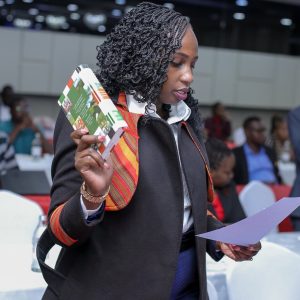
The Political Undercurrents
Behind the court case lies a broader political struggle over accountability. The Ruto administration has faced mounting criticism for its handling of protests, where dozens have died and hundreds injured. Establishing a compensation scheme was seen as a way to soften the blow and neutralize calls for deeper accountability.
But for critics like Makau Mutua—ironically now chairing the panel—the fight is more complex. Mutua, a long-time government critic turned insider, has defended the panel as an innovative transitional justice tool.
“This is about giving dignity to victims,” Mutua said in a recent interview. “The court process will not erase the fact that victims exist and need redress.”
Yet opponents argue that reparations without accountability—especially for police officers implicated in killings—amount to state-sanctioned impunity.
What Happens Next
The High Court has given all parties strict deadlines:
Respondents must file submissions within 7 days of being served.
Petitioner to file submissions within 3 days of response.
All filings to be completed before September 30, 2025.
Case will be mentioned in Kerugoya on October 10, 2025.
Until then, the compensation panel cannot operate.
The suspension of the Mutua-Odhiambo panel reveals a deeper national dilemma: how can Kenya balance justice, politics, and legality in addressing the scars of state violence?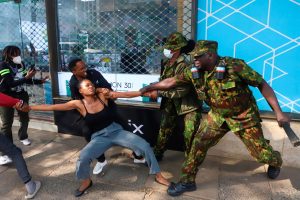
For victims’ families, this legal battle means more waiting, uncertainty, and dashed expectations. For the state, it is a test of credibility. And for the judiciary, it is another chance to assert its role as a check on executive power.
Whether the court ultimately dismantles or greenlights the committee, one thing is clear: the fight over protest victims’ compensation is as much about power and principle as it is about justice for the wounded and the bereaved.



