
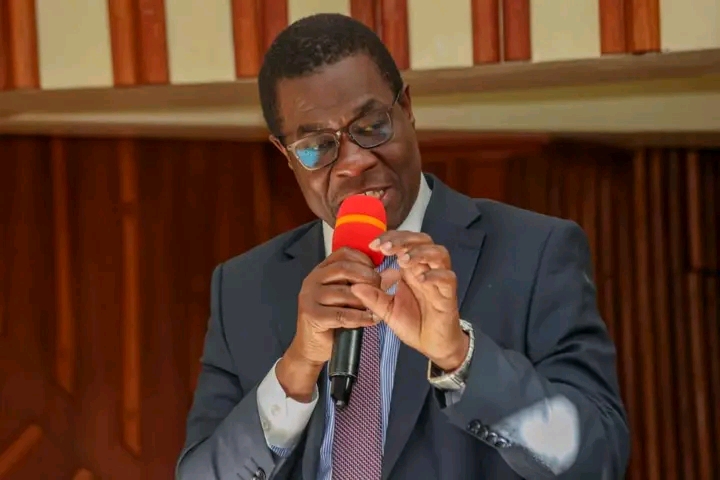
Public debate is the lifeblood of democracy. But when criticism descends into personal vendetta, it ceases to illuminate and instead reveals more about the critic than the subject of the critique. That is precisely the unfortunate impression left by the latest broadside from Peter Owino Ranginya against Cabinet Secretary James Opiyo Wandayi.
Few would deny that Ranginya is a man of considerable intellect, exposure and long engagement with Kenya’s political discourse. For years he was regarded as a thinker whose opinions occasionally found their way to the ears of the political establishment, including Raila Amollo Odinga himself. Yet intellect alone is not the sole measure of wisdom. The missing ingredient in Ranginya’s recent commentary is the most basic human faculty required in political analysis: good judgement.
His verbose attack on Wandayi reads less like reasoned political critique and more like a continuation of a pattern of personal vendettas. Before Wandayi, Ranginya had trained his rhetorical guns on James Aggrey Bob Orengo, the Governor of Siaya and—ironically—his own village mate. The pattern is difficult to ignore: intellectual firepower deployed not to clarify issues of governance but to settle scores.

What may underlie the bitterness is not difficult to infer. Kenyan politics has evolved dramatically over the past two decades. The days when a small circle of ideological hardliners monopolized political influence have given way to a more pragmatic politics of accommodation and coalition-building. In that new political order, some former power-brokers and advisers inevitably feel the chill of irrelevance.
Ranginya himself hints at this changing reality when he recounts that he once arranged consultations involving Raila Odinga during visits abroad. Those were moments when he was occasionally consulted by the “big boys” of Kenyan politics. Today, that consultation is no longer part of the political routine. Such shifts are normal in politics, but they can breed resentment in those who once occupied the inner circles of influence.
Seen through this lens, the crusade against Wandayi begins to look less like an intellectual exercise and more like the frustration of a man who believes the political establishment overlooked his preferences. The suspicion that Wandayi’s rise—particularly his earlier selection by ODM to lead the newly created Ugunja Constituency carved out of Ugenya—did not align with Ranginya’s expectations may well explain the intensity of his rhetoric.

But leadership in Kenya is not determined by the approval of distant commentators. Nor is it measured by who can craft the sharpest insults about intelligence quotients. Governance is ultimately judged by delivery—by whether leaders improve the lives of the citizens they serve.

In that regard, the debate about Wandayi should not revolve around speculative IQ scores or rhetorical theatrics. The real question is whether he has the capacity, intellect and political skill to deliver results for Siaya and for Kenya. On that question, the jury is still engaged in the only meaningful evaluation that matters: performance in office.
Kenyan politics today also requires something Ranginya’s essay conspicuously lacks—measured engagement with institutions of the state. In Siaya, the prevailing political mood is not one of unnecessary confrontation with government, but one of pragmatic engagement to secure development for the people. Leaders who understand this reality are adapting to it. Those clinging to perpetual ideological combat are finding themselves increasingly isolated.
None of this diminishes Ranginya’s long experience in political thought. Indeed, few would question that he possesses a wealth of insights gathered from decades of observing Kenya’s political evolution. But such intellectual capital would serve the nation far better if it were channelled constructively rather than through personal denunciations.
Perhaps the most constructive path forward for Ranginya is not the endless writing of polemics against individual leaders but the undertaking of a more enduring project: documenting the political history he has witnessed and the lessons he has drawn from it. A well-written book reflecting his experiences, encounters and reflections would enrich Kenya’s political literature and preserve his contributions for posterity.
History often remembers thinkers not for their angriest commentaries but for their most thoughtful reflections.
If Ranginya chooses that path, his intellect—undeniably formidable—could yet make a lasting contribution to the national conversation. But as things stand, his latest tirade says less about the leadership of Opiyo Wandayi than it does about the perils of intellect untempered by judgement.


