 ADVERT

 ADVERT
Billionaire Jimi Wanjigi of Safina Party on Saturday landed in Siaya County to officially open Safina Party offices situated at Karemo area of the town.
The occasion marked more than just a routine political event—it signals a potentially transformative shift in one of Kenya’s most politically homogeneous regions. Long regarded as an unshakable stronghold of the Orange Democratic Movement (ODM) Party, Siaya has historically delivered near-unanimous support to the party and its longtime leader the late Raila Odinga. But the ground now appears to be moving.
Wanjigi’s entry—bold, highly visible, and symbolically timed—suggests a deliberate attempt to test the boundaries of ODM dominance. The enthusiastic reception by sections of local youth, including some previously considered ODM stalwarts, underscores a subtle but important shift: political loyalty in Siaya may no longer be as rigid as it once was. Whether driven by generational change, economic frustrations, or evolving political consciousness, the willingness to entertain alternative voices is itself a milestone.
Wanjigi criticized Luo leaders for endorsing an oppressive regime by taking part in the Broadbased government arrangement.
At the operational level, much of the Safina groundwork in Siaya is being coordinated by outspoken Nairobi-based lawyer Willis Evans Otieno. His involvement adds a layer of strategic organization and ideological framing that could help Safina translate symbolic entry into sustained grassroots presence. Otieno has been increasingly visible in governance and constitutional discourse, and his pivot to on-the-ground mobilization in Siaya hints at a more structured challenge to the status quo.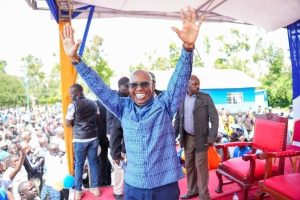
 ADVERT
The broader implication is clear: the political landscape in Siaya is opening up. With Raila Odinga no longer an active electoral contender, the region may be entering a “post-Raila” phase—one defined less by loyalty to a singular figure and more by competitive pluralism. This transition sets the stage for what could be fiercely contested race in 2027, where the “battle of the fittest” replaces the predictability of past elections.
Still, skepticism remains. Critics argue that Wanjigi’s move could be less about genuine political competition and more about strategic vote fragmentation. In this view, Safina’s emergence is seen as a spoiler effort—possibly influenced by external political interests—aimed at diluting the traditionally consolidated Luo vote. Whether these claims hold any substance remains unclear, but they reflect the high-stakes nature of political realignment in the region.
Regardless of motive, one fact is undeniable: Safina has arrived in Siaya with force, and its presence is already reshaping local political calculations.
Nowhere is this more evident than in the evolving dynamics of the Alego Usonga parliamentary race. Local billionaire Martine Otieno—popularly known as Mijesh—is reportedly gearing up for another stab at the coveted Alego-Usonga MP seat
His financial muscle and local influence inject new uncertainty into what had been shaping up as a relatively straightforward path for incumbent Samuel Onunga Atandi. Atandi had been expected to cruise to re-election, particularly after youthful contender Kevin Odhiambo appeared to step back from the race.
Complicating matters further is the re-emergence of Nicholus Kut K’Ochogo, who is also said to be preparing for an onslaught on the Alego-Usonga parliamentary seat. His entry introduces a third serious contender, raising the possibility of a fragmented vote and a highly competitive contest.
Taken together, these developments point to a region bitten by the bug of change.
At the time of going to press the information we have is that former Governor Cornell Rasanga Amoth who had indicated that he would vie for Senate has changed his mind and may go for Alego-Usonga instead.
The once predictable electoral rhythms of Siaya are giving way to a more contested, uncertain, and arguably more democratic political environment. Whether Safina can convert its dramatic entry into lasting influence—and whether Wanjigi’s so-called “Midas touch” will sway voter behavior—remains to be seen.
But one thing is certain: Siaya is no longer politically monolithic. And as 2027 approaches, the county may well become one of the most closely watched battlegrounds in Kenya’s evolving political landscape.



