 ADVERT
 ADVERT
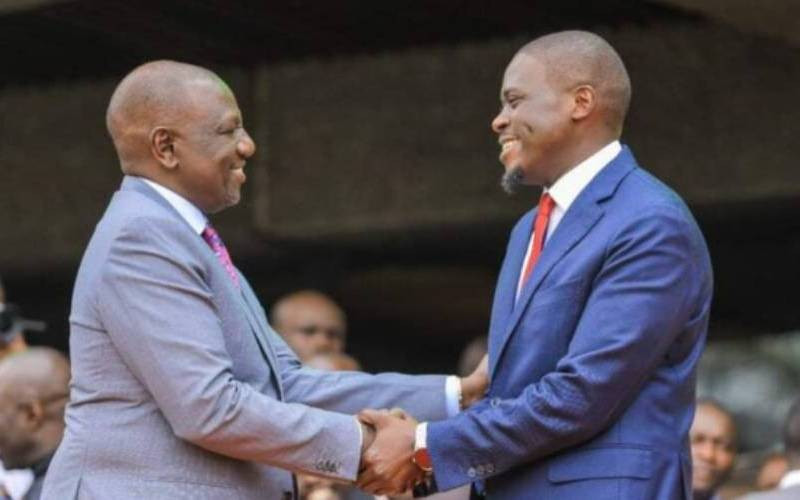
Nairobi Governor Johnson Sakaja and President William Ruto have signed a high-stakes Sh80 billion cooperation agreement, promising to overhaul the city’s crumbling infrastructure and make Nairobi more livable for its 4.4 million residents. Signed on February 17, 2026, at State House, the pact injects massive additional funding from the national government—four times the usual allocation—into critical sectors like roads, bridges, drainage, water and sewerage, housing, street lighting, solid waste management, and Nairobi rivers regeneration.
President Ruto described the deal as a “win-win” partnership rooted in constitutional cooperation between levels of government, not a takeover of devolved functions. A joint steering committee, chaired by Prime Cabinet Secretary Musalia Mudavadi and vice-chaired by Sakaja, will oversee implementation, with immediate commitments including Sh3.7 billion to complete 10,000 stalled streetlights and install 40,000 new ones (many solar-powered), Sh2.1 billion for upgrades at Ng’ethu Treatment Plant to curb massive water losses, and billions more for sewer networks, road upgrades, and waste facilities.
Sakaja defended the agreement as a pragmatic “refinancing” move in the best interest of Nairobians, insisting he has “no regrets” and emphasizing that it unlocks urgently needed resources without surrendering county authority.
But the ink had barely dried before a fierce backlash erupted. Critics, including Nairobi Senator Edwin Sifuna, branded it a “backdoor power grab” and unconstitutional “clawback” on devolution. Sifuna argued the Sh80 billion is a “ruse” and a drop in the ocean compared to over Sh100 billion the national government allegedly owes Nairobi County. He slammed the lack of public participation and Senate involvement, warning it risks exposing funds to misuse.
Embakasi East MP Babu Owino and others echoed the sentiment, calling it a hostile takeover that undermines county autonomy, particularly in revenue and transport. Legal challenges emerged swiftly: petitioners Bernard Peter and Christine Gathoni filed an urgent High Court case to suspend the deal, claiming it unlawfully shifts control of devolved functions, bypasses mandatory consultations, and opens the door to unapproved spending.
 ADVERT
Nairobi MCAs have revived impeachment threats against Sakaja, accusing him of incompetence and selling out the county. On social media, opinions are sharply divided—some hail it as essential urban renewal to fix potholes, garbage mountains, and dark streets, while others decry it as “NMS 2.0,” a potential slush fund for graft ahead of the 2027 elections or a disguised looting scheme.
Ruto and Sakaja have pushed back firmly, insisting the pact strengthens—not weakens—devolution through joint planning and execution. Yet with court battles looming, political temperatures soaring, and questions swirling about transparency and motives, the Sh80 billion question hangs heavy: Is this a genuine lifeline for a choking metropolis, or a clever ploy where one side gets the cash and the other the control—while ordinary Nairobians pay the price?
As lawsuits mount and impeachment whispers grow louder, the real test will be whether the deal delivers gleaming streets or deepens suspicion in Kenya’s fragile devolution experiment. Kenyans are watching closely—the 2027 political chessboard is already in motion.


