 ADVERT
 ADVERT
The state’s decision to investigate alleged fraudulent title deeds on land set aside for the Lamu refinery is a necessary step that speaks to a deeper national concern about the integrity of land administration in major infrastructure projects. At its core, this matter is not only about one parcel on the coast but about the credibility of the processes that underpin investment, public trust, and the rule of law when the country pursues transformative development. Government Spokesperson Charles Owino’s firm position that the land was lawfully acquired, consolidated under a mother title, and that affected families were compensated must be matched by transparent proof and swift accountability where irregularities are found. This is the only way to ensure that the refinery’s promise is not clouded by doubts that can be avoided through clear process and honest communication.
The central theme here is the relationship between land governance and national development ambitions. Large projects such as the Lamu refinery depend on secure tenure, clear records, and predictable procedures because investors, lenders, and the public all need confidence that the foundation of the project is sound. When allegations emerge that fresh titles were created on land already consolidated under a mother title held by the Kenya Ports Authority, the appropriate response is exactly what has been announced: a focused investigation that traces the chain of transactions, identifies those responsible, and ensures that any person with a genuine claim is treated fairly while fraud is punished. This approach protects both the project and the public interest, because it affirms that development will not proceed on the basis of forged documents or opaque deals.
Government Spokesperson Charles Owino’s statement that about ninety families occupying the site during the port’s establishment were compensated and that records exist to show this is an important part of the narrative. It anchors the state’s position in documented process rather than assertion. Yet the same statement also opens space for correction if any person was genuinely left out, because it acknowledges that the government would not hesitate to compensate those who qualify. This balance is critical. It signals that the state is confident in its records while remaining open to evidence that may require adjustment. In a context where land disputes on the coast often involve historical tenure issues, absentee landlords, and competing claims based on long term occupation, such clarity helps separate legitimate grievances from attempts to exploit ambiguity.
The broader subject at stake is how Kenya manages the intersection of infrastructure, investment, and community rights. The Lamu refinery is presented as a catalyst for foreign direct investment, industrial revival, and energy security, with expectations that it will attract significant capital, generate substantial annual inflows, and produce by products that can feed local manufacturing in tyres, plastics, and related sectors. It is also described as a facility that will co generate a large amount of electricity, using part of it to run the refinery and supplying the surplus to the national grid. These are weighty promises that touch on national priorities such as job creation, value addition, and reduced dependence on imported petroleum products. But their realization depends on more than financial commitments and technical capacity. It depends on the perception that the project rests on lawful foundations and that those who bear its social costs are treated with fairness.
This is why the land issue cannot be dismissed as a side story. It is part of the main subject because it tests whether the state can deliver complex infrastructure without compromising procedural integrity. When Government Spokesperson Charles Owino insists that the refinery should not be overshadowed by the land dispute, the point is understandable from the perspective of economic momentum. Yet the most effective way to prevent overshadowing is not to minimize the dispute but to resolve it through visible, credible action. That means publishing the relevant acquisition and compensation records in a form that the public can follow, explaining the status of the mother title and why new titles on the same parcel would be irregular, and demonstrating that the investigation has the independence and resources to reach conclusions that command trust. It also means ensuring that court processes related to the land are respected and that any person with a bona fide claim has a clear path to redress.
 ADVERT
The thematic core of this moment is accountability as an enabler of development. Accountability does not slow down progress; it secures it. When people see that fraud is pursued, that records are open to scrutiny, and that compensation is handled with consistency, they are more likely to support the project and less likely to entertain narratives that could undermine it. Conversely, when irregularities are ignored or obscured, even a project with strong economic logic can become a focal point for distrust, litigation, and delay. Government Spokesperson Charles Owino’s assertion that a team is investigating and that charges will follow in a short time is therefore more than a law and order message. It is a development message, because it tells investors and citizens alike that Kenya intends to build on a foundation of lawful process.
There is also a communication dimension that matters for the main subject. Public statements about compensation, mother titles, and fraud investigations must be matched by accessible evidence if they are to settle doubts rather than amplify them. This does not require releasing sensitive personal data, but it does require clear explanations of how the land was acquired, how the mother title was created, and why the creation of new titles on the same parcel would constitute fraud. It also requires a consistent message across agencies so that the public does not receive conflicting accounts from different offices. When Government Spokesperson Charles Owino notes that Kenya previously had local tyre manufacturing and now relies on imports, the point is well taken as an illustration of the refinery’s potential to revive such industries. But the credibility of that industrial promise is strengthened when the land under the project is beyond reproach.
The subject of the Lamu refinery is ultimately about national direction. It is about whether Kenya can host large scale, regionally significant infrastructure while maintaining the standards of land governance that protect citizens and investors. It is about whether economic benefits described in terms of investment, energy, and industrial linkages can be pursued without creating new grievances or entrenching old ones. And it is about whether the state can demonstrate that its confidence in the legality of acquisition is rooted in verifiable process rather than assertion. The investigation into alleged fraudulent titles is a test of all these questions. If it is conducted with transparency and resolve, it will reinforce the project’s legitimacy and set a standard for future infrastructure. If it is perceived as perfunctory or defensive, it will leave room for doubts that could have been avoided.
The appropriate path forward is straightforward. The state should proceed with the refinery on the basis of its documented position while simultaneously making that documentation comprehensible to the public. It should ensure that the investigation into fraudulent titles is independent, adequately resourced, and time bound, with clear milestones for reporting findings and taking action. It should respect ongoing court processes and use them to clarify contested claims rather than treating them as obstacles to be managed. And it should maintain an open channel for any person who believes they were wrongly excluded from compensation to present their case through the proper procedures. This is not a concession to opponents of the project. It is a reinforcement of the project’s foundation, because it affirms that the refinery will stand on lawful, verified, and publicly defensible ground.
In the end, the main subject is not only the refinery but the kind of development Kenya chooses to pursue. A development model that couples ambition with integrity, that treats land governance as central rather than peripheral, and that communicates with evidence rather than assertion is more likely to deliver lasting benefits. The investigation into alleged fake titles is an opportunity to demonstrate that model in practice. If seized, it will strengthen the Lamu refinery’s place in the national story and affirm that large projects can advance without compromising the principles that sustain public trust. Government Spokesperson Charles Owino’s framing of the issue, when backed by transparent process and accountable action, can help ensure that the refinery advances as a project of national confidence rather than contested legitimacy.
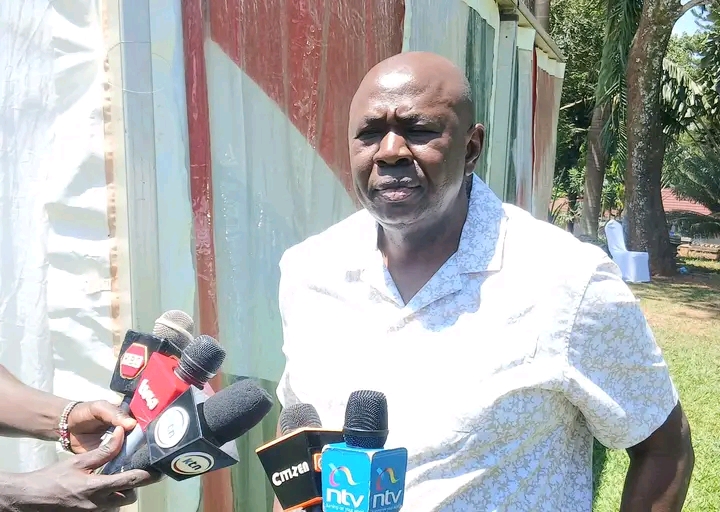
Caption: Government spokesperson Charles Owino addressing the journalists in Kakamega.


