 ADVERT

 ADVERThttps://youtu.be/Sny2O4mVqxU?feature=shared
Africa’s economic transformation will depend not only on what the continent produces, but increasingly on how it protects, commercialises and derives value from its intellectual and creative assets. This was the central message emerging from the 7th All Africa Intellectual Property Summit (AAIPS) held in Nairobi from November 11–13, 2026.
The three-day summit, hosted at Ole Sereni Hotel, brought together policymakers, intellectual property experts, business leaders, innovators, researchers and creatives to explore how intellectual property (IP) can become a powerful driver of Africa’s trade, industrialisation and creative economy.
Held under the theme “Mainstreaming Intellectual Property for Africa’s Trade, Industrial & Creative Economy Transformation,” the summit was organised in strategic partnership with the African Continental Free Trade Area (AfCFTA) Secretariat, underscoring the growing recognition that intellectual property must occupy a central position in Africa’s economic integration and development agenda.
The discussions highlighted a fundamental challenge: Africa has immense creative, cultural, scientific and entrepreneurial potential, but much of its intellectual wealth remains inadequately protected, poorly commercialised or exploited without fair returns to its original creators.
Moving Beyond Legislation to Effective IP Protection
 ADVERT
One of the summit’s central conversations focused on the persistent obstacles undermining Africa’s intellectual property ecosystem.
Participants identified limited public awareness, weak enforcement mechanisms, inadequate institutional capacity, the protection of cultural heritage and music, and the shortage of qualified intellectual property professionals as major impediments.
Small and medium-sized enterprises (SMEs), in particular, continue to face difficulties identifying, valuing, protecting and commercialising their intellectual assets.
Sharon Wata of the Kenya Copyright Board (KECOBO) emphasised that passing legislation alone is insufficient to build a functional intellectual property ecosystem. Effective implementation requires adequately resourced institutions, stronger enforcement capacity and sustained public education.
The message was clear: intellectual property rights must move beyond legal provisions on paper and become practical instruments through which innovators, businesses and creators secure economic benefits from their work.
Digital Creators Must Turn Talent Into Commercial Value
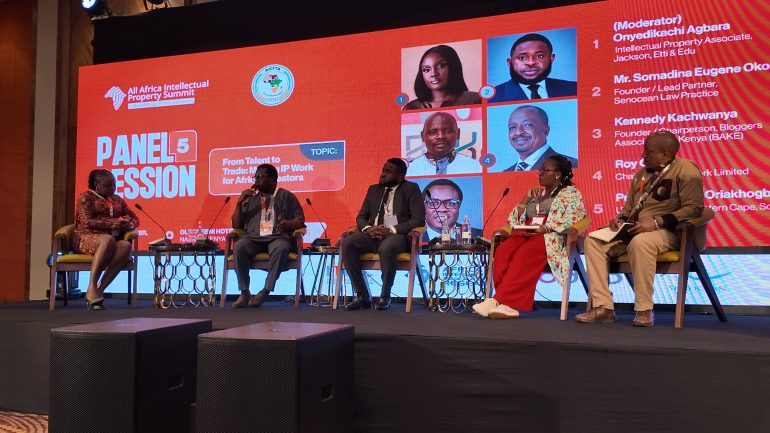
The place of digital creators in Africa’s emerging knowledge economy received particular attention during a panel discussion titled “From Talent to Trade: Making IP Work for African Creators.”
Nelly Nyadzua, a cybersecurity consultant at the Bloggers Association of Kenya (BAKE), participated in the discussion, which examined how creators can transform their creative output into commercially valuable intellectual property.
The panel explored the importance of understanding ownership rights, protecting original content and developing the knowledge required to negotiate licensing agreements and pursue sustainable commercial opportunities.
For bloggers, journalists, photographers, musicians, filmmakers, online publishers and other digital content producers, the conversation carried significant implications.
In an increasingly digital world, an article, photograph, video, podcast, documentary or original publication is more than a piece of content. It represents intellectual effort that can generate income, build brands and create lasting commercial value.
Yet many African creators remain vulnerable to unauthorised reproduction, plagiarism, copyright infringement and the unauthorised commercial exploitation of their work.
The summit reinforced the need for creators to understand their rights and establish mechanisms for protecting and monetising their intellectual assets.
For Kenya’s growing digital media industry, this is particularly important as independent publishers and content creators seek sustainable business models beyond traditional advertising revenue.
Intellectual Property as an Economic and Financial Asset
Beyond copyright protection, the summit examined the wider economic potential of intellectual property as a business asset.
Participants explored how intellectual assets can be valued and potentially used to facilitate access to financing, opening new opportunities for enterprises whose most valuable resources may be patents, trademarks, industrial designs, proprietary technologies or creative works rather than physical property.
The discussions also examined intellectual property’s contribution to pharmaceutical industrialisation, technology transfer, research commercialisation, licensing and the development of competitive African industries.
This represents an important shift in economic thinking. Intellectual property should not merely be viewed as a defensive legal instrument but as an economic resource capable of attracting investment, encouraging research and strengthening enterprise competitiveness.
For African startups and SMEs, the ability to identify and protect intangible assets could become an important ingredient in accessing capital and expanding into regional and international markets.
AfCFTA and Africa’s Emerging Intellectual Property Framework
The summit took place against the backdrop of significant progress towards establishing a continental intellectual property framework.
In February 2026, the African Union approved eight annexes to the AfCFTA Protocol on Intellectual Property Rights, covering utility models; traditional knowledge, traditional cultural expressions and genetic resources; plant variety protection; patents; trademarks; industrial designs; geographical indications; and copyright and related rights.
These instruments are intended to provide a stronger foundation for protecting Africa’s intellectual assets while facilitating trade and cooperation across the continent.
Their significance extends beyond legal harmonisation. They offer an opportunity to ensure that African innovations, indigenous knowledge, cultural expressions and creative industries receive recognition and protection within an increasingly integrated continental marketplace.
However, the effectiveness of this framework will ultimately depend on implementation, institutional preparedness, public awareness and the ability of individual countries to translate continental commitments into tangible benefits for citizens and businesses.
Africa must also ensure that indigenous communities are not reduced to passive custodians of cultural knowledge while external commercial interests reap the economic rewards.
Celebrating Africa’s Intellectual Property Excellence
The summit also provided a platform for recognising outstanding contributions to the continent’s intellectual property ecosystem through the All Africa IP Excellence Awards.
The awards celebrated achievements across several fields, including policy and institutional leadership, academic research, intellectual property law and consultancy, indigenous knowledge, creative industries, startups, technology transfer and young innovators.
Another major highlight was the unveiling of a publication arising from the sixth AAIPS, titled The Future of Intellectual Property in Africa: Innovation, Governance and Emerging Pathways.
Edited by Desmond Oriakhogba, Charlene Musiza and Sand Mba-Kalu, the publication contributes to the growing body of scholarship and policy discussion on the future of intellectual property governance and innovation across Africa.
The programme also featured the Innovation Pavilion and Africa IP Marketplace, providing opportunities for innovators, entrepreneurs and businesses to showcase their work, establish connections and explore commercial partnerships.
The Bigger Picture: Turning African Ideas Into African Wealth
The 7th All Africa Intellectual Property Summit has brought into sharper focus an important development question: how can Africa translate its enormous reservoir of creativity, indigenous knowledge, scientific research and innovation into sustainable economic prosperity?
The continent cannot achieve meaningful industrialisation while its innovators struggle to protect their inventions, its musicians lose control of their creative works, its researchers lack pathways to commercialise discoveries and its small businesses remain unaware of the value of their intellectual assets.
Equally, intellectual property protection must not become an exclusive preserve of large corporations and established institutions. Small businesses, universities, independent journalists, young innovators, cultural practitioners and grassroots entrepreneurs must have access to the knowledge and institutional support necessary to benefit from the system.
For Kenya, the summit presents an opportunity to strengthen public education, empower creative enterprises and improve collaboration between government agencies, universities, professional associations and the private sector.
Ultimately, Africa’s next economic frontier may be determined as much by the value of its ideas as by the abundance of its natural resources.
The challenge is to build an environment where African ideas are protected, African innovations are commercialised and African creators receive fair economic returns from their intellectual labour.
Africa must move from being a source of raw materials and creative talent to becoming an owner, protector and exporter of intellectual wealth.