 ADVERT

 ADVERT
Gerald Otieno Kajwang’ did not simply live in Kenya’s political theatre — he dominated the stage. With a booming baritone that could shake a rally from Kisumu to Kawangware and a signature slogan that became a national soundtrack — “BADO MAPAMBANO!” — Kajwang’ entered history not as a typical legislator, but as a political force of nature.
Nearly a decade after his sudden death in 2014, the story of Bwana Mapambano remains unfinished. His life, his politics, and the controversies he left behind still spark questions, debates, and whispers. This is the deeper, unvarnished story of a man who fought systems, inspired millions, offended power — and left behind a trail of legend, mystery, and family battles still raging today.
Kajwang’s political warpath began early — and violently.
In 1979, as a University of Nairobi student leader, he led one of the earliest and boldest demonstrations against President Daniel arap Moi’s authoritarian regime. The regime’s reply was ruthless: expulsion.
Where others would have broken, Kajwang turned it into origin myth. He packed his few belongings and crossed to Uganda, enrolling at Makerere University. There, he completed his law degree, later passing through the Kenya School of Law.
From the start, “Mapambano” wasn’t a slogan — it was a life philosophy.
 ADVERT
In 1991, representing Jaramogi Oginga Odinga, Kajwang walked into court and confronted a sacred cow: the state broadcaster.
His argument was simple but revolutionary:
KBC was illegally forcing Kenyans to listen to a KANU propaganda song before every news bulletin.
And he won.
The ruling clipped the state’s propaganda machinery and announced Kajwang as a fearless legal mind willing to poke the regime in the eye.
In 1999, the Law Society of Kenya deregistered him over an insurance-claims dispute — one of the darkest stains on his career. Kajwang insisted he was a victim of political sabotage. Critics swore otherwise.
Deregistration didn’t end him. It redirected him — fully, loudly — into politics.
As Mbita MP, Kajwang became a political performer of unmatched charisma: tall, booming, always smiling, always ready with a joke or jab.
But behind the humour was volcanic temperament.
In 2001, during a heated debate, he physically fought Embakasi MP David Mwenje — a chaotic scuffle remembered for one extraordinary detail whispered across political circles:
Kajwang bit him. Inside Parliament.
It was peak Kajwang: unpredictable, explosive, entertaining, and unashamedly human.
ODM insiders later revealed that Kajwang was quietly Raila Odinga’s “secret informant” — a political intelligence officer who warned the party leader of internal rebellions before they erupted.
Many of the plots he exposed would later unfold exactly as he predicted.
Kajwang was more than a singer of slogans. He was a strategist.
During the chaotic 2007 elections and the formation of the “Serikali ya Nusu Mkate,” a bloated power-sharing Cabinet, Kajwang casually sat in his bedroom with his wife — only to see, on live TV, that he had been appointed Minister for Immigration and Registration of Persons.
“Even I was shocked,” he later joked.
But the ministry delivered some of the strangest episodes of his career.
The deportation that became legend
Assigned to deport a controversial cleric to Jamaica — despite no direct flights — Kajwang chartered a private plane, later lamenting publicly that his ministry was broke and asking Kenyans to “M-Pesa the government.”
Only Kajwang.
In 2013, he became the first Senator of Homa Bay. His tenure was short but impactful, setting the stage for a Kajwang political dynasty — later inherited by his younger brother, Moses Kajwang’.
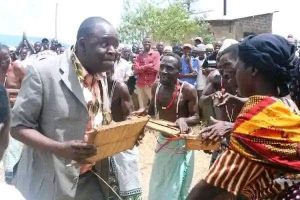
On the night of 19 November 2014, Kajwang collapsed at his Runda home. He was rushed to Mater Hospital. Hours later, he was dead.
Official cause:
Cardiac arrest from chronic heart disease.
But Kenya didn’t believe it. And the rumours exploded.
Version 1: Internal injuries
A post-mortem report allegedly found fractured ribs and internal trauma, linked to an earlier accident in Homa Bay.
Version 2: Sildenafil (Viagra) complication
Another widely circulated narrative claimed the heart attack was triggered by Sildenafil use. Doctors, family, and officials denied it — but the rumour persisted.
Version 3: Foul play
Political allies whispered of suspicious circumstances, inconsistencies in timelines, and missing details.
Version 4: Natural causes
The 2024 High Court succession ruling reaffirmed the cause of death as: “Myocardial infarction due to arteriosclerotic coronary artery disease and systemic arterial hypertension.”
But the contradictions leave a lingering shadow.
Kajwang died as he lived — dramatically, loudly, controversially.
Kajwang left behind two wives — Rose Otieno and Faith Otieno — and several children. What followed was a bitter, public, years-long war over his vast estate:
Land in Nairobi, Lavington, Ngong, Pipeline
Multiple properties in Homa Bay
Bank accounts
SACCO shares
Vehicles
Business interests
Court filings reveal accusations, counter-accusations, allegations of hidden wealth, and disputes over who qualifies as legal wife or dependant.
A decade later, the battles still simmer.
Behind the noise, Kajwang was also:
A grassroots mobiliser who ate in vibandas with ordinary people.
A comic genius, turning political storms into national theatre.
A principled rebel who challenged state media propaganda.
A flawed man, undone by scandals and personal imperfections.
A father, a husband, a brother, a political storm.
He was messy. He was magnetic. He was maddening.
But he was unforgettable.
He left a chant that became a philosophy.
A legacy that became a dynasty.
A death that became a question mark.
And a memory that still charges political rallies with electricity.
In a country where leaders speak softly and do little, Kajwang spoke loudly — and did enough to be remembered.
He was not perfect. But he was real.
And in Kenya’s political story, authenticity is rare currency.
Bado Mapambano — Because the fight Kajwang began never truly ended
He fought repression.
He fought propaganda.
He fought his own demons.
He fought Parliament — literally.
He fought for Raila.
He fought for Mbita.
He fought for Kenya.
In life, Gerald Otieno Kajwang’ roared.
In death, his echo still thunders.
BADO MAPAMBANO.
The struggle continues — because the man who made it a national anthem earned his place in Kenya’s history of fighters.



