 ADVERT
 ADVERT
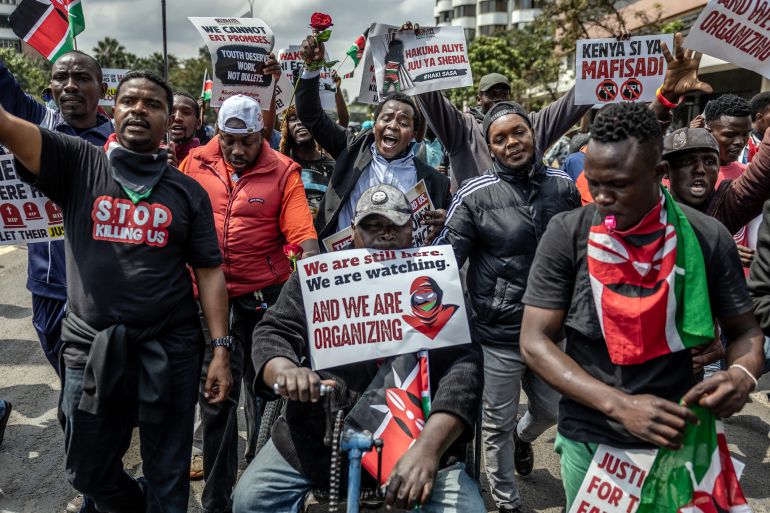
The second anniversary of Kenya’s most defining youth uprising should have been a day of solemn reflection. Instead, Nairobi witnessed a hollow commemoration — one overshadowed by political opportunism, heavy security crackdowns, and a public increasingly disillusioned with street theatrics.
Two years after the unprecedented breach of Parliament during the anti-Finance Bill protests, the capital returned to a familiar script: shuttered businesses, barricaded streets, and clouds of tear gas. The government, led by William Ruto, moved decisively to prevent a repeat of 2024’s chaos, deploying police in force and restricting access to key sites.
Interior Cabinet Secretary Kipchumba Murkomen confirmed over 350 arrests nationwide, defending the measures as necessary for public safety, even as he acknowledged the inconvenience caused. Yet the optics were unmistakable — a state still uneasy with dissent, and a capital locked down against its own memory.
At the heart of the day lay a painful contradiction. Families of those who lost their lives came seeking dignity — a chance to lay flowers, to remember, to grieve. But their quiet resolve was drowned out by megaphones and political slogans.
Opposition figures, sensing a captive audience and national attention, inserted themselves into the demonstrations, reframing a memorial into a platform for political relevance. The result was a distortion of purpose: remembrance gave way to rhetoric, and grief became a backdrop for ambition.
 ADVERT
This was not merely a disruption; it was a disservice. The Gen Z uprising was born outside traditional political structures — organic, leaderless, and fiercely independent. To retroactively claim it is to misunderstand its very essence.
Perhaps the most telling feature of this anniversary was not the protests themselves, but the restraint surrounding them.
Across Nyanza, Rift Valley, Western, and Coastal regions, the response was markedly subdued. The absence of mass mobilisation from these regions underscored a critical truth: Kenya’s protest energy is not uniform, and its political temperature varies geographically.
Many Kenyans chose distance over participation — not out of apathy, but pure caution. The scars of 2024 remain fresh. Lives were lost, livelihoods disrupted, and trust fractured. For a significant portion of the population, the streets no longer represent empowerment, but risk.
The events of June 25, 2026, reaffirm a fundamental national instinct: Kenyans prefer change through the ballot, not the barricade.
The Gen Z protests may have shaken the political establishment, but they also revealed the limits of sustained street action in a democracy where electoral accountability remains the ultimate currency. Citizens are recalibrating — choosing patience, strategy, and the long game over spontaneous upheaval.
The government’s handling of dissent continues to attract scrutiny. Allegations of excessive force and unresolved cases from 2024 linger, casting a long shadow over current actions. While the Ruto administration has acknowledged isolated abuses and set aside compensation for victims, questions of justice remain unresolved.
Yet the opposition, too, stands exposed. Its reliance on charged, often confrontational rhetoric risks deepening divisions rather than offering credible alternatives. In a nation still healing, the politics of agitation without solutions rings increasingly hollow.
What was meant to be a moment of unity became a mirror reflecting Kenya’s political contradictions. A state wary of its citizens. An opposition eager but unfocused. And a public caught in between — watchful, cautious, and quietly disenchanted.
If there is a lesson in this fractured anniversary, it is this: the legacy of June 25, 2024 cannot be preserved through noise. It demands sincerity, restraint, and above all, respect for those who paid the ultimate price.
Until then, Kenya risks turning its most powerful civic moment into just another stage for political performance — loud, visible, but ultimately empty.


