
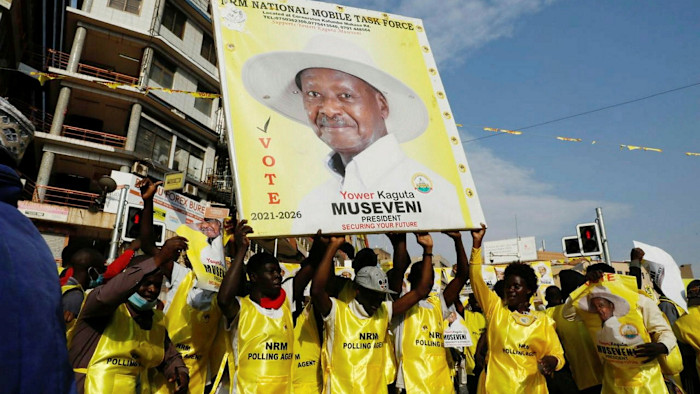
KAMPALA — Uganda’s long-serving President Yoweri Kaguta Museveni has been declared the winner of a contentious presidential election, clinching a seventh term in office and extending his rule to nearly five decades, amid allegations of fraud, violence, and a dramatic manhunt involving the opposition.
According to Uganda’s Electoral Commission, Museveni, 81, secured just under 72% of the vote, delivering a landslide victory over his closest challenger, opposition leader Robert Kyagulanyi, popularly known as Bobi Wine, who garnered 24%. The results were announced Saturday at a ceremony in the capital, Kampala.
The outcome cements Museveni’s grip on power at a moment of rising domestic tension and growing international scrutiny, with the election conducted under an internet blackout that authorities said was aimed at curbing “misinformation.”
Opposition Leader Claims Army Raid, Goes into Hiding
Bobi Wine swiftly rejected the results, alleging widespread electoral fraud and intimidation. In a dramatic twist, the opposition leader said he escaped an overnight military raid on his home, claiming security forces cut power and disabled surveillance cameras.
“Last night was very difficult at our home,” Wine wrote on X. “The military and the police raided us… I managed to escape. Currently, I am not at home.”

People close to Wine told Reuters that he was at large inside Uganda. He further alleged that his wife and family members were placed under house arrest, claims that authorities had not immediately confirmed.
Tensions spilled into violence shortly after polls closed. Police reported that seven people were killed and three injured in central Uganda after officers fired what they described as self-defensive shots against opposition “goons.”
However, local MP Muwanga Kivumbi disputed the official account, alleging that 10 people were shot dead by security forces inside his home.
Despite the clashes, authorities said fears of large-scale unrest—similar to deadly post-election violence seen elsewhere in the region—had not materialized nationwide.
Museveni’s victory was widely expected. Since taking power in 1986 after leading a guerrilla rebellion, he has rewritten the constitution twice, removing both term and age limits, and consolidating control over key state institutions.
He defeated Bobi Wine with 58% in the disputed 2021 election, which the United States said was neither free nor fair. This campaign again saw opposition rallies disrupted by security forces using tear gas and live ammunition, with hundreds arrested and at least one person killed.
Yet Museveni continues to command loyalty from segments of the population who credit him with relative stability, regional security leadership, and hosting millions of refugees. Western allies have also valued his role in deploying Ugandan troops to hotspots such as Somalia.
Campaigning under the slogan “Protecting the Gains,” Museveni promised continuity as Uganda prepares to begin crude oil production, a move expected to push economic growth into double digits.
With Museveni now in his fifth decade of rule, attention is increasingly turning to succession. He is widely believed to favor his son, Muhoozi Kainerugaba, the powerful military chief, though the president has repeatedly denied grooming him for leadership.
In a recent interview, Museveni dismissed calls to step aside.
“If I am available, not dead, not senile, and I still have knowledge,” he said, “why would you not want to take advantage of me?”
As Uganda absorbs the shockwaves of another polarizing election, Museveni’s renewed mandate secures his dominance—but the deepening rift between the state and opposition, coupled with unanswered questions about the future, suggests the political storm is far from over.


