

• Fri. Oct 23rd, 2026
ADVERT

2026 Mazda CX-5 Revealed: Bigger, Bolder, and Button-Less

ByContributor

Jul 12, 2025
ADVERT
Spread the love
ADVERT

Don’t let the recent success of the CX-50 and CX-70 fool you—the Mazda CX-5 is still the automaker’s bread and butter. Last year, record sales helped propel Mazda to its best year in company history. For 2026, Mazda aims to keep the sales momentum going by giving its best-selling model its first major makeover in nearly a decade.
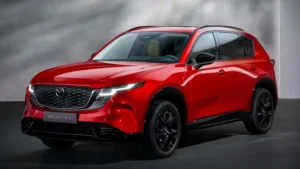
Though it may look familiar on the surface, the 2026 Mazda CX-5 is entirely new from the ground up. Its wheelbase is 3.0 inches longer than before, which gives the CX-5 an extra 4.5 inches of total length as a result. At around 184.6 inches long, that brings the CX-5 closer to rivals like the Honda CR-V (184.8 inches) and Nissan Rogue (183.0 inches).

That extra length results in larger door openings for easier ingress and egress—a chief complaint of the previous model. Even though the company has yet to provide official measurements, Mazda also promises that the CX-5 has one of the roomiest second rows in its class.

Trunk space also improves thanks to that newfound length. The rear hatch has a slightly wider and half-inch lower opening for easier loading, plus buyers get an additional 2.0 inches in cargo length and an extra 1.0 inch in load height.

Kodo, Evolved
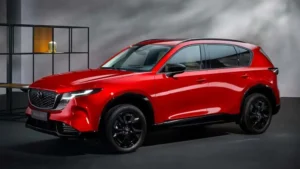
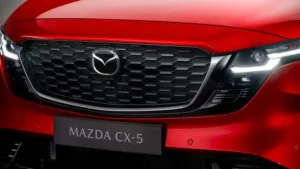
Wearing an updated version of the brand’s signature Kodo design language, the CX-5 has a unique front fascia with stacked headlights. Mazda promises that the new design language will extend to the rest of the lineup. The signature “Wing” grille is sharper, too, while additional details on the front bumper accentuate the CX-5’s now-wider stance.

ADVERT

The rear introduces a new “MAZDA” wordmark badge across the trunk lid (which also makes its way inside to the steering wheel), while the taillights are sharper—reminiscent of the larger CX-70. Buyers will also be able to opt for sporty 19-inch wheels on the top trim.

Hybrid Coming Soon
Powering the 2026 CX-5 is the same four-cylinder engine from last year: A naturally aspirated 2.5-liter unit making 187 horsepower and 185 pound-feet of torque. It’s paired to a six-speed automatic transmission and standard all-wheel drive.
But don’t worry, Mazda isn’t sticking with pure combustion power forever. In 2027, the CX-5 will get a new hybrid powertrain. Unlike the CX-50, though, which pairs a Toyota hybrid system with a 2.5-liter engine, the CX-5 will be the first Mazda with the brand’s new Skyactiv-Z engine, complete with its own hybrid system.

Mazda has already dubbed its new Skyactiv-Z unit the “ideal internal combustion engine.” And the company promises “even higher thermal efficiency and an overwhelmingly wider range” than the Skyactiv-G engine currently in the CX-5.

Big Screen—But No Buttons
Arguably, the most significant changes to the CX-5 are inside. The SUV boasts a sizable 15.6-inch center touchscreen display—the biggest on any Mazda product to date. It runs a new user interface with Google Built-In technology, complete with features like Google Assistant, Google Maps, and more.

Unfortunately, there isn’t a single hard button located on the dashboard or near the gear lever. The 2026 CX-5 ditches the former command controller and volume knob, both located near the gear shifter, for touchscreen and steering wheel controls exclusively. That said, the steering wheel controls are hard buttons; there are no flimsy touch-capacitive controls.
The CX-5 also promises a robust suite of driver assistance features, including a few new options as part of the automaker’s latest Advanced Driver Assistance System.

Pricing & Availability
There’s still plenty we don’t know about the 2026 Mazda CX-5—most notably, price.

The 2025 Mazda CX-5 starts at $30,265 with the $1,495 destination fee included. The 2026 CX-5 shouldn’t be significantly pricier than the current model, but a minor price hike could push the SUV closer to a $32,000 starting price.

The new Mazda CX-5 will likely hit dealerships before the end of the year.

Source: Motor 01

Author

Leave a Reply

Your email address will not be published. Required fields are marked *

ALSO READ

Ne-Yo Lights Up Nairobi as Stanbic Bank’s Mashujaa Day Concert Draws 3,500 Fans Grammy-winning R&B superstar headlines ‘One Night Only: Brunch Edition’ at Ulinzi Sports Complex as Stanbic Bank backs Kenya’s creative economy and local enterprise NAIROBI, October 21, 2026 — Nairobi’s entertainment scene came alive on Mashujaa Day as approximately 3,500 music fans gathered at Ulinzi Sports Complex for One Night Only: Brunch Edition with Ne-Yo, a premium live-music experience title-sponsored by Stanbic Bank. The concert, held on Tuesday, October 20, delivered an afternoon of live performances, music and networking, bringing together Kenyan and international talent for a celebration that blended world-class entertainment with opportunities for the country’s growing creative economy. Performances began at 3:30 pm and concluded shortly after 8:00 pm, maintaining the event’s signature daytime brunch format while giving fans an opportunity to experience some of the biggest names on the lineup before nightfall. Kenyan musician Mutoriah opened the show with an energetic set, setting the pace for the afternoon. UK-based band Sol and the Gang followed with a vibrant performance before three-time Grammy Award-winning American R&B star Ne-Yo took centre stage to close the concert in style. Top Kenyan DJs kept the predominantly millennial audience entertained throughout the event, sustaining the energy between performances and reinforcing Nairobi’s growing appetite for curated, premium music experiences. Stanbic Bank puts creative economy in the spotlight Beyond the music, the concert highlighted the commercial opportunities generated by Kenya’s live-entertainment industry, with Stanbic Bank positioning its sponsorship as an investment in the wider creative ecosystem. The production created business opportunities across multiple segments of the value chain, including artists, sound engineers, stage and technical crews, production specialists, hospitality providers, security personnel, vendors and micro- and small enterprises. For an industry that relies heavily on collaboration among creative professionals and service providers, events of this scale can stimulate local demand, support livelihoods and open new commercial opportunities for businesses operating behind the scenes. Michael Mutiga, Chief Executive of Stanbic Bank Kenya and South Sudan, said the concert demonstrated how large-scale entertainment can combine audience appeal with tangible economic activity. “Yesterday was a powerful demonstration of what happens when world-class entertainment meets meaningful local economic impact,” Mutiga said. He noted that bringing more than 3,000 fans together went beyond the performances on stage, generating business for artists, technical teams, vendors, hospitality partners and small enterprises involved in delivering the event. “Kenya’s creative sector is a dynamic driver of growth, and Stanbic Bank remains committed to strengthening this ecosystem, raising its commercial profile, and supporting the livelihoods anchored in it,” he added. Creative industry contributes 5.32% of Kenya’s GDP The sponsorship comes against the backdrop of the creative economy’s contribution to employment, enterprise development and national output. A 2021 report by the World Intellectual Property Organization (WIPO) and the Kenya Copyright Board (KECOBO) placed the creative industry’s contribution to Kenya’s gross domestic product at 5.32%, while estimating that the sector provided formal employment for approximately 195,000 people. The industry also supports livelihoods across the informal economy, including performers, independent producers, event organisers, designers, content creators, technicians and small businesses that supply goods and services to entertainment productions. Stanbic Bank’s approach underscores the potential of cultural events to serve as more than marketing platforms. By bringing together consumers, performers, businesses and corporate sponsors, such events can create opportunities for local talent, showcase production capabilities and connect home-grown enterprises to wider commercial networks. However, the long-term impact of such initiatives depends on whether the opportunities generated translate into sustained contracts, improved incomes and stronger business prospects for local players beyond individual events. Stanbic Bank celebrates premium daytime entertainment Lilian Onyach, Head of Brand and Marketing at Stanbic Bank Kenya, said the event was designed to offer clients and music enthusiasts a distinctive, world-class daytime entertainment experience. She said the turnout and audience energy reflected the vibrancy of Kenya’s entertainment market and the growing appeal of carefully curated live-music events. “We set out to offer our clients and music enthusiasts a distinctive, world-class daytime experience, and the turnout and energy yesterday proved just how vibrant Kenya’s entertainment market is,” Onyach said. She added that the afternoon schedule allowed the event to preserve its brunch atmosphere while showcasing the artistry, logistical expertise and commercial capacity of Kenya’s creative industry. The format also reflects a broader opportunity for event organisers and sponsors to diversify entertainment offerings beyond traditional late-night concerts, creating experiences that appeal to audiences seeking music, social interaction and premium hospitality in a single setting. Brand recognition reinforces Stanbic Bank’s market position The Ne-Yo concert adds to Stanbic Bank’s brand-building initiatives as the lender continues to pursue market visibility through entertainment, customer engagement and support for economic activity. The bank was recently named Overall Best Bank in Kenya at the Think Business Awards. At group level, its parent, Standard Bank Group, was ranked Africa’s Most Valuable Bank Brand by Brand Finance for the fifth consecutive year. Through sponsorships such as One Night Only, Stanbic Bank is seeking to connect its brand with experiences that attract consumers while supporting businesses and professionals in adjacent industries. As Kenya’s creative sector continues to evolve, the commercial value of live entertainment will increasingly depend on the ability of organisers, sponsors and industry players to convert audience demand into sustainable opportunities for artists, entrepreneurs and the wider workforce. At Ulinzi Sports Complex, Ne-Yo provided the headline attraction, but the broader story extended beyond the stage: a major public celebration that brought international music to Nairobi while spotlighting the economic potential of Kenya’s creative industries