 ADVERT
 ADVERT
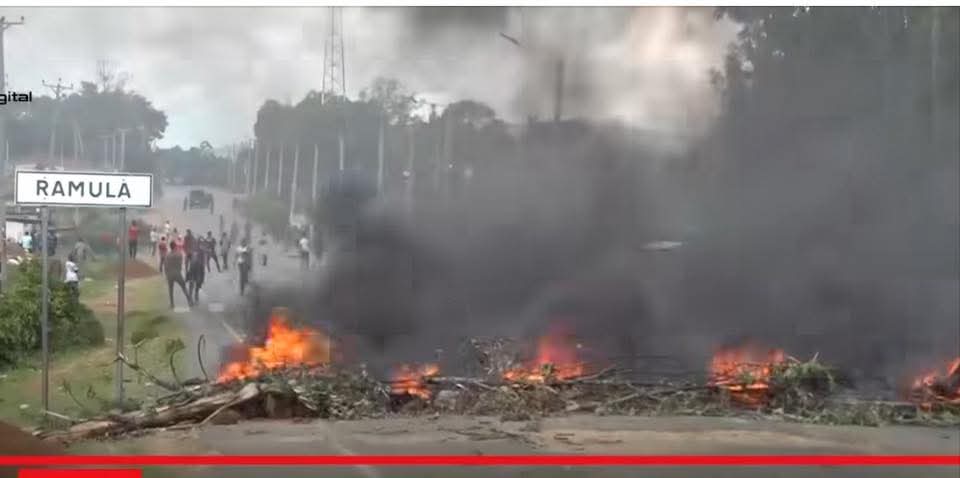
What began as a desperate stand against forced evictions for a major gold mining project has spiralled into deadly violence, claiming two young lives and plunging an entire community into fear and fury.
On Monday, April 6, 2026, an estimated 700 youths stormed Ramula Police Post in Gem Yala Sub-County, pelting officers with stones, damaging vehicles and buildings, and torching a nearby tractor. Police responded with live ammunition inside the station compound, shooting dead two protesters. At least 47 officers sustained injuries in the chaotic clash.
The victims were identified locally as Henry Otieno and Jack Omenda, though official names are yet to be confirmed by authorities.
At the heart of the unrest lies Shanta Gold Kenya Limited’s ambitious West Kenya Gold Project. The company holds a mining licence for large-scale open-pit operations in Ramula, which would require resettling over 1,200 households. Residents accuse the firm of inadequate compensation, poor community engagement, and pushing ahead with relocations despite a February 5, 2026, Environment and Land Court order barring involuntary evictions pending a full hearing.
For many locals, the land represents not just homes, but ancestral heritage, livelihoods, and identity. While some see the project as a pathway to jobs and economic growth, deep mistrust over transparency and fairness has turned promise into protest.
 ADVERT
In the days following the violence, elite General Service Unit (GSU) officers were deployed to restore order. Instead, local leaders say their presence has transformed Ramula into a virtual war zone, with residents fleeing their homes, businesses shuttered, and normal life paralysed.
East Gem MCA Seth Baraka painted a harrowing picture: “The mere presence of GSU at Ramula Centre is intimidation. People are fleeing their homes.” He claimed officers disrupted a media briefing and even pursued him despite knowing he was an elected leader.
Siaya County Assembly Speaker George Okode was more forceful in his condemnation. Speaking at a press briefing alongside other county leaders, Okode declared: “Ramula is deserted. Businesses are shut, health services disrupted, and fear has taken over. The continued presence of GSU is paralysing normal life.”
He demanded the immediate withdrawal of the paramilitary unit and direct intervention from senior government officials. “We cannot resolve a land and livelihood dispute through force,” Okode stressed. “Dialogue—not brutality—must guide the way forward.”
Overnight, five more houses believed to belong to residents seen as sympathetic to the mining project were torched, raising fears of escalating reprisals and deepening community divisions.
Police maintain the demonstration was unlawful and that protesters attacked first, forcing them to defend the station. Shanta Gold officials have continued resettlement validation exercises on the ground, moves critics say only inflamed tensions further.
The tragedy has ignited sharp questions across Kenya: Can large-scale mining investments justify displacing communities? Are security forces being used to shield investors at the expense of citizens’ rights? And where is the balance between national development goals and local consent?
Leaders including Gem MP Elisha Odhiambo and Yala Township MCA William Kinyanyi have called for calm, accountability, and genuine dialogue. “Why should people die for gold to be extracted?” Kinyanyi asked pointedly.
As additional police reinforcements arrive and tensions remain high, Ramula stands at a dangerous crossroads. The gold beneath its soil once symbolised hope. Now, it risks becoming a symbol of how quickly resource wealth can tear communities apart when governance fails.
For peace to return, urgent steps are needed: withdrawal of heavy security, respect for court orders, transparent compensation talks, and inclusive dialogue that puts residents at the centre.
In Ramula today, the true cost of gold is no longer counted in ounces — but in spilled blood, abandoned homes, and a fragile social fabric pushed to breaking point. The coming days will reveal whether Kenya learns from this tragedy, or allows history to repeat itself in its mineral-rich regions.



