 ADVERT
 ADVERT
Siaya is entering a new and potentially dangerous chapter in its political history.
For decades, politics in the county was largely organised around the towering influence of the late Raila Odinga and the remarkable electoral discipline that came to be associated with the famous “six-piece” voting pattern. That political order offered a degree of predictability: party affiliation often mattered more than the individual candidate.
That era is over.
The political marketplace in Siaya is now wide open. David Ochieng’s Movement for Democracy and Growth, ODM, UDA and other political formations are positioning themselves for 2027. The competition is likely to be far more intense than anything the county has experienced in recent electoral cycles.
That should be good for democracy.
 ADVERT
But without political maturity, competition can quickly become confrontation.
The warning signs are already there.
Recent political tensions in Siaya have included disruptions at political gatherings, confrontations involving youths and accusations of goonism. In July, Alego-Usonga MP Samuel Atandi publicly warned youths against storming his meetings and surrounding his vehicle. Earlier, an ODM faction’s political tour in Ugunja was disrupted by youths chanting rival political slogans.
And the wider region has offered an even more disturbing reminder of where political intolerance can lead. The deadly violence witnessed in Kisumu and elsewhere in July prompted the National Police Service to condemn political intolerance and goonism.
Siaya does not need to import that culture.
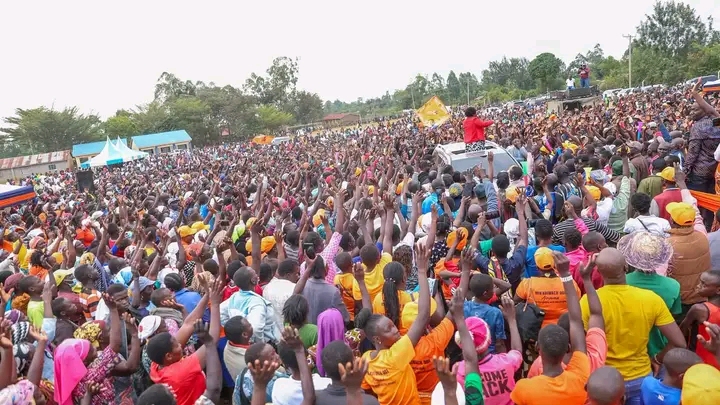
Nor should politicians mistake a large crowd for a large mandate.
A crowd is not a development record
There is a dangerous political theatre taking root in which the size of a rally is presented as evidence of political strength.
It is not.
A crowd can be mobilised. It can be transported. It can be entertained. It can be attracted by lunch money, transport facilitation, promises or the simple expectation of receiving something from a politician.
That does not necessarily translate into votes.
Politicians therefore need to stop measuring themselves by the number of people they can assemble under a tent or along a roadside.
The more important question is brutally simple:
What have you done for the people?
How many classrooms have you helped build?
How many kilometres of roads have you facilitated?
How many young people have acquired sustainable livelihoods?
How many health facilities have improved because of your interventions?
How many farmers have accessed markets, irrigation, inputs or value addition?
How many legislative interventions can you point to?
What measurable difference has your leadership made to an ordinary family?
Those are the questions voters should be asking.
Indeed, even within Siaya’s political discourse there is growing recognition that leadership should be judged by service rather than confrontation. Principal Secretary Raymond Omollo recently urged Siaya residents to measure leadership through integrity, service and the ability to improve people’s lives rather than political confrontation.
That is precisely the conversation the county needs.
Competition is healthy — violence is not
There is nothing inherently wrong with ODM facing serious competition in Siaya.
In fact, competition could be one of the best things to happen to the county.
For years, the political dominance of ODM made it difficult for alternative political formations to establish themselves. But David Ochieng’s political survival in Ugenya demonstrates that voters are capable of making independent choices.
Ochieng defeated an ODM candidate in the 2019 Ugenya by-election, winning 18,730 votes against Christopher Karan’s 14,507. The contest was nevertheless marred by pockets of violence, allegations of voter bribery and low turnout.
Today, Ochieng is openly positioning MDG as a national political vehicle and has rejected the idea that ODM-UDA arrangements should prevent his party from fielding candidates in Nyanza.
Whether one supports Ochieng or opposes him is beside the point.
The important democratic principle is that voters deserve genuine choices.
Political zoning, informal succession arrangements and behind-the-scenes deals may make life easier for party establishments, but they can impoverish democracy when they deny voters meaningful alternatives.
Ochieng himself has argued that competition encourages voters to choose the best leaders.
Siaya should test that proposition.
Let every serious politician come.
Let every party compete.
Let every candidate sell his or her record.
And let the voters decide.
The six-piece era is gone
The death of Raila Odinga has fundamentally altered Nyanza’s political landscape. Even within ODM, competing factions have emerged over the party’s direction and relationship with President William Ruto’s administration.
The old assumption that a particular party could simply dictate the electoral outcome in Siaya should therefore be discarded.
That reality presents both an opportunity and a danger.
The opportunity is that politicians can no longer rely entirely on inherited political loyalty. They must work harder to convince voters.
The danger is that some may attempt to manufacture loyalty through intimidation, mobilisation of unruly youths, inflammatory rhetoric or political patronage.
That would be a tragedy.
Siaya has already witnessed enough bloodshed and confrontation in different contexts. In April, two people were shot dead after protesters stormed Ramula Police Post during tensions surrounding a gold-mining dispute in Gem. While that incident was not itself a partisan political contest, it demonstrated how quickly local grievances can escalate into deadly confrontation when dialogue and lawful processes break down.
The lesson should not be lost on political actors.
Politicians must leave their bad manners at the county border
The 2027 election will attract politicians from across Kenya.
That is normal.
But Siaya should not become a laboratory for imported political intolerance.
The county should be a difficult place for political mediocrity, not a fertile ground for political violence.
Politicians coming to Siaya should understand that residents are not political property belonging to any party, family, faction or ethnic kingpin.
They are citizens.
They have constitutional rights.
They can attend an ODM rally in the morning, listen to an MDG candidate in the afternoon and hear a UDA politician the following day.
That is democracy.
Nobody should be branded a traitor because they listened to another politician.
Nobody should be attacked because they wore another party’s colours.
Nobody should be transported into a rally merely to create the illusion of popularity.
And no politician should build a political career around the capacity to summon youths who are prepared to fight opponents.
The county’s political class must understand that goonism is not grassroots mobilisation. It is a failure of leadership.
Siaya voters should demand receipts
This is perhaps the most important challenge ahead of 2027.
Voters should demand receipts.
Not literally receipts from political rallies — but evidence of performance.
A politician arriving with hundreds of supporters should be asked what those supporters have gained from his or her leadership.
A candidate boasting about an enormous political following should be asked how that following has translated into schools, hospitals, jobs, water, roads, markets, agricultural productivity and accountable governance.
And politicians should be prepared to answer.
There is already substantial development activity in Siaya involving both levels of government. President William Ruto has announced major investments including markets, electricity connections and blue-economy infrastructure, while plans have also been advanced for a 500-bed expansion of Siaya Referral Hospital and the upgrading of Jaramogi Oginga Odinga Stadium.
The political argument should therefore move beyond who can gather the biggest crowd.
It should be about who can ensure such investments actually reach the people.
Who can attract investment?
Who can create jobs?
Who can improve county revenue?
Who can make Siaya’s agriculture commercially viable?
Who can fix urban planning?
Who can improve healthcare?
Who can hold government accountable?
Who can negotiate development without mortgaging the county’s political independence?
Those are gubernatorial questions.
Those are parliamentary questions.
Those are MCA questions.
They are certainly more important than who brought the biggest number of young men to a rally.
Let 2027 be a contest of ideas
Siaya has an opportunity to demonstrate that political competition does not have to produce political chaos.
ODM can defend its record.
MDG can sell its alternative.
UDA can explain what it offers.
Other parties and independent candidates can make their case.
Incumbents can defend their performance.
Challengers can explain what they would do differently.
And voters can judge all of them.
That is how mature democracy works.
The county should not be frightened by competition. It should embrace it — while demanding that every competitor plays by the rules.
The real political revolution in Siaya would not be replacing one party with another.
It would be replacing crowd politics with performance politics.
The politician with 10,000 people at a rally should not automatically be considered stronger than the politician who can demonstrate that 10,000 families have benefited from his or her work.
Let politicians bring their manifestos.
Let them bring their development records.
Let them bring audited achievements, legislative records and measurable results.
But let them leave the goons, intimidation, handout politics and political theatre at home.
Siaya does not need to know how many “sangwenya” a politician can command. It needs to know how many lives that politician can change.
That should be the standard.
And come 2027, voters should be bold enough to say:
Show us your development record — not the size of your crowd.



