 ADVERT
 ADVERT
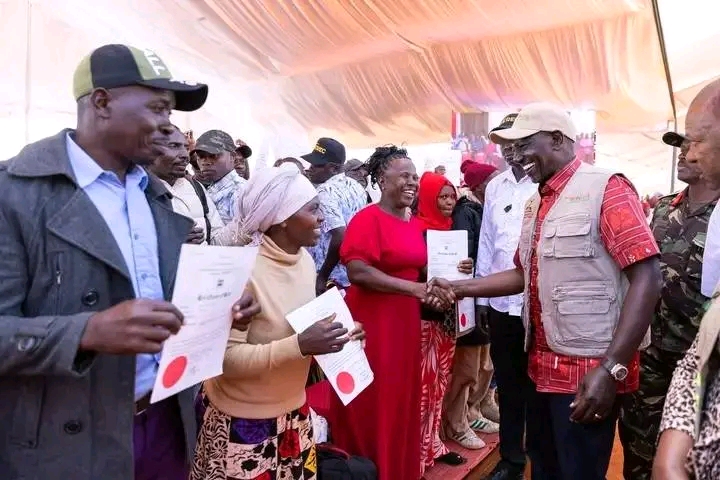
Cabinet secretary Opiyo Wandayi with President William Ruto in Taita Taveta County for the issuance of title deeds to residents of Chawuse, Old Mwatate Market, Bura Ndogo and Kaloleni in Mwatate Constituency, Taita Taveta County marks a decisive moment in the country’s development trajectory. The event underscores the government’s commitment to resolving long standing land ownership challenges while advancing electrification in underserved areas. Land ownership is a foundation of economic empowerment and this agenda complements the government’s investment in the Last Mile Connectivity Program with significant allocation to electrification in Taita Taveta, targeting thousands of households. By expanding electricity access while strengthening land ownership under President Ruto, the administration is laying the foundation for productive homes, thriving small businesses and stronger local economies.
Development must deliver both opportunity and dignity. From secure land tenure to electricity connectivity, these interventions demonstrate a commitment to equitable development by bridging historical divides, including underserved communities and ensuring that every region has a stake in Kenya’s progress. The issuance of title deeds in Mwatate and other parts of Taita Taveta responds to decades of uncertainty for residents who have lived without formal documentation of ownership. For many families, the title deed represents more than a piece of paper. It is recognition of their place in the national story and a tool for planning their future with confidence. When people know their land is secure, they invest in it, they build better homes, they plant trees, they open small enterprises, and they participate more fully in the local economy.
The presence of the Cabinet Secretary for Energy and Petroleum alongside the President signals that land and energy are being treated as interconnected pillars of development rather than separate projects. Electricity access without secure land tenure leaves households vulnerable, while land ownership without power limits the productivity of that land. The Last Mile Connectivity Program in Taita Taveta is designed to bring power to households that have waited long enough, enabling them to use appliances, run small machines, keep food fresh, and study after dark. These are not abstract benefits. They are daily improvements that change how people live and work. The government’s allocation for electrification in the county reflects a deliberate choice to prioritize areas that have historically been left behind in national infrastructure planning.
The focus on Mwatate Constituency and specific localities such as Chawuse, Old Mwatate Market, Bura Ndogo and Kaloleni shows attention to detail in the implementation of national policy. These are places where people have asked for recognition and for services, and the response from the state is now visible in the form of title deeds and electricity projects. The President’s directive to the Cabinet Secretary and the Principal Secretary to ensure completion of electricity projects before the end of the year reinforces the seriousness with which this agenda is being pursued. Timelines matter because delayed projects delay the benefits that communities expect from public investment. When the government sets a deadline and meets it, trust between citizens and the state grows stronger.
Land reform and electrification together create conditions for broader economic activity. A household with a title deed can plan for the long term, knowing that improvements made today will not be lost tomorrow. A household with electricity can extend productive hours, reduce reliance on expensive and harmful alternatives for lighting and cooking, and connect to information and services that depend on power. Small businesses such as shops, salons, welding yards, and milling operations become more viable when they have both secure premises and reliable energy. This is how local economies begin to grow from the ground up, driven by the initiatives of residents who now have the basic tools to succeed.
 ADVERT
The emphasis on equitable development is central to this approach. Historical divides in Kenya have often been geographic, with some regions receiving more attention and resources than others. The current administration’s focus on the Coast, including Taita Taveta, seeks to correct this imbalance by ensuring that every region has a stake in national progress. The issuance of title deeds across multiple coastal counties, with Taita Taveta receiving a substantial allocation, is part of a wider plan to address land ownership challenges that have persisted for generations. This is not a one off event but a sustained effort that includes surveying, adjudication, compensation where necessary, and the actual distribution of ownership documents. The scale of the exercise reflects the magnitude of the problem and the determination to solve it.
Secure land tenure also strengthens social stability. Many disputes in Taita Taveta and other parts of the Coast have arisen from unclear ownership, overlapping claims, and the absence of formal records. By clarifying who owns what, the government reduces the potential for conflict and creates a more predictable environment for investment and development. Communities become more cohesive when people are not fighting over land but are instead focused on improving what they already have. This is a critical foundation for any long term development plan, because without peace and order, other interventions cannot take root.
The integration of land and energy initiatives also speaks to a broader vision of what development should look like. It is not enough to build roads or schools in isolation. These investments must be supported by secure land ownership and access to power if they are to deliver their full impact. A school with electricity can use computers and lights, but if the land it sits on is disputed, its future is uncertain. A clinic with power can store vaccines and operate equipment, but if the surrounding community lacks secure tenure, the population it serves may remain unstable and transient. The government’s approach in Taita Taveta recognizes these interdependencies and seeks to address them together.
The role of leadership in this process cannot be overstated. The President’s personal involvement in the issuance of title deeds and the flagging off of electricity projects sends a clear message that these are priorities at the highest level of government. The Cabinet Secretary for Energy and Petroleum’s presence reinforces the technical and administrative commitment to delivering on these promises. When leaders are seen on the ground, engaging directly with beneficiaries, it strengthens the connection between policy and people. It also holds the bureaucracy accountable, because the expectations set by such visits are public and measurable.
The focus on productive homes and thriving small businesses reflects an understanding that national economic growth is built on the accumulation of countless local successes. When households become more productive, when small enterprises expand, when local markets become more active, the entire economy benefits. This is a bottom up approach to development that starts with the basics, land and power. It is an approach that recognizes the agency of ordinary citizens and seeks to equip them with the tools they need to succeed. The government’s role is to create the enabling environment, to remove the barriers that have held people back, and to provide the infrastructure that makes progress possible.
The commitment to completing electricity projects before the end of the year is a test of implementation capacity. It is one thing to announce projects. It is another to deliver them on time and to the required standard. The directive to the Cabinet Secretary and the Principal Secretary places responsibility squarely on the energy sector to ensure that materials are procured, contractors are supervised, and connections are made without unnecessary delay. This is where the success of the entire initiative will be judged, not in the announcements but in the actual lights that come on in homes and businesses across Taita Taveta. The residents who have waited for power will be the ultimate arbiters of whether this promise has been kept.
The broader context of the Coast development tour, which includes multiple counties and a range of projects, shows that Taita Taveta is part of a larger regional strategy. The issuance of title deeds in Kwale, Kilifi, Lamu, Mombasa and Tana River alongside those in Taita Taveta indicates a coordinated effort to address land and infrastructure deficits across the entire region. This is important because development that is confined to one area while neighbors remain behind can create new imbalances. A regional approach ensures that gains are shared more evenly and that the Coast as a whole moves forward. The inclusion of other projects such as roads, water, and the East Africa Refinery in Lamu further reinforces the comprehensive nature of this development push.
The emphasis on dignity in development is a reminder that these interventions are about more than economic metrics. They are about recognizing the worth of every citizen and ensuring that no one is left without the basic tools to participate in the economy. A title deed restores dignity to a family that has lived in uncertainty for years. Electricity restores dignity to a household that has relied on kerosene lamps and firewood for too long. These are tangible expressions of the government’s commitment to equitable development and social justice. They signal that the state sees its citizens as partners in progress, not as passive recipients of aid.
The focus on underserved communities is a deliberate correction of past neglect. Taita Taveta and other parts of the Coast have not always received the attention they deserve in national development planning. The current administration’s efforts to bridge these historical divides are a recognition that true national progress requires the inclusion of all regions. This is not about charity. It is about fairness and about unlocking the potential that has been constrained by lack of land security and electricity access. When these constraints are removed, communities can thrive on their own terms, contributing to the national economy in ways that were previously impossible.
The integration of land and energy initiatives also has implications for environmental sustainability. Secure land tenure encourages long term stewardship of the land, including tree planting, soil conservation, and sustainable farming practices. Access to electricity reduces reliance on firewood and charcoal, which contribute to deforestation and indoor air pollution. These are co benefits that align with broader national and global goals on climate change and environmental protection. Development that is sustainable is development that can be maintained over the long term, benefiting not just the current generation but future ones as well.
The role of the Cabinet Secretary for Energy and Petroleum in this initiative highlights the importance of technical leadership in implementing complex development programs. The energy sector is responsible for planning, procuring, and overseeing the implementation of electrification projects, which require specialized knowledge and coordination with multiple stakeholders. The Cabinet Secretary’s involvement ensures that these technical aspects are managed effectively and that the projects deliver the intended outcomes. This is a reminder that development is not just about political will. It is also about administrative capacity and technical expertise.
The focus on local economies and small businesses reflects an understanding that national economic growth is driven by the accumulation of local successes. When households become more productive, when small enterprises expand, when local markets become more active, the entire economy benefits. This is a bottom up approach to development that starts with the basics, land and power. It is an approach that recognizes the agency of ordinary citizens and seeks to equip them with the tools they need to improve their own lives. The government’s role is to create the enabling environment, to remove the barriers that have held people back, and to provide the infrastructure that makes progress possible.
The commitment to equitable development and the inclusion of all regions in national progress is a defining feature of this administration’s approach. The issuance of title deeds and the expansion of electricity access in Taita Taveta and other parts of the Coast are concrete examples of this commitment in action. They demonstrate that the government is serious about addressing historical imbalances and ensuring that every Kenyan has the opportunity to participate in the country’s development. This is a vision of Kenya where no one is left behind, where every region has a stake in the national project, and where development delivers both opportunity and dignity to all.


