 ADVERT
 ADVERT
Age is just a number, and Kenya’s marathon king Eliud Kipchoge has delivered another breathtaking demonstration of that timeless sporting truth.
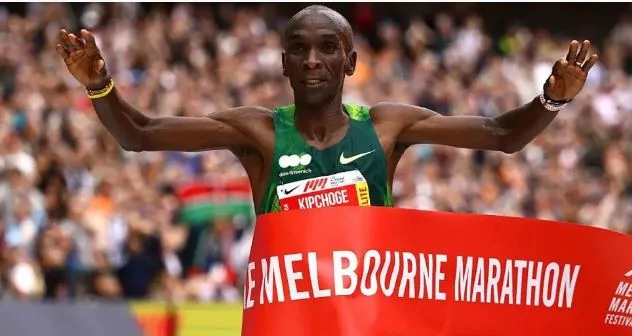
The 41-year-old distance-running legend stormed to victory at the Nike Melbourne Marathon on Sunday, October 11, 2026, setting a new course record of 2 hours, 9 minutes and 10 seconds to end a three-year wait for a marathon title and remind the world that his competitive fire remains very much alive.
In a performance that blended patience, tactical intelligence and extraordinary endurance, Kipchoge broke away from his rivals in the closing stages before powering towards the finish inside the iconic Melbourne Cricket Ground (MCG).
The Kenyan shaved two seconds off the previous course record, completing his 17th career marathon victory and delivering one of the most compelling chapters in his remarkable sporting journey.
KIPCHOGE’S MESSAGE: I’M NOT FINISHED YET
 ADVERT
For an athlete whose career has already redefined the limits of human endurance, Melbourne was about more than another trophy.
It was a statement of resilience, ambition and an enduring appetite for competition.
After crossing the finish line, Kipchoge made it clear that he has no intention of surrendering to the passage of time.
“I believe that my body is still peaking — still able to compete with the next generation,” he said, expressing satisfaction at competing alongside younger runners.
“The oldest athlete is still competing but I am happy to run with the Gen Zs.”
His words offered a glimpse into the mindset that has sustained him through years of gruelling training, global competition and the relentless physical demands of elite marathon running.
Rather than treating age as a limitation, Kipchoge appears determined to use his experience as an advantage, demonstrating that discipline, preparation and mental strength can extend an athlete’s competitive lifespan.
A MASTERCLASS IN PATIENCE AND PRECISION
Kipchoge’s victory was built on tactical discipline rather than a reckless early assault on the course.
He remained in contention during the opening stages, running alongside Australian challengers before making his decisive move in the latter part of the 42.2-kilometre contest.
Once he accelerated, the race changed dramatically.
The Kenyan gradually pulled clear, leaving his opponents struggling to match his rhythm as he pressed towards the finish.
Australian Thomas Do Canto secured second place in 2:10:35, while compatriot Reece Edwards completed the men’s podium in 2:14:33.
Kipchoge’s winning margin over Do Canto was 85 seconds — a significant gap in an elite marathon and a testament to the effectiveness of his late-race surge.
His performance was particularly impressive given that he was making his Melbourne Marathon debut.
The course took runners along some of the Australian city’s most recognisable routes, including sections around Albert Park and the Formula One circuit, before delivering them to a spectacular finish inside the MCG.
As he approached the finishing line, Kipchoge took time to acknowledge the cheering spectators, briefly slowing to wave to the crowd.
It was a fitting gesture from a champion whose appeal extends beyond finishing times and medals.
THREE YEARS LATER, THE WINNER RETURNS
Kipchoge’s Melbourne triumph ended a title drought stretching back to his victory at the Berlin Marathon in September 2023.
The intervening period presented challenges that would have tested even the most accomplished athletes.
He finished 10th at the 2024 Tokyo Marathon, failed to finish the marathon at the Paris Olympics that year and placed sixth at the 2025 London Marathon.
For an athlete accustomed to winning the world’s biggest races, those results marked a difficult chapter in a career defined by extraordinary consistency.
Melbourne has now provided a powerful response.
The victory does not erase the challenges of recent years, but it demonstrates that Kipchoge remains capable of competing at a high level against younger opposition.
At 41, he has added another major milestone to a career that has already secured his place among the greatest marathon runners in history.
FROM OLYMPIC GLORY TO GLOBAL RUNNING AMBASSADOR
Kipchoge’s achievements have long transcended individual race results.
The Kenyan won Olympic marathon gold at Rio 2016 and successfully defended his title at the Tokyo Games in 2021, becoming one of the defining figures of modern distance running.
He has also established himself as one of the most successful competitors in the World Marathon Majors, winning multiple titles in Berlin and London, among other major international races.
In 2019, he made history in Vienna by becoming the first person to complete the marathon distance in under two hours during the INEOS 1:59 Challenge.
Although that performance was not recognised as an official world record because it took place under specially arranged conditions, it remains one of the most celebrated feats in athletics.
The achievement reinforced Kipchoge’s belief that human potential can be expanded through a combination of preparation, innovation and an uncompromising commitment to excellence.
His Melbourne performance has added fresh substance to that philosophy.
SEVEN CONTINENTS, ONE AMBITION
Beyond the immediate glory of victory, Melbourne formed part of Kipchoge’s ambitious global running tour.
The project aims to take him to all seven continents over a period of approximately two years, including Antarctica, while using running to inspire communities and encourage healthier lifestyles.
Melbourne was the third stop on the journey, following races in Cape Town, South Africa, and Porto Alegre, Brazil.
The initiative represents a shift in emphasis for the veteran champion: from pursuing records and major titles to using his international profile to promote participation in running and demonstrate its power to unite people across cultures.
His reception in Melbourne suggested that the mission is already striking a chord.
The MCG crowd cheered the Kenyan as he approached the finish, and Kipchoge spent time acknowledging fans after the race.
For a city celebrated for its sporting culture, his appearance provided an opportunity to witness one of athletics’ most recognisable figures in action.
CAMILLE FRENCH CLAIMS WOMEN’S CROWN
While Kipchoge dominated the men’s contest, New Zealand’s Camille French delivered an equally memorable performance in the women’s race.
French won in 2:28:25, finishing ahead of Australia’s Sinead Diver, who clocked 2:28:49.
Ireland’s Nichola Sheridan took third place in 2:29:13.
French’s victory added another international dimension to a race that showcased the depth of marathon talent across several countries.
KENYA’S ENDURING MARATHON LEGACY
For Kenya, Kipchoge’s latest triumph is another reminder of the country’s remarkable contribution to global distance running.
From the high-altitude training grounds of the Rift Valley to the streets of the world’s biggest cities, Kenyan athletes have built a reputation for endurance, tactical sophistication and extraordinary competitive spirit.
Kipchoge remains one of the most prominent ambassadors of that tradition.
His success in Melbourne also carries a message for emerging athletes: setbacks need not signal the end of a career, and past achievements do not have to become the limits of future ambition.
The three-year wait for another marathon victory could easily have become a narrative of decline.
Instead, Kipchoge has rewritten the story with a course record and a commanding performance against younger rivals.
His victory is a reminder that sporting greatness is not measured solely by the speed of a runner’s legs, but also by the discipline to keep preparing, the courage to keep competing and the resilience to return after disappointment.
At 41, the Kenyan legend has once again given the world reason to watch his next move.
In Melbourne, Kipchoge did more than win a marathon. He reminded the world that his remarkable story is still being written.



