 ADVERT

 ADVERThttps://youtu.be/Sny2O4mVqxU?feature=shared
The launch of the Last Mile Connectivity Project and the groundbreaking of the Nyangori–Esani–Riamoni Road in Kitutu Masaba Constituency, Nyamira County, underscore an important principle of national development: infrastructure delivers its greatest value when it directly improves the lives of ordinary citizens.
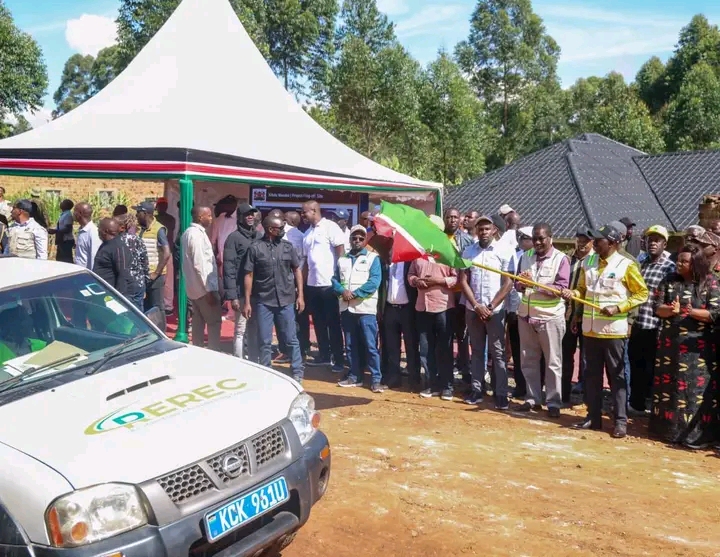
President William Ruto, accompanied by Cabinet Secretary for Energy and Petroleum Opiyo Wandayi, presided over the development initiatives, placing electricity access and road connectivity at the centre of the Government’s development agenda. The two projects demonstrate the importance of investing in infrastructure that connects households to opportunity, strengthens rural economies and reduces inequalities in access to essential services.
The significance of these interventions extends beyond the ceremonial launch. For households, farmers, small-scale traders, learners and young entrepreneurs, electricity and reliable roads are not luxuries. They are essential foundations for economic participation, improved living standards and sustainable community development.
KSh500 Million Investment to Expand Electricity Access
The Last Mile Connectivity Project addresses one of the persistent challenges facing rural communities: the gap between the availability of electricity infrastructure and actual household connections.
 ADVERT
In many rural areas, electricity distribution lines pass close to homes, schools, health facilities and trading centres, yet thousands of households remain unconnected because of the cost and technical requirements involved in the final connection.
The programme seeks to bridge this gap by extending electricity access to households and enterprises that have remained outside the national grid.
In Nyamira County, the Government is implementing 71 Last Mile Connectivity projects at a cost of KSh500.35 million, targeting 6,840 households.
The investment represents a significant opportunity for a county whose economy relies substantially on agriculture, small-scale trade, education and local enterprises.
Electricity has the potential to transform everyday life. It allows children to study after sunset, enables health facilities to preserve vaccines and essential medicines, and gives small businesses the capacity to operate more efficiently and extend their working hours.
For local entrepreneurs, access to electricity can support refrigeration, welding, tailoring, food processing, digital services and other income-generating activities.
The project should therefore be understood not merely as an exercise in installing electricity connections, but as an investment in productivity, enterprise development and economic empowerment.
Kitutu Masaba Takes the Largest Share
Kitutu Masaba Constituency has received the largest allocation of the county’s Last Mile Connectivity investment, with KSh160.59 million earmarked for 20 projects targeting 2,111 households.
This represents 32.1 per cent of the total county investment and 30.9 per cent of the targeted households.
The constituency’s allocation reflects the potentially significant impact of expanded electricity access in communities where agriculture, household enterprises and small-scale commercial activities remain central to livelihoods.
Beyond domestic lighting, the connections could unlock opportunities for businesses to adopt modern equipment, improve service delivery and participate more effectively in an increasingly digital economy.
Schools could strengthen digital learning, establish computer laboratories and improve administrative efficiency. Health facilities could enhance the storage of medicines and vaccines while operating essential equipment more reliably.
Electricity also improves security through better lighting in homes, trading centres, schools and public spaces.
Ultimately, the value of rural electrification should be measured not simply by the number of poles erected or households connected, but by the economic and social opportunities created for beneficiaries.
Nyangori–Esani–Riamoni Road: Opening Up Rural Communities
The groundbreaking of the Nyangori–Esani–Riamoni Road complements the electricity programme by addressing another critical development priority: physical connectivity.
Roads are essential arteries of economic activity. They determine how efficiently farmers transport produce, how easily traders access markets and how quickly residents reach schools, hospitals and other public institutions.
For agricultural communities, poor road infrastructure can significantly increase transportation costs, delay the movement of produce and expose farmers to avoidable post-harvest losses.
An improved road network can reverse these disadvantages by reducing travel time, lowering transport costs and making rural markets more accessible.
The Nyangori–Esani–Riamoni Road is expected to improve movement between communities in Kitutu Masaba and the surrounding areas, while supporting trade and access to essential services.
Its benefits could extend to farmers transporting agricultural inputs and produce, traders restocking their businesses, students travelling to school and patients seeking medical attention.
Improved connectivity can also encourage investment by making rural areas more attractive to businesses and service providers.
A road is therefore much more than a stretch of tarmac or improved earth surface. Properly constructed and maintained, it becomes an economic asset that connects people to markets, services and opportunities.
Why Electricity and Roads Must Go Together
The simultaneous pursuit of electricity expansion and road development is particularly significant because the two forms of infrastructure reinforce each other.
Electricity provides the energy required for production, innovation and modern service delivery, while roads facilitate the movement of people, goods and services.
A rural enterprise may have access to electricity but remain commercially constrained by poor transport infrastructure. Equally, a community with good roads but limited electricity may struggle to attract investment and fully embrace modern economic opportunities.
By addressing both challenges, the Government is pursuing a more integrated approach to rural development.
This is the kind of infrastructure planning required to unlock the productive potential of counties such as Nyamira, where agriculture and small-scale enterprises provide livelihoods for a substantial section of the population.
Development Must Be Measured Through Equity
The Nyamira projects also bring into focus the broader question of equitable national development.
For too long, rural communities have faced infrastructure deficits that have limited their ability to compete economically with better-connected urban centres.
Access to reliable electricity, modern roads, digital connectivity and quality public services should not depend on geographical location or political influence.
Rural communities contribute immensely to national economic activity through agricultural production, labour, commerce and other productive activities. They deserve infrastructure investment that enables them to translate their contribution into improved household incomes and better living standards.
Investing in historically underserved areas is therefore not an act of political favour. It is a necessary component of balanced national development.
The allocation of KSh160.59 million to Kitutu Masaba, targeting 2,111 households through 20 electricity projects, illustrates the importance of directing public resources towards communities where infrastructure gaps remain significant.
However, equity must also be reflected in the quality, distribution and accessibility of completed projects.
From Groundbreaking Ceremonies to Tangible Results
While the launch of these projects is welcome, their ultimate success will depend on implementation.
Groundbreaking ceremonies and public announcements are important expressions of development commitment, but citizens ultimately judge governments by completed projects and the improvements they experience in their daily lives.
The Government must therefore ensure timely implementation, transparent procurement, quality workmanship and effective supervision.
Electricity connections must translate into reliable and affordable power supply, while roads must be constructed to acceptable standards and maintained to withstand local weather conditions and regular use.
Contractors and implementing agencies must be held accountable for delays, substandard work and unnecessary cost escalations.
Community participation is equally important. Residents should receive clear information about project timelines, connection procedures, employment opportunities and mechanisms for reporting implementation challenges.
Local communities understand their infrastructure needs and should be involved throughout the project cycle, from planning and execution to monitoring and maintenance.
Such engagement strengthens public ownership and ensures that development interventions respond to actual needs rather than merely fulfilling administrative targets.
A Practical Pathway to Inclusive Growth
The Last Mile Connectivity Project and the Nyangori–Esani–Riamoni Road represent an important investment in the future of Kitutu Masaba and Nyamira County.
The KSh500.35 million allocated to 71 electricity projects targeting 6,840 households demonstrates a substantial commitment to expanding access to modern energy. Within this investment, Kitutu Masaba’s KSh160.59 million allocation for 20 projects targeting 2,111 households gives the constituency a significant stake in the county’s electrification programme.
Combined with improved road connectivity, these interventions could stimulate local enterprise, strengthen agricultural value chains, improve public services and expand opportunities for young people.
The real measure of success, however, will be found in ordinary lives: a child studying comfortably under electric light, a small business operating more efficiently, a farmer reaching the market at lower cost and a patient accessing healthcare without unnecessary transportation difficulties.
That is when infrastructure ceases to be a political talking point and becomes a genuine instrument of social and economic transformation.
President Ruto and CS Opiyo Wandayi’s development engagements in Nyamira provide an opportunity to advance this practical vision of inclusive growth. The responsibility now lies in ensuring that the commitments made translate into completed, functional and sustainable infrastructure.
Development is not ultimately defined by the number of projects launched, but by the number of lives meaningfully transformed.
Photo: President William Ruto and Cabinet Secretary for Energy and Petroleum Opiyo Wandayi during the flag-off of the Last Mile Connectivity Project in Nyamira County.