 ADVERT

 ADVERT
James Wandayi, Cabinet Secretary for Energy and Petroleum, marked a significant moment by handing over a 33-seater Isuzu NQR welfare bus to Bunge la Wananchi – Kisumu Chapter, under the Kisumu 19 United Development CBO. This event at a Nairobi dealership underscores a commitment to grassroots economic empowerment in Kenya’s dynamic political landscape. By linking the initiative to the late Rt Hon Raila Odinga, Wandayi bridges national leadership with local transformation, signaling continuity in pro-people programs amid evolving governance priorities.
For many Kenyans, especially in Nyanza, politics has too often been reduced to rallies, slogans, and electoral cycles that leave ordinary citizens watching from the sidelines. The handover of a welfare bus may look like a small ceremony, but when situated in the broader context of community organizing, devolution, and economic justice, it speaks to a deeper reimagining of what political leadership should mean. This is leadership that shows up not only in cabinet meetings and policy documents, but in concrete, usable assets that ordinary people can see, touch, and benefit from.
In Kenya’s vibrant Nyanza region, where community-based organizations like Kisumu 19 UD-CBO drive development, such handovers represent more than material aid; they embody strategic investment in human capital. Bunge la Wananchi, known for mobilizing citizens on governance issues, gains mobility to extend its reach across Kisumu’s wards, facilitating welfare services, advocacy, and economic activities for vulnerable groups. The bus becomes an organizing tool – a moving platform for dialogue, outreach, and service delivery.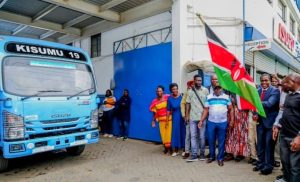
The choice of an Isuzu NQR 33-seater is also telling. This is a workhorse on Kenyan roads, widely used in public transport, school runs, and institutional logistics. For Kisumu 19 UD-CBO, it can ferry youth to training centres, women’s groups to markets, and community leaders to civic education forums. It shifts the CBO from reactive, localised activism to a more coordinated, county-wide presence. In a region where distance, poor infrastructure, and transport costs have often limited participation, the simple ability to move people safely and reliably is transformative.
Raila Odinga’s enduring influence on empowerment initiatives cannot be overstated; for decades, his political philosophy has centred on the idea that liberation must be social and economic, not just electoral. From pushing for multiparty democracy to advocating for constitutional reforms and devolution, Odinga framed politics as a tool to redistribute opportunity, not merely power. The economic empowerment programs he championed sought to place resources – whether through funds, equipment, or training – directly in community hands.
 ADVERT
By explicitly crediting this welfare bus to an economic empowerment program “originally initiated” by the late Raila Odinga, Wandayi is making a deliberate statement. He is reminding the region that Odinga’s legacy is not only in his speeches, protests, or electoral contests, but in the everyday structures that allow people to organise and uplift themselves. In that sense, this bus is not a gift in isolation; it is a moving extension of Odinga’s unfinished project of inclusive development and people-centred politics.
This is especially significant in the wake of Odinga’s passing, a moment that has left a deep emotional and political vacuum in Nyanza and beyond. Many have wondered what will become of the values and networks he built. By tying his own gesture to Odinga’s legacy, Wandayi is helping to anchor that legacy in tangible projects rather than nostalgia. He is saying: the struggle for dignity and economic justice continues, but now through new hands and new institutions.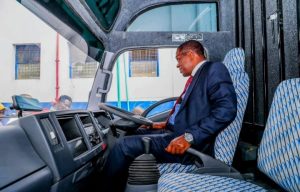
This milestone arrives at a pivotal time for Wandayi, who rose from a vocal Member of Parliament and parliamentary Minority Leader to a cabinet position overseeing energy and petroleum. That trajectory matters because it reflects a shift from opposition politics to executive responsibility, from criticism to implementation. Yet, in this bus handover, he shows that assuming a national portfolio does not mean abandoning the grassroots ethos that defined his earlier career.
For years, Wandayi has been associated with Siaya’s political heritage – a region that has produced some of Kenya’s most outspoken reformists. His involvement with Kisumu 19 UD-CBO demonstrates that he understands the expectations of a politically conscious constituency: they want leaders who can move seamlessly between the national and the local, who can speak energy policy in boardrooms and still show up in the village as a partner in development.
By congratulating the officials and members of the CBO and framing the bus as a “transformative milestone,” he elevates their agency instead of presenting himself as a benevolent saviour. This shift from “doing things for the people” to “doing things with the people” is crucial. Too many government programmes have collapsed because they were designed without community ownership. Here, the ownership structure is clear: the bus is under Kisumu 19 United Development CBO and directly benefits Bunge la Wananchi – Kisumu Chapter, entities that already have internal structures, leadership, and experience in mobilising citizens. The state’s role is catalytic, not controlling.
Devolution promised to bring government closer to the people, but in many counties the gap between rhetoric and reality remains wide. Elite capture, corruption, and patronage networks have often meant that resources remain in the hands of a few while the majority watch from the fringes. In such a context, strengthening credible CBOs is not just a welfare gesture; it is a democratic strategy.
Bunge la Wananchi is not a conventional NGO; it is a people’s parliament, a forum through which ordinary citizens debate, criticise, and propose solutions on governance and development. Equipping such a movement with logistical capacity is effectively a bet on participatory democracy. The bus can transport members to public hearings, county budget forums, community barazas, and regional dialogues where their voices can shape policy. For Kisumu’s 19 wards, this means the possibility of coordinated engagement rather than isolated, easily ignored complaints.
In the long run, this kind of empowerment can deepen devolution in three ways. First, it improves information flow, as organised members can travel to where key decisions are being made. Second, it enhances accountability, because leaders know citizens can mobilise and appear physically to demand answers. Third, it stimulates local economies; when people can move, they can trade, learn, and connect to opportunities that were previously out of reach.
Critics might question the optics of a national figure supporting entities that have historically been linked to specific political traditions. Kenya’s political landscape is heavily polarised, and any resource transfer risks being read through the lens of patronage. However, the more important question is not “who is perceived to benefit politically?” but “who actually benefits materially and structurally?”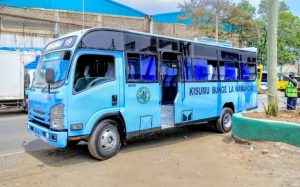
If the bus is well-managed, transparently used, and accessible to the community across party lines, its impact will speak louder than the suspicions. It will matter that schoolchildren can be ferried to educational tours, women’s groups to markets, youth groups to sports and training events, and community organisers to civic forums. The challenge, therefore, is not to avoid such initiatives for fear of criticism, but to embed them in strong governance mechanisms that protect them from becoming mere political trophies.
Wandayi’s gesture can, in fact, set a higher bar for what political capital should be used for. Instead of branding roads and stadiums with individual names or pouring money into short-lived handouts, leaders could compete on the quality of assets they place in community hands – from buses and ambulances to ICT hubs and community libraries. The message then shifts from “I gave you something” to “we built something together that outlives any one politician.”
It is also worth reflecting on what it means for the Cabinet Secretary in charge of energy and petroleum to be associated with this kind of initiative. The energy docket is often seen as technical and distant, concerned with megawatts, pipelines, refineries, and regulatory frameworks. Yet, at its core, energy policy is about people: who gets connected, who can afford power, which regions get industrial parks and which remain dark.
By engaging in a visible act of community empowerment, Wandayi is sending a subtle message about how he sees his role. Public buy-in for large-scale energy projects – from grid expansion to renewable investments – depends on whether citizens feel the state is responsive to their daily struggles. A cabinet secretary who appears only in newspapers when signing deals or announcing tariffs risks being perceived as detached. One who occasionally meets people where they are, in their CBO offices and community gatherings, builds trust that is priceless when tough decisions must be made.
In this sense, the bus handover can be read as part of a broader social contract: as the ministry pursues national goals like energy security and industrialisation, it recognises that prosperity must be anchored in communities that feel seen, heard, and supported. When people associate the energy ministry not only with bills and blackouts, but also with tangible improvements in their mobility and livelihoods, they become more willing partners in national development.
Yet, for all its promise, the success of this initiative will depend on sustainability. A bus is an asset, but it is also a liability if not well-managed. Fuel costs, driver salaries, insurance, routine servicing, and unexpected repairs can strain any community organisation. Many well-intentioned donations have ended as grounded vehicles, rotting behind offices because there was no clear plan beyond the ribbon-cutting.
Kisumu 19 UD-CBO and Bunge la Wananchi will therefore need a robust management framework. This could include a clear schedule of how the bus is used for welfare, advocacy, and income-generating activities; transparent booking and accountability systems, so that no single individual or clique captures it; and a revolving fund built from modest hire fees, contributions from partners, or grants, dedicated specifically to maintenance and insurance. Paradoxically, charging reasonable fees for certain uses can ensure the poorest ultimately benefit more, because the bus remains operational. It is better to pay a small amount to use a functioning vehicle than to have free access to one that no longer moves. A culture of shared responsibility will distinguish this project from past donations that died under the weight of entitlement and mismanagement.
At a deeper level, this bus handover should provoke a rethink of how Kenyan society views community-based organisations. Too often, CBOs are treated as extensions of political campaigns or as passive recipients of charity. Yet, in places where government is slow or absent, it is these organisations that organise clean-ups, mediate disputes, run savings groups, and hold leaders accountable. They are, in practice, co-governors of public life.
Recognising CBOs as development partners implies that the state should systematically invest in them, not just sporadically donate to them. Infrastructure like offices, transport, digital tools, and training are not luxuries; they are the minimum equipment for effective civic engagement. When Wandayi stands alongside Kisumu 19 UD-CBO officials and addresses them as equals in a shared project of transformation, he models a more mature relationship between government and organised citizens.
This redefinition has implications beyond Kisumu. If replicated nationwide, it could see ministries and county governments establishing structured programmes for supporting strong CBOs with assets, capacity-building, and policy space. Instead of seeing organised citizens as a threat, the state would see them as a force multiplier. In such a future, a welfare bus is not an anomaly; it is standard practice.
Ultimately, the handover of a 33-seater welfare bus may not change all the structural injustices that Odinga spent his life confronting. It will not, on its own, solve unemployment, eliminate inequality, or guarantee fair elections. But symbols matter, and in politics, symbols backed by substance matter even more.
As Bunge la Wananchi – Kisumu Chapter rolls out with this new tool, it carries more than passengers; it carries a story about what kind of politics Nyanza and Kenya at large want to embrace. It is a story where legacies are honoured not by endless eulogies, but by replicating and updating the ideas that gave those legacies meaning.
It is a story where cabinet secretaries remember their roots and use their elevated positions to lift others. It is a story where community organisations stop waiting for salvation and instead organise to demand, receive, and manage the tools of their own empowerment.
If this bus remains on the road for years, ferrying generations of young people, women, and community leaders to spaces of opportunity and influence, then Raila Odinga’s vision of people-centred power will continue to live – not in marble statues or renamed avenues, but in the ordinary, hopeful journeys of Kisumu’s residents. And in that everyday motion, the true measure of Wandayi’s gesture will quietly, steadily unfold.
James Kilonzo Bwire is a Media and Communication Practitioner.


